

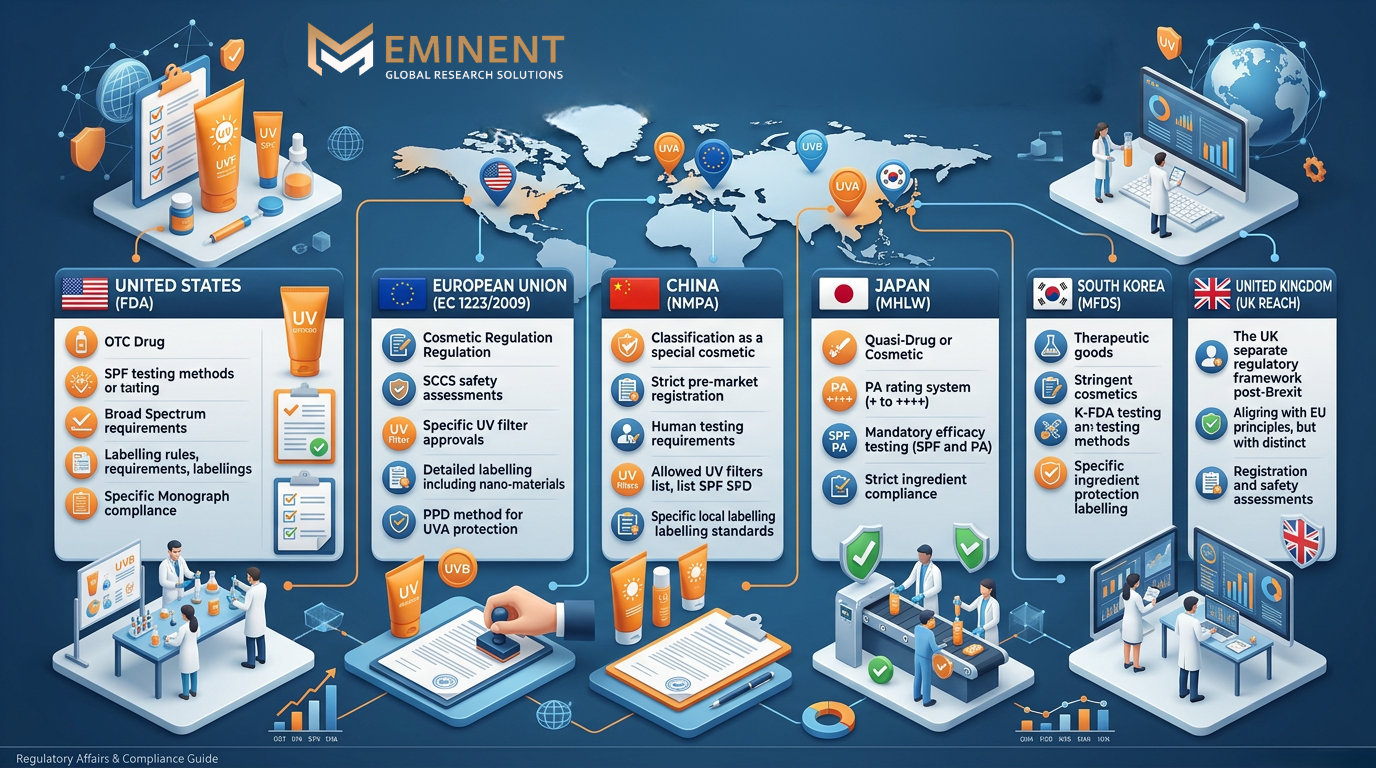
As consumer awareness of sun protection continues to grow, sunscreen products have become a critical segment of the global skincare market. However, regulatory requirements for sunscreen products vary significantly across regions, creating challenges for manufacturers seeking international expansion.
Unlike many cosmetic products, sunscreens often fall into unique regulatory categories because they are intended to protect against ultraviolet (UV) radiation and reduce health risks associated with sun exposure. Depending on the market, sunscreens may be regulated as cosmetics, over-the-counter (OTC) drugs, quasi-drugs, or therapeutic goods.
For companies operating globally, understanding these regulatory differences is essential for product development, market entry, labeling compliance, and commercialization strategy.
Why Sunscreen Regulations Matter
Sunscreens occupy a unique position between beauty and healthcare.
While consumers often purchase sunscreen as part of their skincare routine, regulators evaluate these products based on their ability to protect human health from UV-related damage, including sunburn, premature aging, and skin cancer risks.
As a result, authorities impose specific requirements related to:
- Active ingredients
- Safety assessments
- Efficacy testing
- Labeling claims
- SPF verification
- Broad-spectrum protection standards
- Product registration procedures
Failure to comply with regional requirements can delay product launches, trigger recalls, or restrict market access.
United States: FDA OTC Drug Framework
In the United States, sunscreens are regulated as Over-the-Counter (OTC) drugs by the FDA.
Key Requirements
Regulatory Classification
- Sunscreens are classified as OTC drugs.
- Products must comply with FDA monograph requirements.
SPF Testing
- Mandatory SPF testing.
- Broad-spectrum testing required for UVA and UVB protection claims.
Active Ingredients
- Only FDA-approved sunscreen active ingredients can be used.
- Regulatory review for new UV filters is often lengthy.
Labeling Requirements
- Drug Facts panel required.
- SPF value prominently displayed.
- Water resistance claims limited to approved durations.
Industry Impact
The U.S. market has fewer approved UV filters compared to several international markets, which can limit formulation flexibility for global brands.
European Union: Cosmetics Regulation Framework
The European Union regulates sunscreen products as cosmetics under the EU Cosmetics Regulation.
Key Requirements
Regulatory Classification
- Sunscreens are cosmetic products.
- No pre-market product approval required.
Safety Assessment
- Mandatory Cosmetic Product Safety Report (CPSR).
- Responsible Person required within the EU.
Ingredient Compliance
- UV filters must be listed in approved annexes.
- More UV filters are permitted than in the U.S.
Efficacy Standards
- Broad-spectrum protection expected.
- UVA protection should be at least one-third of labeled SPF value.
Product Notification
- Notification through the Cosmetic Products Notification Portal (CPNP).
Industry Impact
The EU framework provides greater flexibility for innovation while maintaining rigorous safety and efficacy requirements.
United Kingdom: Post-Brexit Cosmetic Requirements
The UK largely mirrors EU sunscreen regulations but operates under independent regulatory systems.
Key Requirements
- Sunscreens regulated as cosmetics.
- Product notification required through the UK Submit Cosmetic Product Notification (SCPN) system.
- Responsible Person required within the UK.
- Compliance with UK Cosmetics Regulation.
Industry Impact
Companies selling in both the EU and UK often require separate notifications and compliance documentation.
Australia: Therapeutic Goods Administration (TGA)
Australia has one of the world’s strictest sunscreen regulatory systems due to high UV exposure levels.
Key Requirements
Regulatory Classification
- Many sunscreens are classified as therapeutic goods.
Registration
- Products may require inclusion in the Australian Register of Therapeutic Goods (ARTG).
Testing Standards
- Strict SPF validation requirements.
- Broad-spectrum protection testing mandatory.
Manufacturing Standards
- Compliance with Good Manufacturing Practices (GMP).
Industry Impact
Australia’s rigorous standards contribute to strong consumer confidence but increase regulatory complexity for manufacturers.
Japan: Quasi-Drug Classification
Japan regulates many sunscreens as quasi-drugs.
Key Requirements
Regulatory Classification
- Most sunscreen products fall under the quasi-drug category.
Approval Process
- Approved active ingredients required.
- Product review may be necessary depending on claims and formulations.
PA Rating System
- UVA protection communicated using PA+, PA++, PA+++, and PA++++ ratings.
SPF Claims
- SPF testing required according to Japanese standards.
Industry Impact
The PA system has become influential globally and is widely recognized by consumers.
China: Evolving Cosmetic Regulations
China’s sunscreen regulations have undergone significant modernization in recent years.
Key Requirements
Regulatory Classification
- Sunscreens are classified as special cosmetics.
Registration Requirements
- Product registration required before commercialization.
Safety Documentation
- Extensive safety and efficacy data required.
Ingredient Review
- Approved ingredient lists must be followed.
Testing Requirements
- SPF and UVA efficacy validation required.
Industry Impact
China’s large and growing sun care market makes regulatory compliance a strategic priority for global brands.
South Korea: Functional Cosmetics Framework
South Korea regulates sunscreens as functional cosmetics.
Key Requirements
Regulatory Classification
- Functional cosmetic category.
Ingredient Compliance
- Approved UV filters required.
Performance Testing
- SPF and UVA testing mandatory.
Regulatory Notification
- Product review and documentation requirements vary depending on formulation.
Industry Impact
South Korea’s advanced skincare market encourages innovation while maintaining strong efficacy standards.
Common Global Compliance Challenges
For multinational sunscreen brands, several recurring challenges emerge:
1. Different Regulatory Classifications
A sunscreen may be:
- A cosmetic in Europe
- An OTC drug in the U.S.
- A therapeutic good in Australia
- A quasi-drug in Japan
This creates substantial regulatory complexity.
2. UV Filter Approval Differences
Approved UV filters vary widely across markets, often requiring multiple formulations for global distribution.
3. Labeling Variations
Requirements differ regarding:
- SPF claims
- Broad-spectrum statements
- Water resistance claims
- Warning statements
- Active ingredient disclosures
4. Testing Standards
Testing methodologies may differ across jurisdictions, increasing development and compliance costs.
Strategic Considerations for Global Brands
To successfully commercialize sunscreen products internationally, companies should prioritize:
Regulatory Intelligence
Continuous monitoring of:
- Ingredient approvals
- Regulatory updates
- Labeling requirements
- Market-specific guidance
Global Formulation Strategy
Developing formulations that maximize compatibility across multiple markets can reduce costs and accelerate launches.
Early Compliance Planning
Regulatory requirements should be incorporated during product development rather than after formulation completion.
Market Prioritization
Companies should assess:
- Regulatory complexity
- Market size
- Registration timelines
- Commercial opportunity
before determining launch sequences.
The Future of Sunscreen Regulation
The sunscreen industry is increasingly influenced by:
- Growing skin cancer awareness
- Environmental sustainability concerns
- Reef-safe ingredient discussions
- Advanced UV filter innovation
- Personalized skincare trends
Regulators are expected to continue strengthening requirements related to safety, efficacy, and transparency.
For manufacturers, regulatory compliance will become an even more important competitive advantage as consumer expectations and scientific standards evolve.
Organizations that combine strong regulatory expertise with innovation capabilities will be better positioned to succeed in the rapidly expanding global sun care market.