

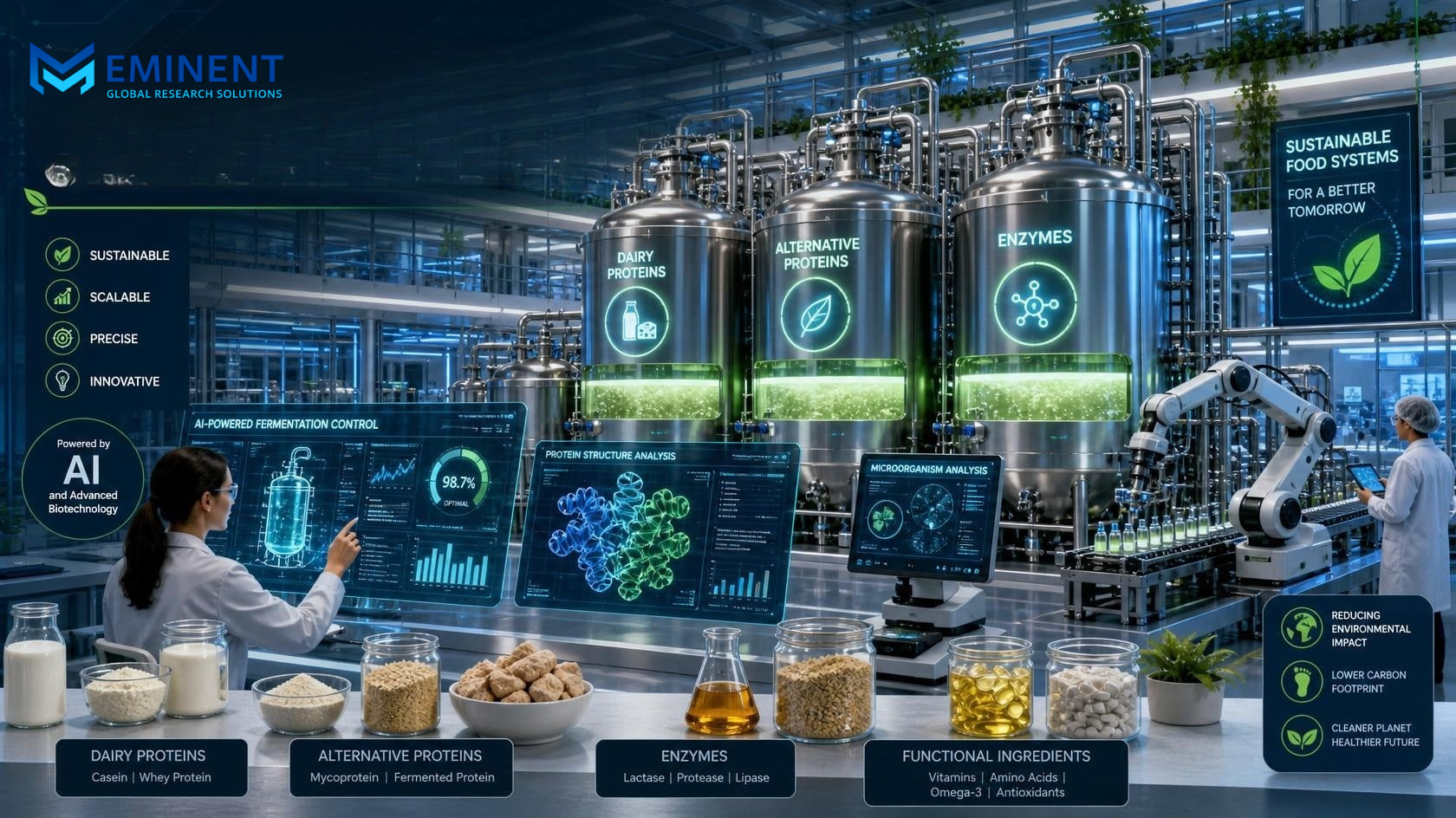
The global food industry is undergoing a profound transformation driven by technological innovation, sustainability demands, and changing consumer preferences. Among the emerging technologies shaping the future of food production, precision fermentation has gained significant attention for its ability to produce high-value food ingredients with greater efficiency, consistency, and sustainability than many traditional manufacturing methods.
Often described as one of the next frontiers in food technology, precision fermentation enables microorganisms such as yeast, fungi, or bacteria to produce specific proteins, enzymes, vitamins, fats, and bioactive compounds by programming them with targeted genetic instructions. Rather than relying on conventional agriculture or animal-derived sources, manufacturers can create identical functional ingredients in controlled fermentation environments.
While precision fermentation is already widely used in pharmaceutical manufacturing and industrial biotechnology, its application in food production is expanding rapidly. As investment flows into alternative proteins, functional ingredients, and sustainable food systems, the technology is moving beyond niche innovation toward commercial-scale manufacturing.
For food manufacturers, ingredient suppliers, and investors, the question is no longer whether precision fermentation has potential—but how quickly it can transform global food production.
Understanding Precision Fermentation
Precision fermentation is an advanced biotechnology process that programs microorganisms to produce specific molecules with remarkable precision. Unlike traditional fermentation used to make products like bread, yogurt, or beer, precision fermentation focuses on creating targeted ingredients with consistent quality and functionality.
These microorganisms act as microscopic production factories, manufacturing valuable food components such as:
- Dairy proteins
- Egg proteins
- Natural flavors
- Functional enzymes
- Vitamins
- Healthy fats
- Sweet proteins
- Nutritional compounds
Once fermentation is complete, the desired ingredient is purified and incorporated into food formulations.
The result is a highly controlled production process that reduces dependence on traditional agricultural systems while maintaining ingredient performance.
Why Food Manufacturers Are Paying Attention
Global food production faces mounting challenges.
Population growth, climate change, supply chain disruptions, water scarcity, and rising demand for sustainable products are placing unprecedented pressure on conventional food manufacturing.
At the same time, consumers increasingly expect products that are:
- Sustainable
- Clean label
- High quality
- Nutritionally enhanced
- Ethically produced
- Environmentally responsible
Precision fermentation addresses many of these challenges simultaneously.
By producing ingredients inside bioreactors rather than relying on livestock or extensive agricultural land, manufacturers can significantly reduce environmental impact while improving production consistency.
For food companies, this creates opportunities to:
- Secure stable ingredient supplies
- Improve manufacturing efficiency
- Reduce climate-related risks
- Differentiate products through innovation
- Meet evolving sustainability goals
These advantages are making precision fermentation one of the fastest-growing segments within food biotechnology.
Sustainability as a Competitive Driver
Sustainability has become a strategic priority across the food industry.
Traditional agriculture often requires extensive land use, significant water consumption, and substantial greenhouse gas emissions. Precision fermentation offers an alternative production model that can dramatically reduce resource requirements for certain ingredients.
Potential sustainability benefits include:
- Lower carbon emissions
- Reduced land usage
- Lower water consumption
- Improved resource efficiency
- Reduced dependence on animal agriculture
- Greater supply chain resilience
As governments, retailers, and consumers continue emphasizing environmental responsibility, manufacturers adopting sustainable ingredient technologies may strengthen both regulatory positioning and brand value.
Sustainability is increasingly becoming a commercial advantage rather than simply a corporate responsibility initiative.
Unlocking Innovation Through Biotechnology
Precision fermentation expands the possibilities for food innovation.
Manufacturers are no longer limited by naturally occurring ingredient availability. Instead, biotechnology allows companies to develop ingredients optimized for functionality, nutrition, taste, and production efficiency.
Emerging applications include:
- Animal-free dairy proteins
- Sustainable egg alternatives
- Specialty fats for confectionery
- Functional nutrition ingredients
- Flavor enhancement compounds
- Next-generation food enzymes
- Personalized nutrition components
This capability enables food companies to create products that were previously difficult—or impossible—to manufacture at scale.
Biotechnology is transforming ingredient development from extraction-based production to precision-designed innovation.
Commercialization Challenges Remain
Despite its promise, precision fermentation faces several commercialization hurdles.
Scaling laboratory breakthroughs into industrial manufacturing requires significant investment in:
- Fermentation infrastructure
- Bioprocess optimization
- Downstream purification
- Quality assurance
- Supply chain integration
- Skilled workforce development
Manufacturing costs remain a challenge for some applications, particularly when competing with well-established commodity ingredients.
Additionally, regulatory approval processes vary across global markets. Companies must navigate evolving food safety regulations, labeling requirements, and consumer communication strategies.
Consumer acceptance also plays a critical role. While awareness of food biotechnology is growing, successful commercialization depends on transparent education and clear communication about product safety and sustainability.
Organizations that proactively address these challenges may accelerate market adoption and strengthen long-term competitiveness.
Strategic Implications for Food Manufacturers
Precision fermentation is more than a technological innovation—it is becoming a strategic business capability.
Forward-looking companies should evaluate:
- Which ingredients are best suited for precision fermentation
- Opportunities to partner with biotechnology firms
- Manufacturing investment requirements
- Regulatory pathways for commercialization
- Consumer positioning strategies
- Long-term sustainability objectives
Companies that begin integrating precision fermentation into innovation roadmaps today may gain first-mover advantages as the market matures.
The technology also encourages greater collaboration between food companies, biotechnology startups, academic institutions, and ingredient manufacturers, accelerating cross-industry innovation.
The Future of Food Manufacturing
Precision fermentation is expected to play a central role in the evolution of global food systems over the coming decade.
As production costs decline, manufacturing capacity expands, and regulatory frameworks mature, the technology could become a mainstream platform for producing high-value food ingredients.
Future food manufacturing may increasingly combine:
- Biotechnology
- Artificial intelligence
- Automation
- Sustainable production
- Precision nutrition
- Digital manufacturing
Together, these technologies will create more resilient, efficient, and consumer-focused food ecosystems.
For consulting firms, food manufacturers, ingredient suppliers, and investors, precision fermentation represents one of the most promising opportunities for long-term growth and innovation.
The companies that invest early in scalable biotechnology platforms, regulatory preparedness, and strategic commercialization may define the next generation of food industry leadership.
Precision fermentation is no longer simply an emerging technology—it is becoming a catalyst for transforming how the world produces food.