

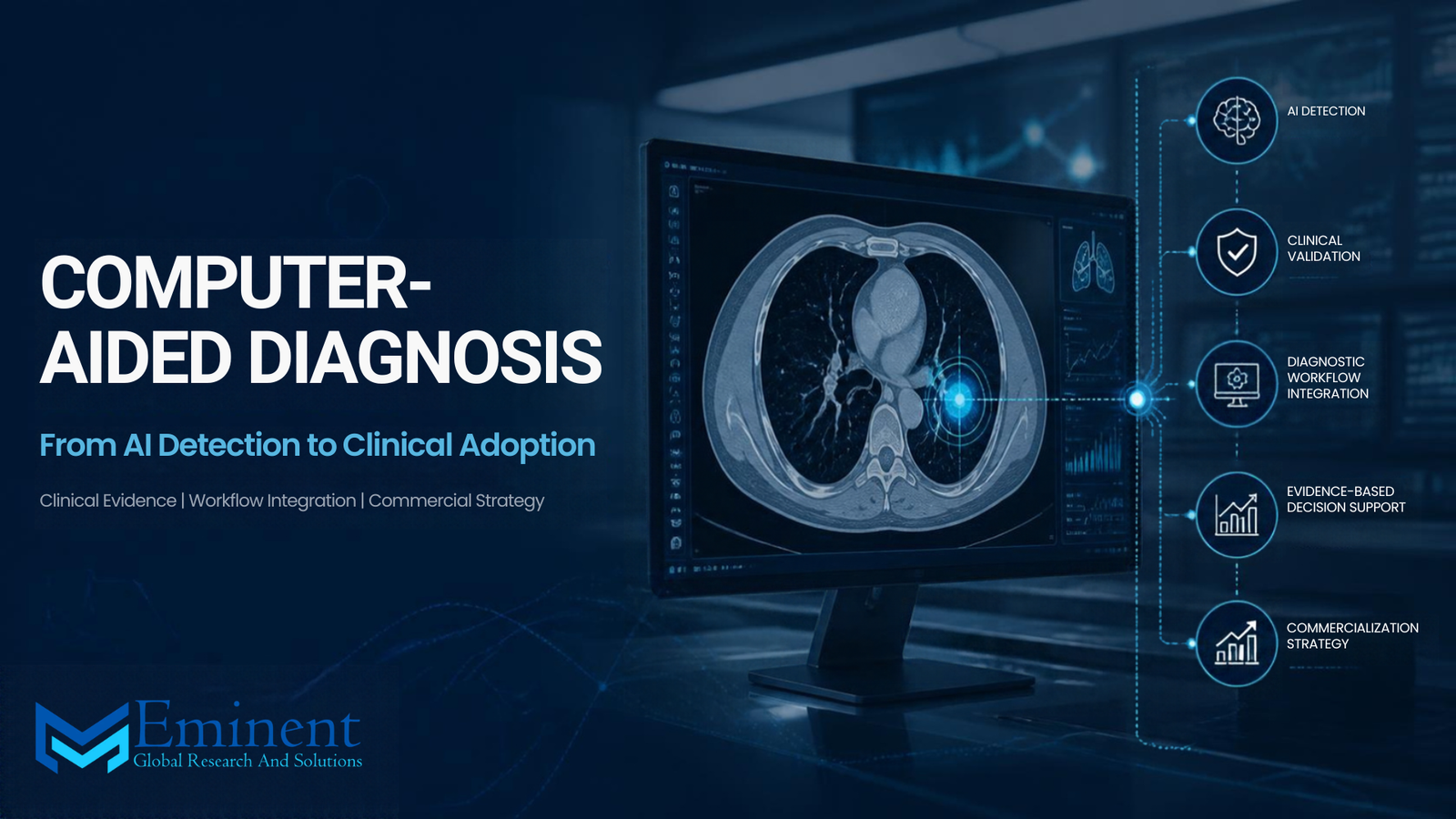
Computer-Aided Diagnosis Moves Toward Broader Clinical Adoption
Introduction: From Diagnostic Assistance to Clinical Decision Support
Medical diagnostics is undergoing a significant transformation as healthcare providers increasingly explore technologies that can improve diagnostic accuracy, support clinical decision-making, and manage growing workloads. Computer-aided diagnosis (CAD) is becoming an important part of this transition, evolving from specialized image-analysis software into a broader category of digital tools that can assist clinicians in identifying abnormalities, prioritizing cases, and interpreting complex medical data.
Traditionally, CAD systems have been associated with medical imaging applications such as mammography, computed tomography (CT), magnetic resonance imaging (MRI), and chest radiography. Today, advances in artificial intelligence (AI), machine learning, and deep learning are expanding their capabilities. Newer systems can analyze medical images, detect patterns that may be difficult to identify consistently, and help clinicians assess potential signs of disease.
However, broader clinical adoption will depend on more than technical performance. Healthcare organizations must evaluate clinical evidence, workflow compatibility, regulatory requirements, interoperability, cost-effectiveness, and the ability of these technologies to deliver measurable improvements in patient care.
For medical technology companies, healthcare providers, and investors, the opportunity lies not simply in developing more sophisticated algorithms, but in translating diagnostic innovation into dependable clinical and commercial value.
The Evolution of Computer-Aided Diagnosis
Early CAD systems primarily relied on predefined rules and engineered image features to identify suspicious patterns. Although these systems demonstrated the potential of computational assistance, their performance could vary across imaging equipment, patient populations, and clinical environments.
The emergence of deep learning has expanded what CAD systems can accomplish. Modern AI-enabled tools can be trained on large datasets to recognize complex patterns associated with particular diseases or abnormalities. Depending on their intended use and validation, these technologies may support detection, classification, segmentation, quantitative assessment, and clinical triage.
Applications include identifying suspicious lesions in breast imaging, detecting potential lung abnormalities in chest X-rays or CT scans, supporting stroke assessment, and assisting with the evaluation of retinal images for signs of diabetic eye disease.
The distinction between traditional CAD and AI-enabled diagnostic software is important. Not every CAD product uses advanced AI, and not every AI-enabled medical tool is authorized to make a diagnosis independently. Many systems are designed to assist qualified healthcare professionals rather than replace their clinical judgment.
This shift toward clinician-centered decision support is central to the technology’s future.
Key Factors Driving Clinical Adoption
1. Growing Diagnostic Workloads
Healthcare systems face increasing demand for imaging, screening, and diagnostic services. Radiologists and other specialists must review substantial volumes of clinical information while maintaining quality and turnaround times.
CAD tools can help prioritize potentially urgent cases, highlight suspicious findings, and automate selected measurement tasks. In appropriate settings, this may improve workflow efficiency and help clinicians focus their attention where it is most needed.
The extent of these benefits, however, depends on the application, implementation model, and quality of integration with existing clinical processes.
2. Advances in AI and Medical Imaging
Improvements in computing infrastructure, image-processing techniques, and machine-learning methods have increased the potential of automated image interpretation.
Some systems can evaluate multiple image characteristics simultaneously, quantify changes over time, or provide visual indicators that help clinicians examine suspicious regions. These capabilities may support greater consistency in selected diagnostic tasks.
Nevertheless, strong performance on retrospective datasets does not automatically translate into reliable performance in everyday clinical practice. Prospective evaluation and validation across representative patient populations remain essential.
3. Earlier Detection and Clinical Prioritization
In certain applications, CAD can support earlier identification of suspicious findings or help prioritize cases requiring faster review.
For example, an AI-enabled imaging system may flag a scan for urgent assessment when it detects patterns associated with a potentially serious condition. The clinician remains responsible for interpreting the finding in the broader clinical context.
The potential benefit is therefore not simply faster image analysis. It is the possibility of improving the timing and consistency of clinical action without introducing unacceptable levels of false alarms or missed findings.
4. Pressure to Demonstrate Healthcare Value
Healthcare providers increasingly need evidence that new technologies improve outcomes, reduce avoidable workload, or deliver efficiencies that justify their costs.
CAD developers must therefore demonstrate more than algorithmic accuracy. Evidence may need to address diagnostic sensitivity and specificity, effects on clinician performance, false-positive and false-negative rates, workflow impact, downstream testing, and economic value.
These measures are particularly important when organizations compare products that appear technically similar but differ in clinical applicability, integration requirements, and total cost of ownership.
Major Barriers to Wider Adoption
Despite growing interest, CAD adoption remains uneven across clinical specialties and healthcare systems.
Clinical validation and generalizability: A model trained using data from one hospital, geographic region, or imaging platform may perform differently in another setting. Variations in patient demographics, disease prevalence, image quality, and clinical protocols can affect real-world performance.
False positives and false negatives: A system that flags too many normal findings can increase workload and trigger unnecessary follow-up investigations. Conversely, missed abnormalities can create false reassurance. The acceptable balance depends on the clinical application and intended use.
Workflow integration: Diagnostic software must fit into existing picture archiving and communication systems (PACS), radiology information systems, electronic health records, and reporting processes where relevant. Poor integration can create additional steps instead of reducing workload.
Regulatory and liability considerations: CAD products may fall under medical-device regulations, including requirements for evidence, quality management, and ongoing performance monitoring. Requirements differ by jurisdiction and product intended use. Healthcare organizations must also establish clear accountability for clinical decisions and software-related incidents.
Data governance and cybersecurity: Medical images and associated clinical data are sensitive assets. Providers and technology suppliers need appropriate privacy protections, access controls, secure infrastructure, and governance arrangements.
Clinician trust and adoption: Healthcare professionals need to understand what a system can and cannot do. Transparent limitations, relevant training, explainable outputs where appropriate, and dependable performance are important for sustained use.
The Commercial Opportunity for Medical Technology Companies
The expanding CAD market creates opportunities for medical device manufacturers, AI developers, imaging-platform providers, and healthcare technology companies. Yet commercial success will depend on the ability to connect technical differentiation with clearly defined clinical needs.
Develop application-specific value propositions
Rather than positioning a product as a universal diagnostic solution, companies should identify the clinical task, target population, intended user, and healthcare setting where the technology can deliver the strongest evidence-based benefit.
Build evidence into the commercialization strategy
Clinical validation should not be treated as a final milestone before launch. Evidence generation, usability evaluation, health-economic assessment, and post-market monitoring should be integrated into product development and commercialization planning.
Prioritize interoperability
Products that integrate smoothly with existing imaging and clinical infrastructure may face fewer adoption barriers. Partnerships with imaging equipment manufacturers, hospital software vendors, and healthcare networks can strengthen market access.
Evaluate markets beyond technical demand
Market entry decisions should consider regulatory pathways, reimbursement arrangements, hospital procurement processes, local infrastructure, competition, and the availability of suitable clinical data.
A technically advanced product may still struggle commercially if it lacks a clear reimbursement pathway or requires expensive workflow changes.
The Role of Market and Competitive Intelligence
As the CAD landscape becomes more competitive, market intelligence can help companies distinguish promising opportunities from crowded or difficult-to-commercialize segments.
A structured assessment should examine emerging clinical applications, competitor product claims, regulatory clearances and authorizations, patent activity, clinical-trial evidence, strategic partnerships, pricing models, and unmet diagnostic needs.
Patent intelligence can help identify technology clusters, potential freedom-to-operate concerns, and opportunities for differentiated product development. Regulatory intelligence can clarify market-specific requirements and help companies anticipate changes affecting product development or expansion.
Technology scouting can also identify potential acquisition targets, licensing opportunities, and partnerships with specialized AI developers or established imaging companies.
For investors and corporate strategy teams, these perspectives can inform portfolio prioritization, partnership decisions, and market-entry planning.
Strategic Outlook: What Comes Next?
The next phase of CAD adoption is likely to focus increasingly on clinical utility rather than algorithmic novelty alone. Healthcare organizations will want to know whether a tool improves decisions, reduces avoidable delays, fits into routine workflows, and performs reliably across relevant patient groups.
Multimodal diagnostic systems that combine imaging with clinical history, laboratory results, and other relevant information may create new opportunities. However, broader data integration also increases the need for rigorous validation, privacy protection, and clear governance.
Another important development is the growing importance of lifecycle management. AI-enabled systems may require ongoing monitoring to detect performance changes caused by shifts in patient populations, clinical practice, equipment, or data characteristics. Products that support appropriate monitoring and controlled updates may be better positioned to maintain clinical confidence.
Adoption will also vary by application. Tasks with well-defined outputs and measurable performance may progress differently from complex diagnostic decisions requiring extensive clinical context. As a result, the market is unlikely to develop uniformly across all specialties.
Conclusion
Computer-aided diagnosis is moving toward a broader role in clinical decision support, supported by advances in AI, increasing diagnostic demand, and the need for more efficient healthcare workflows. Its long-term success, however, will depend on demonstrating reliable clinical value under real-world conditions.
For medical technology companies, the strategic challenge is to connect algorithm development with clinical evidence, regulatory readiness, interoperability, and viable commercialization models. For healthcare providers, the priority is to adopt technologies that complement professional judgment and improve care without creating new safety or operational risks.
The organizations best positioned to succeed will be those that understand both sides of the equation: the science behind diagnostic innovation and the market conditions required to turn that innovation into sustainable clinical adoption.
At Eminent Global Research Solutions, market intelligence, competitive intelligence, patent analysis, regulatory intelligence, and technology scouting can help stakeholders assess emerging CAD opportunities and develop evidence-informed commercialization strategies.