

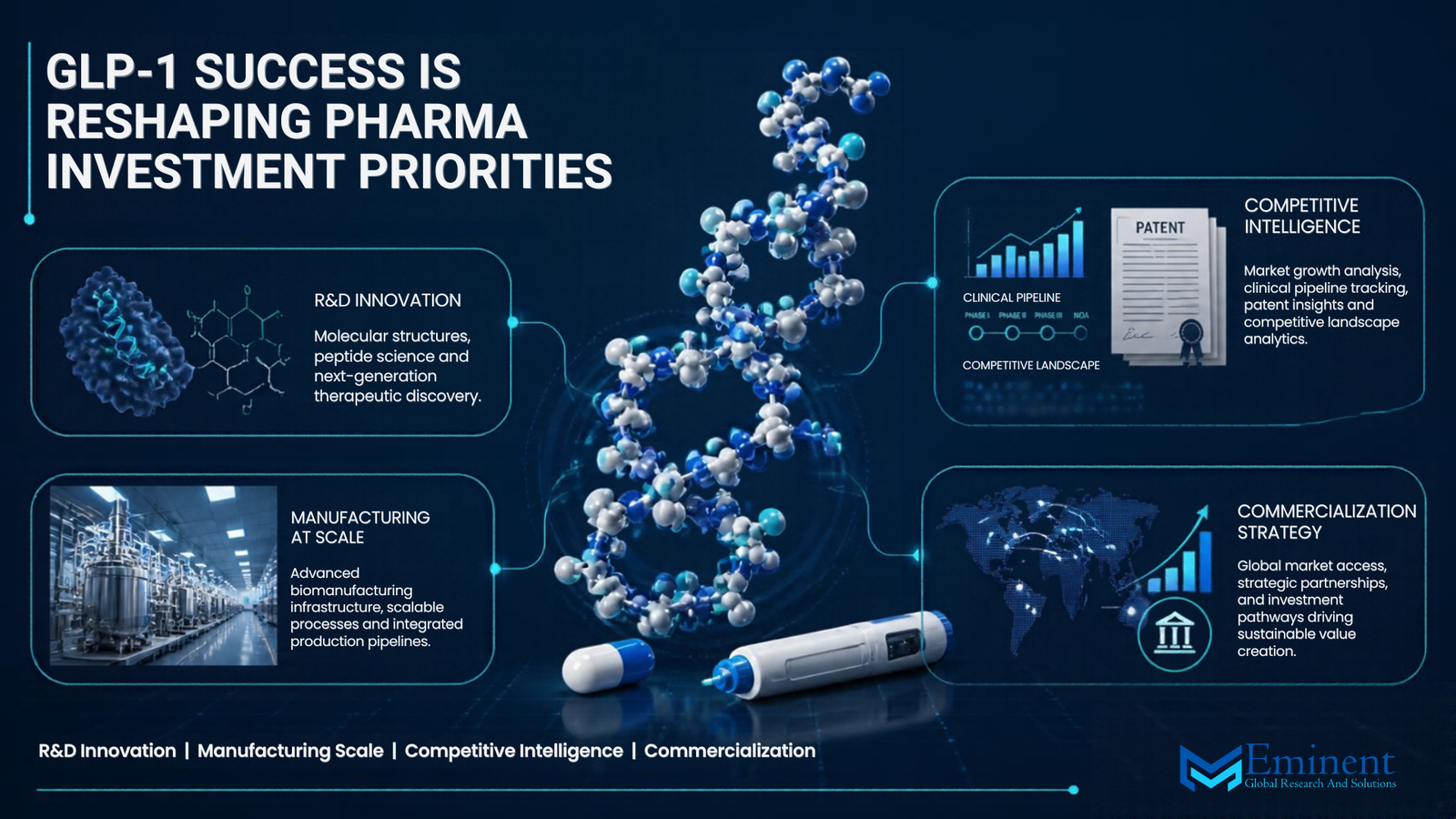
GLP-1 Success Is Reshaping Pharma Investment Priorities
Introduction: From Therapeutic Breakthrough to Strategic Investment Priority
The rapid growth of glucagon-like peptide-1 (GLP-1) receptor agonists has become one of the most consequential developments in the pharmaceutical industry. Initially established as treatments for type 2 diabetes, medicines targeting the GLP-1 pathway have gained significant commercial attention for their role in weight management. Emerging evidence across cardiovascular, metabolic, and other disease areas has further expanded interest in this therapeutic class.
For pharmaceutical companies, GLP-1 medicines represent more than a successful product category. They illustrate how scientific innovation, unmet medical needs, expanding treatment populations, and strong commercial demand can reshape investment decisions across an entire industry.
As competition intensifies, pharmaceutical companies are reassessing research priorities, evaluating adjacent therapeutic opportunities, investing in advanced manufacturing, and exploring partnerships that could strengthen their positions in metabolic health.
The central strategic question is no longer simply how to participate in the GLP-1 market. It is how to build a sustainable competitive position in a therapeutic area where scientific differentiation, patient access, production capacity, and long-term outcomes will increasingly determine success.
GLP-1 Success Is Expanding the Scope of Metabolic Medicine
The growing adoption of GLP-1-based treatments reflects a broader shift in how the pharmaceutical industry approaches metabolic diseases.
Obesity and type 2 diabetes are complex, chronic conditions associated with substantial healthcare burdens. Treatments that demonstrate meaningful clinical benefits can therefore address large patient populations and create opportunities for long-term disease management.
This potential has encouraged pharmaceutical companies to look beyond conventional diabetes treatment strategies. Research interest now extends across weight management, cardiovascular risk reduction, metabolic dysfunction-associated steatohepatitis (MASH), and other areas where incretin-based therapies may offer clinical value.
However, the commercial opportunity varies by indication, patient population, clinical evidence, and regulatory status. Results established for one medicine or indication should not automatically be generalized to the entire drug class.
For investors and pharmaceutical strategists, this distinction matters. The most attractive opportunities will depend not only on the size of a potential market but also on the strength of clinical evidence, differentiation from existing treatments, and the feasibility of reaching patients at scale.
Research and Development Priorities Are Changing
The success of established GLP-1 products has increased the strategic importance of obesity and metabolic health within pharmaceutical R&D portfolios.
Companies are investigating approaches designed to improve efficacy, tolerability, dosing convenience, durability of weight loss, and patient adherence. Research includes oral formulations, longer-acting therapies, combination treatments, and multi-receptor agonists that target complementary biological pathways.
These approaches could help address limitations associated with existing treatments and serve different patient segments.
Yet investment decisions require careful evaluation. A promising mechanism does not guarantee clinical superiority, regulatory approval, or commercial adoption. Late-stage development costs, safety requirements, manufacturing complexity, and competition must all be considered.
Pharmaceutical companies therefore need robust technology and competitive intelligence to understand which emerging approaches are genuinely differentiated, where competing pipelines are concentrated, and which scientific opportunities remain underexplored.
Manufacturing Capacity Is Becoming a Competitive Differentiator
Demand for GLP-1 medicines has also highlighted the importance of reliable, scalable pharmaceutical manufacturing.
Peptide production, formulation development, device assembly, fill-finish operations, and quality control can all influence the ability to supply products consistently. Injectable delivery systems introduce additional considerations, while oral products may require different formulation technologies and manufacturing capabilities.
Companies must determine whether to expand internal capacity, establish contract manufacturing relationships, invest in new technologies, or develop more resilient supply chains.
These decisions have long-term implications for capital allocation. Manufacturing capacity built for a specific product or delivery format may not transfer easily to every future candidate. Overinvestment can create financial pressure if demand, competition, or treatment preferences change; underinvestment can constrain growth when demand exceeds supply.
Manufacturing strategy must therefore be integrated with clinical development forecasts, competitive assessments, regulatory requirements, and commercial planning.
Competition Is Shifting Toward Differentiation
As the GLP-1 market expands, commercial success will increasingly depend on differentiation rather than participation alone.
Pharmaceutical companies may compete through improved clinical outcomes, more convenient administration, better tolerability, differentiated combinations, or evidence supporting additional indications. Patient affordability, reimbursement, distribution, and continuity of treatment will also influence real-world adoption.
The market may consequently develop into multiple competitive segments rather than remaining a single, uniform category.
For example, a therapy designed for long-term weight management may face different competitive requirements from a treatment targeting patients with diabetes and elevated cardiovascular risk. A convenient oral medicine may appeal to a different patient population than an injectable treatment, depending on its efficacy, safety, availability, and cost.
Competitive intelligence can help companies map these segments, track clinical milestones, assess intellectual property positions, and identify potential partnerships or acquisition targets.
Capital Allocation: Follow the Evidence, Not Just the Momentum
The commercial performance of GLP-1 medicines creates incentives for companies to increase investment. However, allocating capital based solely on market momentum can introduce significant risks.
Drug development remains uncertain. Candidates may fail in clinical trials, produce less differentiation than anticipated, encounter unexpected safety concerns, or face commercial barriers. Competition may also compress margins, while reimbursement policies and affordability constraints can influence market access.
A disciplined investment strategy should evaluate opportunities across several dimensions:
Scientific differentiation: Does the mechanism or product offer a meaningful advantage over existing therapies?
Clinical and regulatory feasibility: Is the evidence sufficient to support development, and what milestones remain?
Competitive intensity: How crowded is the pipeline, and where are the strongest competitors positioned?
Manufacturing readiness: Can the product be produced consistently at the required scale and cost?
Commercial attractiveness: What are the likely patient segments, access barriers, and treatment economics?
Intellectual property position: How defensible is the innovation, and what freedom-to-operate considerations may arise?
This framework helps distinguish opportunities supported by credible scientific and commercial fundamentals from those driven primarily by expectations.
Strategic Partnerships and Acquisitions May Accelerate Growth
The complexity of metabolic medicine creates opportunities for collaboration among pharmaceutical companies, biotechnology firms, research institutions, diagnostics developers, and manufacturing specialists.
Partnerships can provide access to novel drug candidates, delivery technologies, combination approaches, or specialized manufacturing capabilities. Acquisitions may offer a faster route to pipeline expansion than building every capability internally.
However, strategic fit is critical. An attractive partnership should address a defined capability gap, create a differentiated development opportunity, or strengthen access to a relevant market.
Patent landscapes, clinical pipeline analysis, technology scouting, and market intelligence can help identify potential partners before opportunities become widely recognized. These tools can also support due diligence by clarifying competitive overlap, intellectual property risks, development timelines, and commercialization potential.
What Pharmaceutical Leaders Should Do Next
The GLP-1 opportunity requires a portfolio-level response rather than a narrow focus on individual products.
Pharmaceutical leaders should reassess their metabolic health strategies, identify differentiated pipeline opportunities, and align R&D decisions with manufacturing and market-access capabilities. They should also monitor developments in oral therapies, multi-agonists, combination treatments, and emerging indications without assuming that every new approach will become commercially viable.
Three priorities stand out.
First, companies should strengthen forward-looking competitive intelligence to understand the direction of scientific innovation and the density of competing pipelines.
Second, they should integrate technology scouting and intellectual property intelligence into investment decisions, particularly when evaluating partnerships, acquisitions, and new therapeutic platforms.
Third, they should connect market forecasts with clinical evidence, manufacturing constraints, pricing, and reimbursement realities. Large addressable markets do not automatically translate into accessible or profitable markets.
Conclusion: A New Test for Pharmaceutical Strategy
GLP-1 medicines demonstrate how a therapeutic breakthrough can influence an industry’s investment priorities. Their success has elevated metabolic health, encouraged innovation in drug design, increased attention to manufacturing capacity, and intensified competition for differentiated assets.
Yet the next phase of growth will require more than expanding investment in a popular drug class. It will depend on identifying credible scientific opportunities, establishing sustainable production and supply chains, demonstrating meaningful clinical value, and developing commercially viable strategies.
For pharmaceutical companies, the competitive advantage will belong to those that can translate market signals into evidence-based portfolio decisions.
At Eminent Global Research Solutions, market intelligence, technology scouting, competitive intelligence, and patent landscape analysis can help organizations evaluate emerging opportunities, understand competitive dynamics, and make better-informed investment decisions across the evolving metabolic health landscape.