

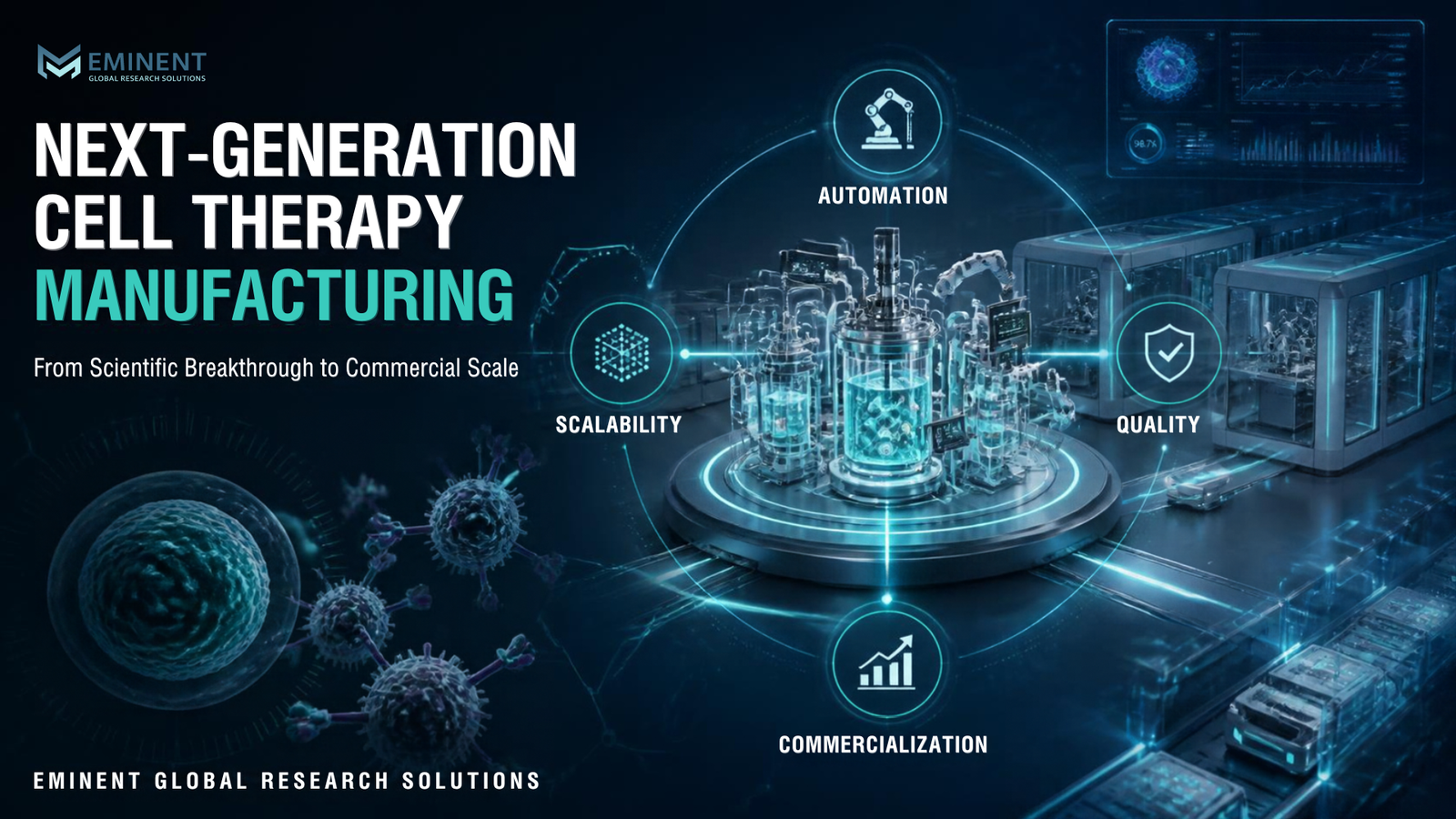
How automation, closed systems, smart factories, and regulatory modernization are reshaping the economics of cell therapy
Cell and gene therapies are moving from scientific breakthroughs toward a more industrial phase of healthcare innovation. As more cell therapies progress through clinical development and toward commercialization, the industry is confronting a fundamental question: Can manufacturing evolve quickly enough to make these therapies scalable, reproducible, and economically viable?
The answer is increasingly being shaped by investment in next-generation manufacturing infrastructure.
In 2026, major investments and commercial agreements have highlighted a clear shift toward automated, closed, data-driven and digitally integrated manufacturing platforms. Johnson & Johnson, for example, announced an investment of more than $1 billion in a next-generation cell therapy manufacturing facility in Pennsylvania. Meanwhile, Cellares raised $257 million in Series D financing to expand its automated “smart factory” manufacturing model across the U.S., Europe and Japan.
The development is significant because manufacturing is no longer simply an operational function. For cell therapy companies, it is becoming a strategic component of product differentiation, commercialization, regulatory readiness and market access.
Why Cell Therapy Manufacturing Is at an Inflection Point
Traditional cell therapy manufacturing can involve labor-intensive processes, multiple manual interventions, complex logistics and highly controlled environments.
These challenges become more significant for autologous therapies, where a patient’s own cells are collected, processed, modified and returned to the same patient.
The manufacturing model therefore has to manage several variables simultaneously:
- Patient-specific production
- Short manufacturing windows
- Batch-to-batch consistency
- Chain of identity and chain of custody
- Contamination control
- Quality testing
- Manufacturing cost
- Facility capacity
- Regulatory compliance
As clinical pipelines expand, simply adding more people and conventional manufacturing suites may not provide a sustainable solution.
This is creating demand for closed manufacturing systems, automation, modular facilities, integrated quality control and digital process monitoring.
Industry research published in 2026 highlights the transition from open and manual workflows toward closed and automated systems as cell therapies move toward commercial-scale production.
Automation Is Becoming a Core Manufacturing Strategy
One of the most important changes is the emergence of automation as an integral part of cell therapy production.
Sartorius launched its Eveo Cell Therapy Platform in March 2026, describing an integrated approach to production and quality control for autologous cell therapies. The company says the platform can increase output substantially within existing cleanroom space and potentially reduce manufacturing costs in CAR-T processes.
Similarly, Cellares’ investment round is supporting automated smart-factory expansion in locations including South San Francisco, New Jersey, the Netherlands and Japan. The company is pursuing a model designed to industrialize cell therapy production through automation and standardized manufacturing infrastructure.
The strategic significance goes beyond labor reduction.
Automation can potentially improve:
Reproducibility → Standardization → Process control → Quality → Throughput → Cost economics
That creates an important opportunity for companies developing therapies where manufacturing complexity could otherwise become a bottleneck to commercialization.
Closed Systems Could Redefine Facility Economics
Another major trend is the movement toward closed and integrated manufacturing environments.
Traditional cell processing may require extensive cleanroom infrastructure and multiple manual handling steps. Closed systems can reduce exposure to the external environment while integrating several manufacturing activities within a controlled platform.
This can potentially reduce:
- Contamination risk
- Manual interventions
- Cleanroom requirements
- Manufacturing variability
- Labor intensity
- Facility footprint
The implications are particularly important for companies attempting to establish distributed manufacturing networks.
Instead of building increasingly large centralized facilities, the industry could move toward smaller, highly automated manufacturing units capable of producing standardized therapies closer to treatment centers.
However, achieving this model requires sophisticated process engineering, validated equipment, robust digital infrastructure and regulatory alignment.
Investment Is Expanding Beyond Manufacturing Facilities
Importantly, investment is not limited to large physical factories.
The broader ecosystem is attracting capital across:
- Automated cell-processing platforms
- Single-use technologies
- Cell expansion systems
- Quality-control technologies
- Process analytical technologies
- Digital manufacturing systems
- Cryopreservation and logistics
- Critical raw materials
- Cytokines and growth factors
- Manufacturing software
- CDMO/IDMO infrastructure
Sartorius, for example, invested more than €140 million in a new competence center in Freiburg dedicated to quality-critical materials used in the cell and gene therapy market, more than doubling its manufacturing capacity for these materials.
This indicates that the manufacturing opportunity extends across the entire value chain, rather than being concentrated among therapy developers.
Regulatory Modernization Is Reinforcing the Investment Case
Manufacturing innovation is also developing alongside regulatory changes.
In January 2026, the FDA announced greater flexibility in its approach to chemistry, manufacturing and controls requirements for cell and gene therapies. The agency subsequently published final guidance in May 2026 describing CMC flexibilities for CGT products developed for biologics license applications.
In August 2026, the FDA also finalized guidance addressing common development questions for cellular and gene therapy products across areas including regulatory review, CMC, pharmacology, toxicology and clinical development.
These developments do not eliminate manufacturing requirements. Instead, they signal a regulatory environment increasingly focused on science-, risk- and lifecycle-based approaches to CGT development.
For manufacturers, this creates an important strategic consideration:
Manufacturing technology must be designed not only for operational efficiency, but also for regulatory scalability.
The Economics of Cell Therapy Are Changing
The next stage of competition may therefore be determined by manufacturing economics as much as clinical performance.
A therapy can demonstrate strong clinical efficacy yet face commercialization challenges if its manufacturing process is:
- Too expensive
- Too slow
- Difficult to reproduce
- Capacity constrained
- Highly dependent on skilled labor
- Difficult to scale across facilities
This makes manufacturing a potential commercialization bottleneck.
Companies that successfully industrialize production could gain advantages in:
1. Cost
Automation and process optimization may reduce labor and facility requirements.
2. Capacity
Higher-throughput systems could allow manufacturers to serve more patients.
3. Consistency
Standardized processes can potentially reduce manufacturing variability.
4. Speed
Shorter manufacturing cycles could improve patient access.
5. Geographic reach
Modular manufacturing models could support regional production.
6. Regulatory readiness
Better process control and data integration can strengthen CMC strategies.
What This Means for Pharma and Biotech Companies
For cell therapy developers, manufacturing strategy should increasingly be considered during early-stage R&D, rather than after clinical proof of concept.
Key strategic questions include:
- Can the current process scale to commercial volumes?
- Which manufacturing steps should be automated?
- What components can be standardized?
- Is an internal facility economically justified?
- Should production be outsourced to a CDMO?
- Could an IDMO model provide greater flexibility?
- Which technologies are likely to become industry standards?
- What IP is emerging around automated cell processing?
- Which suppliers control critical manufacturing inputs?
- How could regulatory changes affect the development pathway?
These questions require a combination of technology intelligence, IP intelligence, market intelligence and regulatory intelligence.
The Next Competitive Advantage May Be Manufacturing
The cell therapy sector is entering a phase where scientific innovation alone may not determine commercial success.
The companies that can translate promising biology into repeatable, scalable and economically sustainable manufacturing may be better positioned to reach larger patient populations.
The recent investment activity—from billion-dollar facilities to automated smart factories and critical-material infrastructure—suggests that the industry increasingly views manufacturing as a strategic asset rather than a back-end function.
For pharma and biotech companies, the strategic question is therefore changing.
It is no longer simply:
“Can we manufacture this therapy?”
It is becoming:
“Can we build a manufacturing model that makes this therapy commercially scalable?”
That distinction could define the next phase of the cell and gene therapy market.
How Eminent Global Research Solutions Can Help
For companies navigating this rapidly evolving environment, manufacturing investment decisions require visibility across technology, competitors, patents, suppliers, regulatory developments and market opportunities.
Eminent Global Research Solutions can support organizations through:
- Technology Scouting — identifying next-generation cell therapy manufacturing technologies
- IP & Patent Intelligence — mapping emerging manufacturing platforms and competitive IP
- Competitive Intelligence — tracking pharma, biotech, CDMO and technology-provider strategies
- Regulatory Intelligence — monitoring evolving CGT CMC requirements and regulatory pathways
- Market Intelligence — assessing manufacturing markets, capacity, suppliers and investment trends
- Technology Commercialization — evaluating opportunities to translate manufacturing innovations into commercial value
The future of cell therapy will not be determined by biology alone. It will also be determined by the ability to manufacture that biology at scale.