

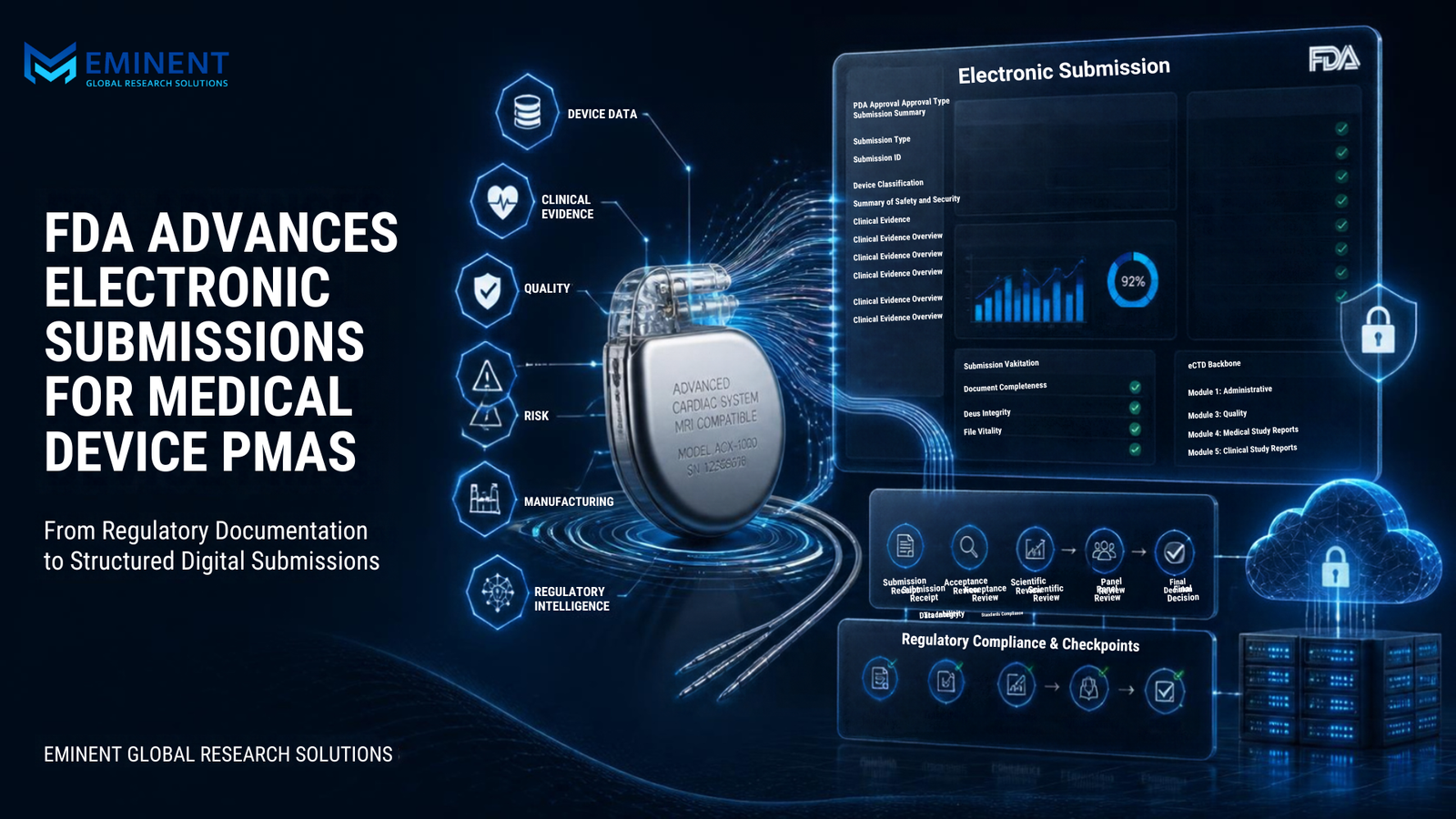
The U.S. Food and Drug Administration (FDA) is taking another significant step toward modernizing the way medical device companies prepare and submit Premarket Approval Applications (PMAs).
In September 2026, FDA issued a draft guidance on the Electronic Submission Template for Premarket Approval Applications (PMA). The guidance introduces the current electronic resources available for PMA and certain PMA supplement submissions and represents another step toward more standardized, structured, and technology-enabled regulatory submissions.
The development is important because PMA is FDA’s most stringent premarket pathway for medical devices, generally applying to Class III devices where general and special controls are not sufficient to provide reasonable assurance of safety and effectiveness.
While the September 2026 document is draft guidance and is not yet for implementation, it provides an important signal about the direction of FDA’s regulatory infrastructure: electronic submissions are moving beyond simply replacing paper with PDFs toward structured, guided, and increasingly standardized regulatory workflows.
From Electronic Documents to Structured Regulatory Submissions
FDA has been progressively expanding electronic submission requirements across medical devices.
Electronic submission requirements already apply to 510(k) submissions, with eSTAR becoming mandatory for applicable submissions in October 2023, and De Novo submissions moving to mandatory eSTAR submission in October 2025, subject to exemptions.
PMA submissions have historically involved electronic copies and established submission requirements. FDA’s latest draft guidance introduces a more structured approach through eSTAR the electronic Submission Template And Resource.
According to FDA, eSTAR is a dynamic, structured PDF designed to guide applicants through preparation of an electronic submission. It uses questions, logic, prompts, databases and links to relevant regulations and guidance to help applicants construct their submissions.
The FDA currently makes eSTAR available for voluntary use for several PMA categories, including original PMAs and selected PMA supplements.
This distinction matters.
The current development should not be interpreted as saying that every PMA must already be submitted through a mandatory PMA eSTAR process. Rather, FDA is establishing the infrastructure and regulatory framework that could support broader electronic-standardization requirements in the future.
Why This Matters for Medical Device Companies
The shift has implications beyond document formatting.
A PMA contains extensive scientific, clinical, manufacturing, risk-management and other information. Preparing such a submission requires coordination across regulatory affairs, clinical teams, engineering, quality, manufacturing, statistics and other functions.
A structured submission environment can potentially improve consistency by guiding applicants through expected information and organizing content in a format aligned more closely with FDA’s internal review processes.
FDA states that the eSTAR approach is intended to improve submission consistency and enhance efficiency in the premarket review process. The PMA draft guidance also indicates that the electronic submission structure closely follows FDA’s Submission Memo And Review Template (SMART), an internal review tool used for certain PMA submission types.
For manufacturers, this creates an important strategic consideration:
Regulatory submission readiness increasingly begins well before the submission is assembled.
Companies need the underlying evidence, documentation and regulatory rationale to be organized in a way that can be efficiently translated into structured electronic submissions.
The Potential Impact on Regulatory Strategy
The move toward structured submissions could influence several areas of regulatory operations.
1. Greater emphasis on submission completeness
Structured templates can help identify missing information and guide applicants through required sections.
This does not eliminate the need for scientific or regulatory judgment. Instead, it shifts more attention toward the quality and consistency of the underlying content.
2. More standardized regulatory workflows
As regulatory agencies increasingly use digital submission systems, companies may need to rethink how regulatory information is created and managed internally.
Instead of treating the regulatory submission as a final document assembled near the end of development, companies can increasingly treat regulatory content as a continuously maintained information set.
3. Greater importance of cross-functional data management
A PMA can involve clinical evidence, nonclinical information, device descriptions, software documentation, manufacturing information, statistical analyses, labeling and risk-related information.
The ability to maintain consistency across these data sources becomes increasingly important when submissions are prepared through structured templates.
4. Potentially more efficient review interactions
FDA’s broader objective is to make incoming submissions more consistent and facilitate more efficient review.
The CDRH Portal already provides online submission and tracking capabilities for several premarket submission types, including PMAs, allowing authorized users to monitor submission progress.
The combination of structured preparation + electronic submission + digital tracking points toward a more integrated regulatory ecosystem.
What Medical Device Companies Should Do Now
Because the PMA eSTAR guidance remains a draft, companies should avoid treating the document as a finalized mandatory requirement.
However, the direction is sufficiently clear that regulatory teams can begin preparing.
Review existing PMA workflows
Companies should evaluate how PMA information is currently generated, reviewed, version-controlled and assembled.
Map evidence to regulatory requirements
Organizations can create internal evidence maps connecting clinical, technical, manufacturing and quality information to specific regulatory requirements.
Assess electronic submission readiness
Companies should evaluate whether their current document-management and regulatory-information systems can efficiently support structured electronic submissions.
Monitor FDA guidance development
The September 2026 guidance is open for public comment, and FDA states that the final guidance is intended to provide further standards for electronic submissions, a timetable for establishing those standards, and criteria for waivers and exemptions.
Build regulatory intelligence into the process
The most important question is not simply “What template is FDA using?”
It is:
“How will FDA’s evolving submission architecture change the way we prepare, organize and manage regulatory evidence?”
That is a regulatory intelligence question.
From Compliance Activity to Strategic Capability
FDA’s move toward electronic PMA submissions reflects a broader transformation in regulatory affairs.
Regulatory teams are increasingly operating in an environment where data structure, digital workflows, regulatory intelligence and submission quality intersect.
For medical device manufacturers, this means regulatory excellence may increasingly depend on the ability to connect scientific evidence with structured regulatory requirements well before a PMA reaches FDA.
The organizations that prepare early can establish internal processes that make future submission transitions less disruptive.
For companies developing complex Class III devices, combination products, software-enabled technologies or other highly regulated innovations, understanding these regulatory changes can also support better development planning, technology commercialization and market-entry strategy.
The September 2026 PMA eSTAR draft is therefore more than a change in submission format. It is another signal that the medical device regulatory environment is moving toward digital, structured and increasingly data-driven regulatory operations.
For companies, the strategic question is no longer simply how to submit a PMA.
It is how to build a regulatory information infrastructure capable of supporting the entire journey from product development → evidence generation → regulatory submission → FDA review → commercialization.
How Eminent Global Research Solutions Can Support
At Eminent Global Research Solutions, regulatory intelligence can help medical device and life sciences organizations monitor evolving FDA requirements, assess regulatory developments, map competitive and technology landscapes, and identify implications for product development and commercialization strategies.
Our work across regulatory intelligence, market intelligence, IP intelligence, technology scouting and commercialization strategy can help organizations translate regulatory developments into actionable business insights.