

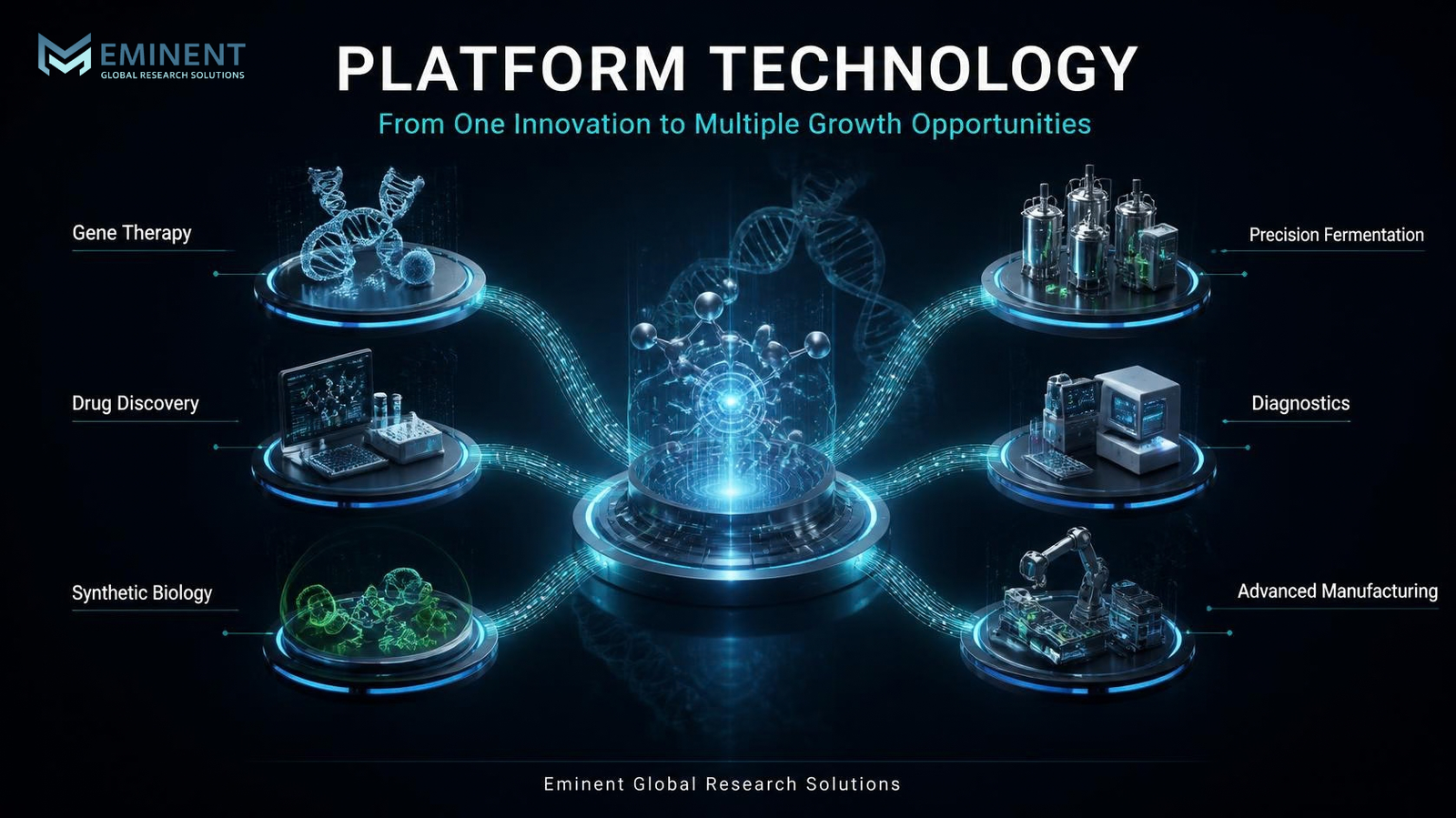
Biotechnology has traditionally been evaluated through the lens of individual products: a novel therapy, a breakthrough diagnostic, a proprietary enzyme, or a differentiated biological ingredient. However, the economics of the biotechnology industry are increasingly creating a different strategic question:
Is the platform behind the product becoming more valuable than the product itself?
A successful biotechnology platform can generate multiple products, applications, partnerships, and revenue opportunities from a common technological foundation. Instead of relying on the commercial success of a single asset, platform companies can potentially build diversified pipelines around a repeatable technology engine.
This shift is particularly relevant across gene therapy, cell therapy, synthetic biology, precision fermentation, AI-enabled drug discovery, biologics manufacturing, and advanced diagnostics.
For biotechnology companies and investors, the strategic implications are significant. The value proposition is increasingly moving from “What product have you developed?” toward “What can your technology repeatedly create?”
From Product-Centric to Platform-Centric Biotechnology
Traditional biotechnology businesses often follow a relatively linear model.
A company identifies a biological problem, develops a candidate product, conducts research and clinical development, obtains regulatory approval where required, and commercializes the resulting product.
The economics can be attractive when the product succeeds. However, the model also carries substantial concentration risk.
If the lead asset fails during development, encounters manufacturing problems, receives limited market adoption, or faces strong competition, the company’s growth trajectory can be severely affected.
Platform technologies offer a different strategic structure.
A platform can provide a repeatable technological capability that supports multiple products or applications. Examples include technologies for gene editing, targeted delivery, antibody discovery, synthetic biology, computational drug discovery, or precision fermentation.
The platform therefore becomes an engine for generating future opportunities rather than simply supporting one commercial product.
Why Platform Technologies Can Create Strategic Leverage
The primary advantage of a platform is repeatability.
Once a biotechnology company has established a validated platform, subsequent programs may benefit from existing scientific knowledge, infrastructure, data, manufacturing capabilities, and development processes.
This can potentially improve:
- Research productivity
- Pipeline diversification
- Development efficiency
- Partnering opportunities
- Intellectual-property leverage
- Capital utilization
- Commercial scalability
For example, a platform capable of generating multiple therapeutic candidates may create a broader pipeline than a company focused exclusively on one molecule.
Similarly, a precision-fermentation platform could potentially produce multiple high-value ingredients across cosmetics, food, nutrition, and pharmaceutical applications.
The platform creates optionality.
Platform Technology Can Expand the Addressable Market
A single biotechnology product typically addresses a defined market opportunity.
A platform can potentially address several markets.
This distinction is strategically important.
Consider a technology capable of engineering biological organisms to produce specialized molecules. Its applications may extend across pharmaceuticals, food ingredients, cosmetics, agriculture, and industrial chemicals.
The underlying technology therefore has a potentially broader addressable market than any single application.
This cross-industry potential can make platform technologies particularly attractive for companies pursuing long-term growth.
However, broad applicability does not automatically translate into commercial success. Companies must still demonstrate technical performance, economic viability, regulatory feasibility, and customer demand within each application.
Intellectual Property Becomes More Strategic
Platform companies also require a different approach to intellectual-property strategy.
A product-focused company may concentrate its IP portfolio around a particular molecule, formulation, device, or application.
A platform company may need to protect the underlying technology, processes, algorithms, biological mechanisms, delivery systems, manufacturing methods, and downstream applications.
This creates a more complex IP landscape.
Strong platform IP can potentially support multiple commercial programs and licensing relationships. It can also become an important asset when negotiating partnerships with pharmaceutical, biotechnology, food, cosmetics, or industrial companies.
For businesses operating in technology-intensive sectors, IP intelligence and competitive landscape analysis therefore become critical components of platform strategy.
Understanding where competitors are investing, which patents are emerging, and which technological approaches are gaining traction can help organizations identify potential white spaces and partnership opportunities.
Partnerships Can Multiply Platform Value
Platform technologies can also change the economics of strategic partnerships.
Instead of licensing a single product, a large pharmaceutical or consumer company may partner with a biotechnology organization to access an underlying technology platform.
This can create multiple collaboration opportunities.
A platform company may generate revenue through:
- Licensing agreements
- Milestone payments
- Research collaborations
- Co-development partnerships
- Technology access fees
- Royalties
- Joint ventures
The result is a potentially diversified commercial model.
For larger organizations, platform partnerships can also provide access to external innovation without requiring the company to develop every capability internally.
This is particularly valuable in rapidly evolving fields where technological expertise can become obsolete quickly.
But Platform Does Not Automatically Mean Higher Value
It is important to distinguish technological potential from commercial value.
A platform may have impressive scientific capabilities but still struggle to create sustainable economics.
Several questions need to be answered:
Can the technology work consistently?
Scientific proof-of-concept is only the beginning. Commercial applications require reproducibility, scalability, and reliability.
Can it be manufactured economically?
A technology that works in a laboratory but becomes prohibitively expensive at commercial scale may have limited market potential.
Can customers adopt it?
Technology must solve a meaningful customer problem better than existing alternatives.
Can regulatory requirements be addressed?
In healthcare and food applications, regulatory pathways can significantly influence development timelines and investment requirements.
Can the IP remain defensible?
If competitors can replicate the technology or develop alternative approaches, the platform’s strategic advantage may decline.
These factors demonstrate why platform valuation requires a comprehensive assessment rather than simply counting the number of potential applications.
The Commercialization Challenge
One of the biggest challenges facing platform biotechnology companies is converting technological breadth into commercial focus.
Having ten possible applications does not mean a company should pursue all ten simultaneously.
Management teams must determine where the platform has the strongest combination of:
- Market demand
- Technical feasibility
- Regulatory accessibility
- Competitive differentiation
- Commercial economics
- Strategic fit
This is where market intelligence and commercialization strategy become particularly valuable.
A structured market assessment can help determine which applications should be prioritized and which should remain longer-term opportunities.
What This Means for Biotech Strategy
The growing importance of platform technologies suggests that biotechnology companies may increasingly need to think like technology companies.
Instead of asking only:
“How do we commercialize this product?”
executives may need to ask:
“How do we build an ecosystem around our technology?”
This could involve developing multiple applications, forming strategic partnerships, licensing capabilities, expanding into adjacent industries, and continuously strengthening the underlying platform.
For investors and corporate development teams, the analysis also changes.
Rather than evaluating only the revenue potential of an individual product, they may need to examine the platform’s:
- Pipeline generation capacity
- Technology scalability
- IP defensibility
- Partnership potential
- Manufacturing economics
- Addressable markets
- Competitive positioning
The Future: Platforms as Biotechnology Growth Engines
The biotechnology industry is moving toward increasingly interconnected technology ecosystems.
AI-enabled drug discovery platforms can generate multiple therapeutic candidates. Synthetic biology platforms can support diverse biological manufacturing applications. Gene-editing technologies can potentially address multiple genetic diseases. Precision-fermentation platforms can create ingredients for several industries.
This does not mean individual biotechnology products are becoming less important. Ultimately, commercial products generate revenue and demonstrate whether a platform can create real-world value.
Instead, the strategic relationship between the two is changing.
Products prove the platform. Platforms multiply the opportunity.
For biotechnology companies, pharmaceutical organizations, investors, and corporate strategy teams, understanding this distinction will become increasingly important.
The next generation of biotechnology leaders may not be defined solely by the products they successfully commercialize, but by their ability to build technology platforms capable of generating a sustained pipeline of products, partnerships, and markets.
For Eminent Global Research Solutions, this creates an important consulting opportunity: helping biotechnology and life sciences companies assess platform technologies, identify high-value applications, map competitive landscapes, evaluate IP positioning, prioritize markets, and develop commercialization strategies.
The strategic question is no longer simply whether a biotechnology product can succeed.
It is whether the underlying technology can create the next portfolio of opportunities.