

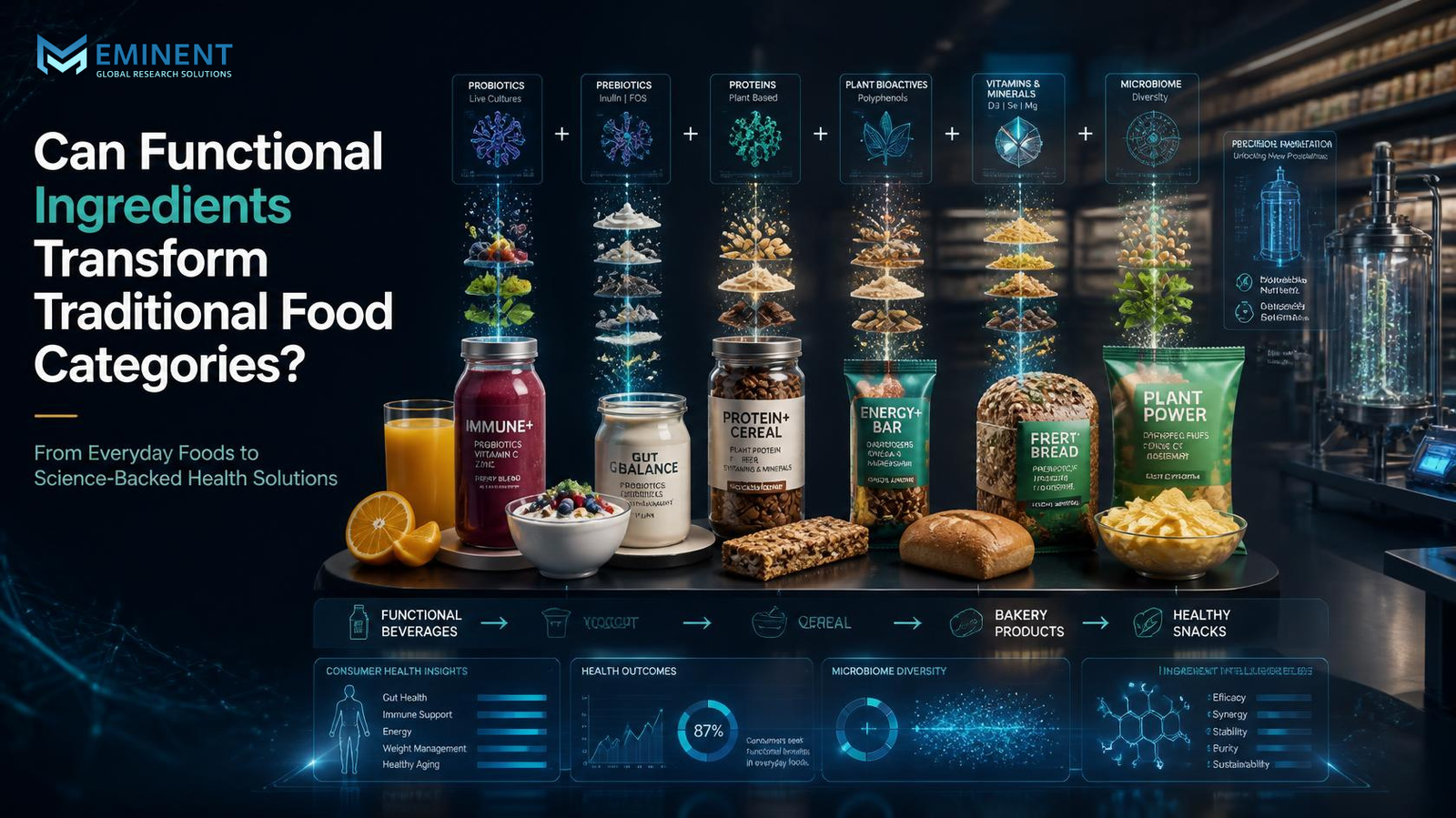
The global food industry is undergoing a fundamental transformation. Consumers are no longer choosing products solely based on taste, convenience, price, or brand recognition. Increasingly, they are looking for foods that deliver additional health and wellness benefits.
This shift is creating significant opportunities for functional ingredients—bioactive compounds, fibers, probiotics, proteins, vitamins, minerals, plant extracts, and other ingredients that can provide benefits beyond basic nutrition.
The strategic question for food manufacturers is no longer simply whether functional ingredients can be incorporated into existing products. It is whether these ingredients can transform traditional food categories into higher-value, health-oriented consumer propositions.
From beverages and snacks to dairy, bakery, cereals, and confectionery, functional ingredients are creating opportunities to redesign established categories and capture consumers willing to pay a premium for measurable health benefits.
From Food Products to Health Solutions
Traditional food categories have historically competed on familiar dimensions: flavor, convenience, affordability, packaging, and brand equity.
Functional nutrition introduces another dimension—health functionality.
A conventional beverage can become a hydration product with electrolytes. A snack can be repositioned around protein, fiber, or metabolic wellness. A dairy product can incorporate probiotics or prebiotics. A breakfast product can be formulated around heart health, digestive wellness, or healthy aging.
This creates an opportunity for manufacturers to move from selling a food product to offering a more specific consumer benefit.
The implications are substantial.
Instead of competing exclusively within crowded categories, companies can create differentiated subcategories around emerging consumer needs such as:
- Gut health
- Immunity
- Healthy aging
- Cognitive wellness
- Metabolic health
- Sports nutrition
- Women’s health
- Energy and recovery
- Weight management
- Digestive health
Functional ingredients therefore have the potential to expand the addressable market of traditional food products.
Why Functional Ingredients Are Gaining Momentum
Several structural trends are supporting the growth of functional foods.
1. Preventive Health Is Becoming More Important
Consumers are increasingly interested in preventing health problems rather than simply responding to them.
This is driving demand for everyday products that can be incorporated into existing lifestyles without requiring significant behavioral changes.
A functional food fits naturally into this model.
Consumers can potentially obtain targeted nutritional benefits through familiar products such as yogurt, beverages, snacks, cereals, and nutritional bars.
2. Healthy Aging Is Creating New Demand
Global demographic changes are creating growing demand for products designed around healthy aging.
Consumers are increasingly interested in maintaining muscle health, cognitive function, cardiovascular wellness, and overall vitality as they age.
This creates opportunities for ingredients such as high-quality proteins, omega-3 fatty acids, specific vitamins and minerals, fibers, and other scientifically studied compounds.
Food manufacturers that identify these emerging needs early can develop differentiated portfolios before categories become saturated.
3. Consumers Want Convenience
Modern consumers increasingly want health benefits without sacrificing convenience.
Functional foods address this demand by integrating nutritional functionality into products that consumers already understand and regularly consume.
This is particularly relevant for beverages, snacks, ready-to-eat foods, and convenient nutrition formats.
The winning products may not necessarily be the most scientifically complex. They may be the products that translate sophisticated nutritional science into simple, convenient consumer experiences.
Ingredient Innovation Is Becoming a Competitive Advantage
Functional ingredients are also changing how food companies approach R&D.
Historically, product development often started with the food format and then focused on formulation.
Increasingly, companies are beginning with a consumer health need and working backward toward the appropriate ingredient, delivery format, and product proposition.
For example:
Consumer need → Scientific evidence → Ingredient selection → Product formulation → Clinical validation → Market positioning
This approach creates opportunities for ingredient suppliers to become strategic innovation partners rather than commodity vendors.
Ingredient companies that can provide scientific evidence, formulation support, regulatory expertise, and application development may capture significantly greater value from the food innovation ecosystem.
Science and Evidence Will Determine Winners
The rapid growth of functional foods also creates a major challenge: consumer trust.
Not every ingredient marketed as “functional” provides the same level of scientific evidence.
As the category matures, companies will increasingly need to distinguish between emerging ingredient trends and scientifically substantiated health benefits.
This makes evidence generation increasingly important.
Companies should evaluate:
- Quality of clinical evidence
- Mechanism of action
- Dosage requirements
- Bioavailability
- Product stability
- Consumer relevance
- Regulatory requirements
- Permitted health claims
Scientific credibility can become a major competitive differentiator.
Brands that make strong claims without adequate evidence may face regulatory and reputational risks. Conversely, companies that invest in robust research can build stronger consumer confidence and justify premium positioning.
The Premiumization Opportunity
Functional ingredients can create a powerful premiumization strategy.
Consumers may be willing to pay more when a product delivers a clearly understood benefit supported by credible evidence.
This allows manufacturers to potentially increase value per unit rather than relying solely on volume growth.
Consider the difference between:
Traditional snack → Protein snack → Targeted wellness snack
Each stage can represent a progressively more differentiated proposition.
However, premiumization must be supported by meaningful consumer value. Adding an expensive ingredient to a product without a compelling benefit does not automatically create a successful premium product.
The commercial opportunity depends on the intersection of:
Consumer demand + scientific evidence + ingredient functionality + product experience + acceptable price
The Role of Biotechnology
Biotechnology is likely to become increasingly important in the functional ingredient ecosystem.
Advances in fermentation, precision fermentation, microbial biotechnology, extraction technologies, and bioengineering are enabling the development of novel ingredients with improved functionality and scalability.
These technologies may help manufacturers address challenges such as:
- Ingredient consistency
- Production scalability
- Sustainability
- Bioavailability
- Supply security
- Novel ingredient development
This creates an important convergence between food technology and biotechnology.
For food companies, monitoring biotechnology innovation is becoming increasingly relevant to future ingredient sourcing and product development strategies.
Challenges Food Companies Need to Consider
Despite the opportunity, functional ingredient innovation is not without challenges.
Formulation complexity: Some functional ingredients can affect taste, texture, color, stability, or shelf life.
Cost: High-value ingredients may significantly increase production costs.
Regulatory requirements: Health claims and novel ingredients can face complex regulatory requirements across different markets.
Consumer education: Consumers may not immediately understand the value of technically sophisticated ingredients.
Supply chain risk: Emerging ingredients may have limited production capacity or concentrated supplier bases.
Evidence gaps: Some popular ingredients may have promising early research but insufficient evidence for strong commercial claims.
Companies therefore need a structured approach to evaluating functional ingredient opportunities rather than simply following market trends.
A Strategic Framework for Food Companies
For food manufacturers considering functional ingredient innovation, five questions should guide investment decisions:
1. What consumer problem are we solving?
Start with a clearly defined consumer need rather than an ingredient trend.
2. Is the science strong enough?
Assess clinical evidence, efficacy, dosage, safety, and mechanism of action.
3. Can the ingredient be commercially scaled?
Evaluate supplier capability, manufacturing economics, supply security, and quality consistency.
4. Can the product achieve regulatory clearance?
Understand market-specific ingredient and health-claim requirements before commercialization.
5. Will consumers pay for the benefit?
Ultimately, scientific functionality must translate into perceived consumer value.
What This Means for the Future
Functional ingredients have the potential to fundamentally reshape traditional food categories.
The next generation of successful food products may increasingly sit at the intersection of food, nutrition, biotechnology, and preventive health.
For food manufacturers, the opportunity is not simply to add functional ingredients to existing products. It is to identify emerging health needs and build entirely new product propositions around them.
For ingredient suppliers, this represents an opportunity to move further up the value chain through scientific research, application development, and co-innovation.
For investors and strategic decision-makers, functional ingredients represent an important area for technology scouting, market intelligence, competitive analysis, and portfolio expansion.
At Eminent Global Research Solutions, this evolving landscape creates an important strategic question for the food industry:
Which functional ingredient technologies have the scientific, commercial, and market potential to create the next generation of high-value food categories?
The companies that answer that question early may be better positioned to transform consumer trends into sustainable growth.