

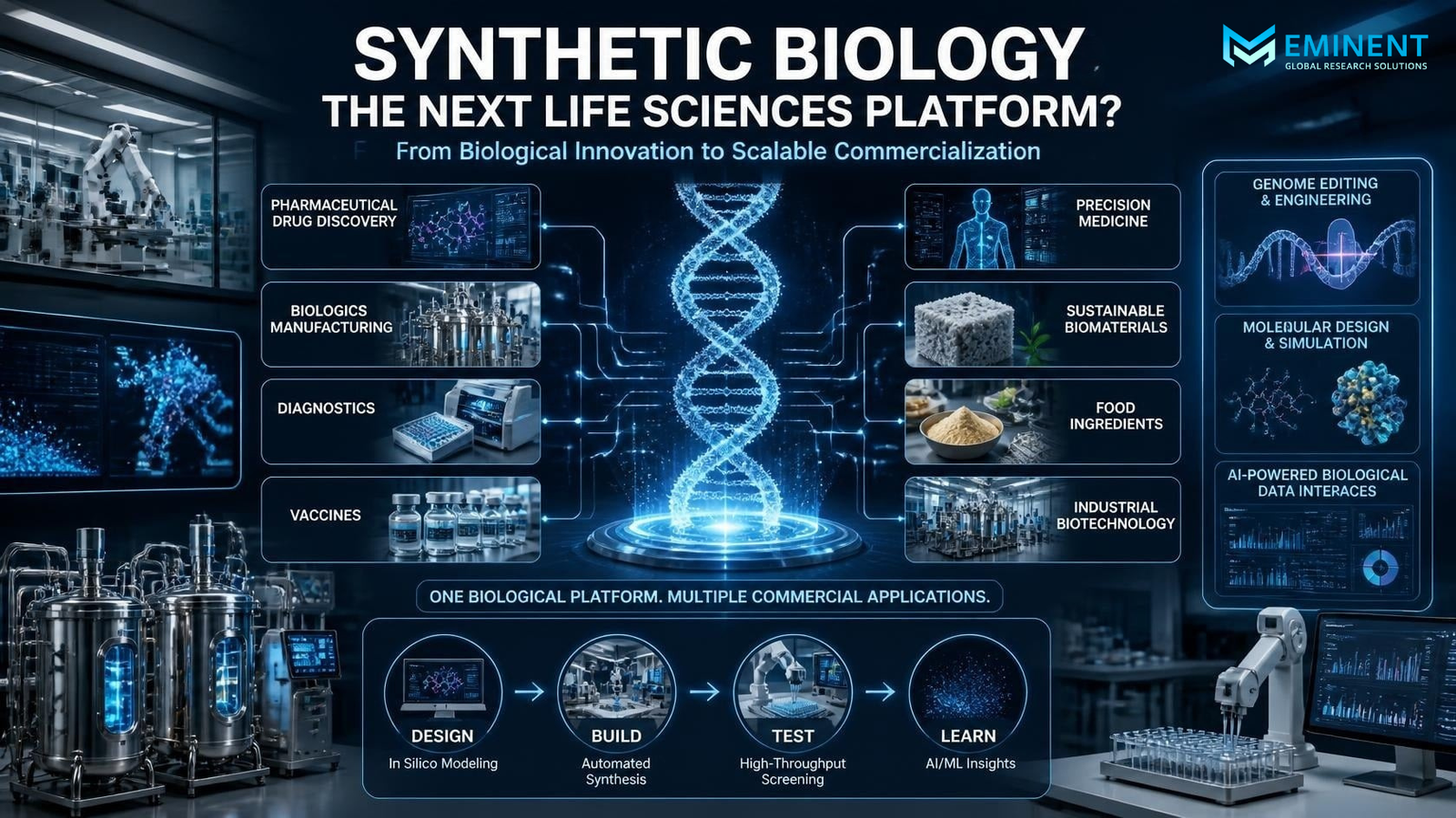
Synthetic biology is rapidly moving beyond its origins as a niche research discipline and emerging as a potential platform technology for the broader life sciences industry.
By combining biology, engineering, computational science, and advanced manufacturing, synthetic biology enables researchers to design, modify, and produce biological systems for specific applications. Its potential spans pharmaceuticals, therapeutics, diagnostics, vaccines, agriculture, food ingredients, industrial biotechnology, and biomaterials.
The strategic question is no longer whether synthetic biology can generate scientific breakthroughs. The more important question for life sciences companies is whether these technologies can be scaled, commercialized, and integrated into repeatable business models.
If the technology reaches sufficient maturity, synthetic biology could become analogous to other platform technologies that have transformed the life sciences industry—providing reusable capabilities that generate multiple products, applications, and revenue streams.
For pharmaceutical and biotechnology companies, this could fundamentally change how innovation portfolios are built.
From Biological Discovery to Biological Engineering
Traditional biotechnology often focuses on discovering useful biological properties from naturally occurring organisms or molecules. Synthetic biology introduces a more engineering-oriented approach.
Researchers can design biological systems to perform specific functions rather than relying entirely on naturally occurring biology.
Advances in DNA synthesis, genome engineering, computational biology, automation, and machine learning are accelerating this process.
Companies can potentially engineer microorganisms or cells to produce:
- Therapeutic proteins
- Enzymes
- Vaccines and vaccine components
- Specialty chemicals
- Functional ingredients
- Biomaterials
- Diagnostic components
- Novel therapeutic molecules
This ability to program biological systems creates a fundamentally different innovation model.
Instead of developing every product independently, organizations can build platform capabilities that support multiple products and applications.
That distinction could become strategically important for life sciences companies seeking to improve R&D productivity.
Why Synthetic Biology Could Become a Platform Technology
A platform technology creates value because the underlying capability can be reused across multiple applications.
Synthetic biology has many characteristics associated with platform technologies.
A single engineered biological system, production process, computational model, or genetic engineering capability can potentially support multiple commercial applications.
This creates opportunities for companies to develop technology platforms around:
Design: Computational tools can help identify and design biological sequences and systems.
Build: DNA synthesis and genome engineering enable the construction of biological systems.
Test: Automated experimentation can evaluate biological performance at significantly greater scale.
Learn: Experimental data can be fed back into computational models, improving subsequent designs.
This creates a continuous design-build-test-learn cycle.
As automation and AI become increasingly integrated into synthetic biology workflows, the speed of biological experimentation could increase substantially.
For life sciences companies, that could translate into shorter development cycles, broader R&D pipelines, and improved probability of identifying commercially valuable applications.
AI Is Accelerating Synthetic Biology
The convergence of artificial intelligence and synthetic biology could be one of the most important developments shaping the sector.
AI can analyze enormous biological datasets, identify patterns, predict molecular behavior, optimize biological sequences, and help researchers prioritize experiments.
Rather than relying exclusively on physical experimentation, researchers can increasingly use computational models to narrow the number of experiments required.
This creates an important strategic feedback loop:
Biological data → AI models → engineered designs → experiments → new data → improved models
As the quantity and quality of biological data increases, this feedback loop could become increasingly powerful.
For companies, the competitive advantage may therefore shift from simply possessing biological technologies to possessing proprietary biological data, computational capabilities, and scalable experimentation infrastructure.
Pharmaceutical Applications
The pharmaceutical industry represents one of the most significant opportunities for synthetic biology.
Potential applications extend across drug discovery, manufacturing, therapeutics, and diagnostics.
Synthetic biology could help companies engineer biological systems to produce complex molecules more efficiently or develop entirely new therapeutic approaches.
It may also support the production of difficult-to-manufacture biologics and specialized compounds.
For pharmaceutical companies, the strategic value lies in potentially improving:
- R&D productivity
- Manufacturing efficiency
- Molecule development
- Supply-chain resilience
- Product differentiation
- Access to novel therapeutic modalities
However, commercialization remains significantly more complex than laboratory development.
Companies must demonstrate safety, consistency, scalability, regulatory compliance, and economic viability.
Consequently, the organizations most likely to benefit will be those that connect scientific innovation with strong commercialization capabilities.
Manufacturing Could Be the Hidden Opportunity
While synthetic biology often receives attention for its potential in drug discovery and therapeutics, biomanufacturing could represent an equally important commercial opportunity.
Biological systems can potentially manufacture materials and chemicals using renewable feedstocks and controlled biological processes.
This could create new opportunities across:
- Specialty chemicals
- Ingredients
- Enzymes
- Biomaterials
- Industrial compounds
- Food ingredients
- Sustainable alternatives to petrochemical products
For manufacturers, the attraction is not simply biological production.
The larger opportunity is the ability to create new production architectures that may offer improved sustainability, customization, and supply-chain flexibility.
However, achieving cost competitiveness at industrial scale remains a major challenge.
Laboratory success does not automatically translate into commercially viable manufacturing.
Scale-Up Remains a Major Barrier
Synthetic biology companies face a critical commercialization challenge: scaling biological processes from laboratory environments to industrial production.
Biological systems can behave differently when production volumes increase. Factors such as temperature, nutrient availability, oxygen transfer, contamination control, and process stability can significantly affect output.
This makes scale-up one of the most important areas for investment and technical development.
Companies need capabilities spanning:
- Bioprocess engineering
- Fermentation
- Process optimization
- Quality control
- Manufacturing automation
- Supply-chain management
- Regulatory compliance
Strategic partnerships with specialized manufacturing organizations may therefore become increasingly important for emerging synthetic biology companies.
The Regulatory Landscape Will Shape Adoption
Synthetic biology also introduces complex regulatory considerations.
Products derived from engineered biological systems may fall under different regulatory frameworks depending on their application and jurisdiction.
Pharmaceutical products face stringent requirements for safety, efficacy, quality, and manufacturing consistency. Food and cosmetic applications may follow different regulatory pathways.
Companies therefore need regulatory strategies aligned with their intended commercial applications from the earliest stages of development.
Regulatory intelligence can help organizations identify:
- Applicable regulatory pathways
- Market-specific requirements
- Product classification issues
- Safety assessment requirements
- Manufacturing compliance considerations
- Potential commercialization barriers
Regulatory readiness could become an important competitive advantage as synthetic biology moves from research toward large-scale commercial deployment.
Intellectual Property Could Become a Major Battleground
As synthetic biology matures, intellectual property strategy will become increasingly important.
Competitive advantage may exist not only in the final product but across the underlying technology stack.
This can include:
- Engineered biological systems
- Genetic sequences
- Production processes
- Proprietary organisms
- Computational models
- Experimental datasets
- Manufacturing methods
Companies will need to determine where they should patent technologies, where trade secrets provide stronger protection, and how to navigate existing third-party intellectual property.
For investors and corporate strategy teams, understanding the competitive IP landscape will become increasingly important when evaluating synthetic biology companies and technology platforms.
What This Means for Life Sciences Leaders
Synthetic biology has the potential to fundamentally change the economics of biological innovation.
But technological potential alone does not guarantee commercial success.
Life sciences organizations evaluating synthetic biology should consider five strategic questions:
1. Where is the strongest commercial opportunity?
Not every synthetic biology application will generate attractive returns.
2. Can the technology scale economically?
Production economics must be evaluated alongside scientific performance.
3. What regulatory pathway will apply?
Regulatory complexity can significantly influence time-to-market.
4. Where is the defensible IP?
Companies need sustainable competitive barriers around their technology.
5. Can the platform generate multiple products?
The strongest platform businesses may be those capable of supporting multiple commercial applications.
The Road Ahead
Synthetic biology is entering an important transition from scientific possibility to commercial execution.
The next phase of industry growth will likely be determined not simply by who can engineer biology, but by who can commercialize engineered biology at scale.
Companies that successfully combine synthetic biology with AI, automation, advanced manufacturing, regulatory expertise, and strategic commercialization may create powerful technology platforms capable of serving multiple markets.
For life sciences leaders, this makes synthetic biology an important area for technology scouting, competitive intelligence, portfolio strategy, and investment analysis.
The central question is therefore becoming increasingly relevant:
Can synthetic biology become the next platform technology for life sciences?
The answer may depend less on the science itself and more on the industry’s ability to scale, protect, regulate, and commercialize it.