
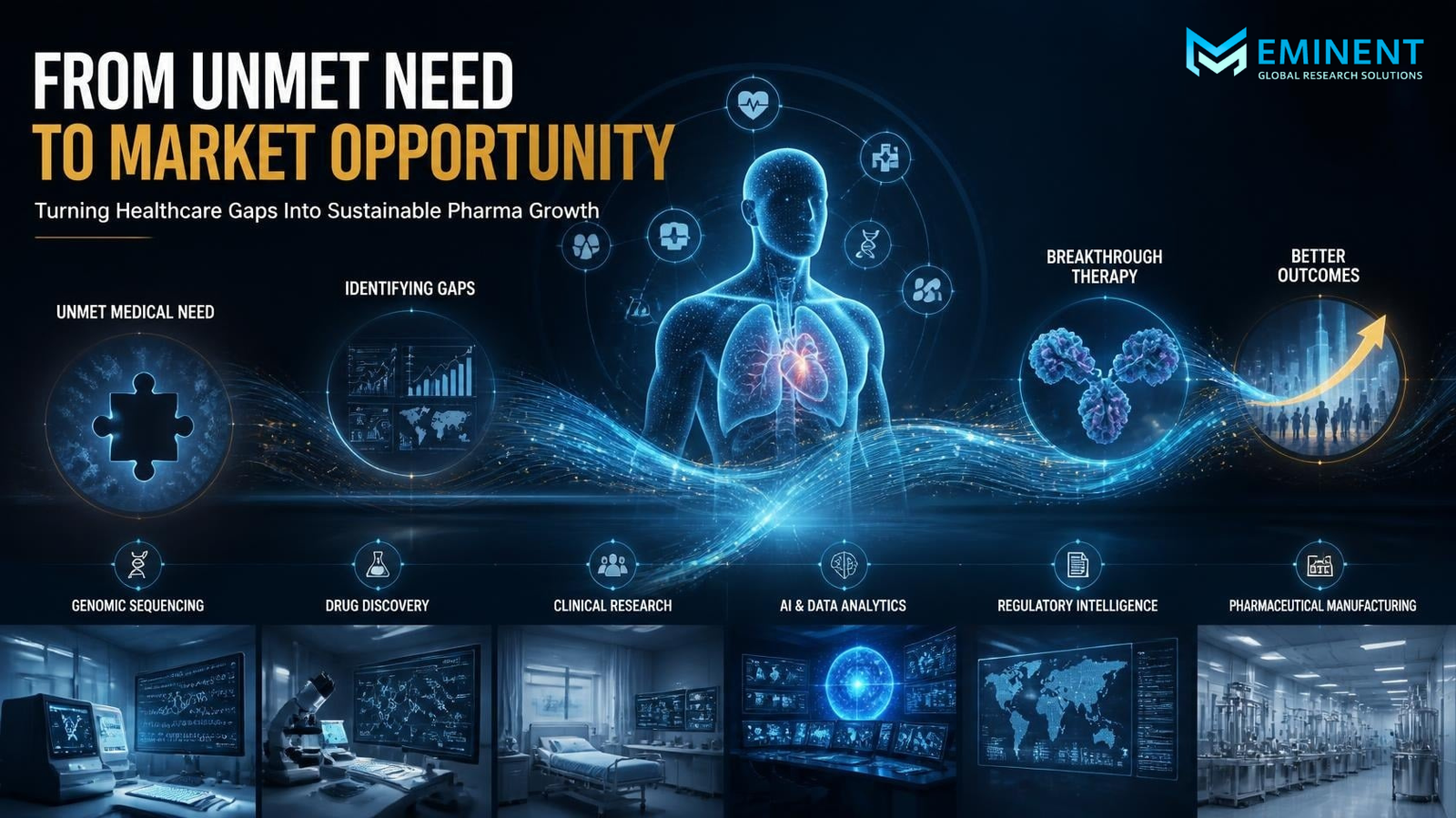
The pharmaceutical industry has traditionally focused on developing medicines for large and commercially attractive disease markets. However, a fundamental shift is taking place. As competition intensifies in established therapeutic areas, pharmaceutical companies are increasingly looking toward unmet medical needs as both a healthcare priority and a potential source of long-term growth.
Unmet medical needs exist where available treatments fail to adequately address the needs of patients, healthcare providers, or healthcare systems. These gaps can involve diseases with no effective treatment, inadequate treatment outcomes, significant side effects, difficult administration, poor diagnosis, limited patient access, or populations that remain underserved.
For pharmaceutical companies, addressing these gaps can create a powerful combination of clinical impact, differentiation, market opportunity, and long-term commercial value.
But identifying an unmet need is only the beginning. Sustainable growth depends on understanding where the need is greatest, whether the scientific opportunity is commercially viable, how competitive the landscape is evolving, and whether healthcare systems will ultimately support adoption.
Why Unmet Medical Needs Are Becoming Strategic Priorities
The pharmaceutical market is becoming increasingly competitive.
Established therapeutic categories such as oncology, immunology, diabetes, and cardiovascular disease attract significant investment from global pharmaceutical companies and emerging biotechnology firms. While these markets can generate substantial revenue, they also face intense competition, patent expirations, pricing pressure, and increasingly sophisticated treatment options.
In this environment, unmet medical needs can provide companies with opportunities to develop differentiated therapies rather than competing solely on incremental improvements.
Areas with significant unmet needs may include:
- Rare and orphan diseases
- Treatment-resistant cancers
- Neurodegenerative diseases
- Complex autoimmune conditions
- Pediatric diseases
- Genetic disorders
- Neglected diseases
- Diseases with limited diagnostic capabilities
The opportunity is particularly attractive when scientific advances make previously difficult-to-treat conditions addressable.
Innovations in gene therapy, cell therapy, RNA technologies, immunotherapy, precision medicine, and artificial intelligence-enabled drug discovery are expanding the range of diseases that pharmaceutical companies can potentially target.
From Medical Gap to Commercial Opportunity
Not every unmet medical need represents a viable commercial opportunity.
A disease may have a significant patient burden but lack a practical market opportunity because of limited diagnosis, fragmented healthcare infrastructure, reimbursement challenges, or extremely high development costs.
Therefore, pharmaceutical companies need to distinguish between clinical need and commercially addressable need.
A structured opportunity assessment should consider several dimensions:
1. Size of the Patient Population
Understanding the number of patients affected by a condition is fundamental. However, patient population alone should not determine investment decisions.
A smaller population with severe disease and no effective treatment may represent a more attractive opportunity than a large population with multiple established therapies.
2. Treatment Gap
Companies need to understand exactly where existing therapies fall short.
Is the problem efficacy?
Safety?
Administration frequency?
Durability?
Diagnosis?
Patient adherence?
Or access?
Understanding the specific treatment gap helps companies identify opportunities for meaningful differentiation.
3. Competitive Intensity
The competitive pipeline must also be evaluated.
A market with significant unmet need may already attract dozens of companies developing competing therapies. Understanding clinical-stage assets, technology platforms, patent landscapes, partnerships, and emerging mechanisms of action is therefore essential.
The most attractive opportunity may not necessarily be the market with the largest unmet need, but the one where a company can establish defensible differentiation.
Precision Medicine Is Expanding the Opportunity
One of the most important developments in addressing unmet medical needs is the rise of precision medicine.
Traditional drug development often treats broad patient populations based on disease classification. Precision medicine enables pharmaceutical companies to identify specific biological characteristics that influence treatment response.
This can create opportunities within diseases previously considered too heterogeneous for targeted intervention.
Biomarkers, genomic profiling, companion diagnostics, and real-world patient data can help companies identify patient subgroups with specific therapeutic needs.
This creates a more targeted commercialization model:
Disease → Patient Segment → Biomarker → Target → Therapy → Measurable Outcome
Such an approach can improve clinical development strategies while supporting stronger differentiation in the marketplace.
Regulatory Incentives Can Accelerate Innovation
Governments and regulatory agencies increasingly recognize the need to encourage pharmaceutical innovation in areas where conventional market incentives may be insufficient.
Programs supporting orphan drugs, breakthrough therapies, accelerated development, and other advanced regulatory pathways can help companies reduce development timelines or gain additional commercial advantages where applicable.
Regulatory strategy therefore becomes an important component of opportunity assessment.
Companies should evaluate regulatory pathways early rather than treating regulatory planning as a late-stage activity.
Understanding the likely regulatory requirements can influence:
- Clinical trial design
- Patient recruitment
- Evidence generation
- Development timelines
- Manufacturing requirements
- Commercial launch planning
A strong regulatory strategy can potentially turn scientific opportunity into a faster and more predictable commercialization pathway.
Market Access Determines Commercial Sustainability
A therapy can demonstrate strong clinical efficacy and still struggle commercially if patients cannot access it.
This is particularly relevant for innovative therapies targeting rare diseases or conditions requiring expensive and specialized treatment.
Pharmaceutical companies must increasingly consider market access during early-stage development.
Key questions include:
- Who will pay for the therapy?
- What clinical outcomes will justify reimbursement?
- How will the therapy compare with existing standards of care?
- What is the long-term economic value to healthcare systems?
- Could outcomes-based reimbursement models support adoption?
Health economics and outcomes research are becoming increasingly important in this process.
The commercial value of a therapy is increasingly determined not simply by its clinical efficacy, but by its value relative to the total cost of care.
The Role of Strategic Partnerships
Addressing complex unmet medical needs rarely depends on a single organization.
Pharmaceutical companies are increasingly forming partnerships with biotechnology companies, universities, research institutes, technology providers, diagnostic companies, and specialized manufacturing organizations.
These collaborations can provide access to:
- Novel scientific platforms
- Intellectual property
- Biomarker technologies
- Specialized clinical expertise
- Patient populations
- Manufacturing capabilities
- Regional market knowledge
For pharmaceutical companies, strategic partnering can reduce development risk while accelerating access to innovative technologies.
For smaller biotechnology companies, partnerships with established pharmaceutical organizations can provide the regulatory, manufacturing, and commercial capabilities required to scale their innovations.
Turning Unmet Need Into a Repeatable Growth Strategy
The most successful pharmaceutical companies will not simply react to unmet medical needs. They will develop systematic approaches for identifying and prioritizing them.
A strategic unmet-needs framework can combine:
Market Intelligence + Clinical Intelligence + Technology Intelligence + IP Intelligence + Regulatory Intelligence + Commercial Assessment
This integrated approach allows organizations to evaluate opportunities from multiple perspectives.
For example, a promising disease area should be assessed not only based on patient numbers but also according to scientific maturity, competitive pipeline activity, intellectual property barriers, regulatory environment, treatment economics, and commercialization potential.
This can help companies identify opportunities before markets become overcrowded.
The Future of Pharma Growth
The pharmaceutical industry’s next phase of growth may increasingly depend on its ability to solve problems that remain unresolved.
The opportunity is not simply to launch another product into an established market. It is to identify significant healthcare gaps and develop solutions that deliver measurable value to patients, physicians, and healthcare systems.
Companies that successfully combine scientific innovation with market intelligence, regulatory strategy, IP positioning, and commercialization planning can create stronger and more sustainable growth opportunities.
The key question for pharma leaders is therefore shifting from:
“Where is the biggest market?”
to:
“Where is the most important unmet need that we can uniquely and profitably solve?”
That shift in perspective could define the next generation of pharmaceutical market leaders.