

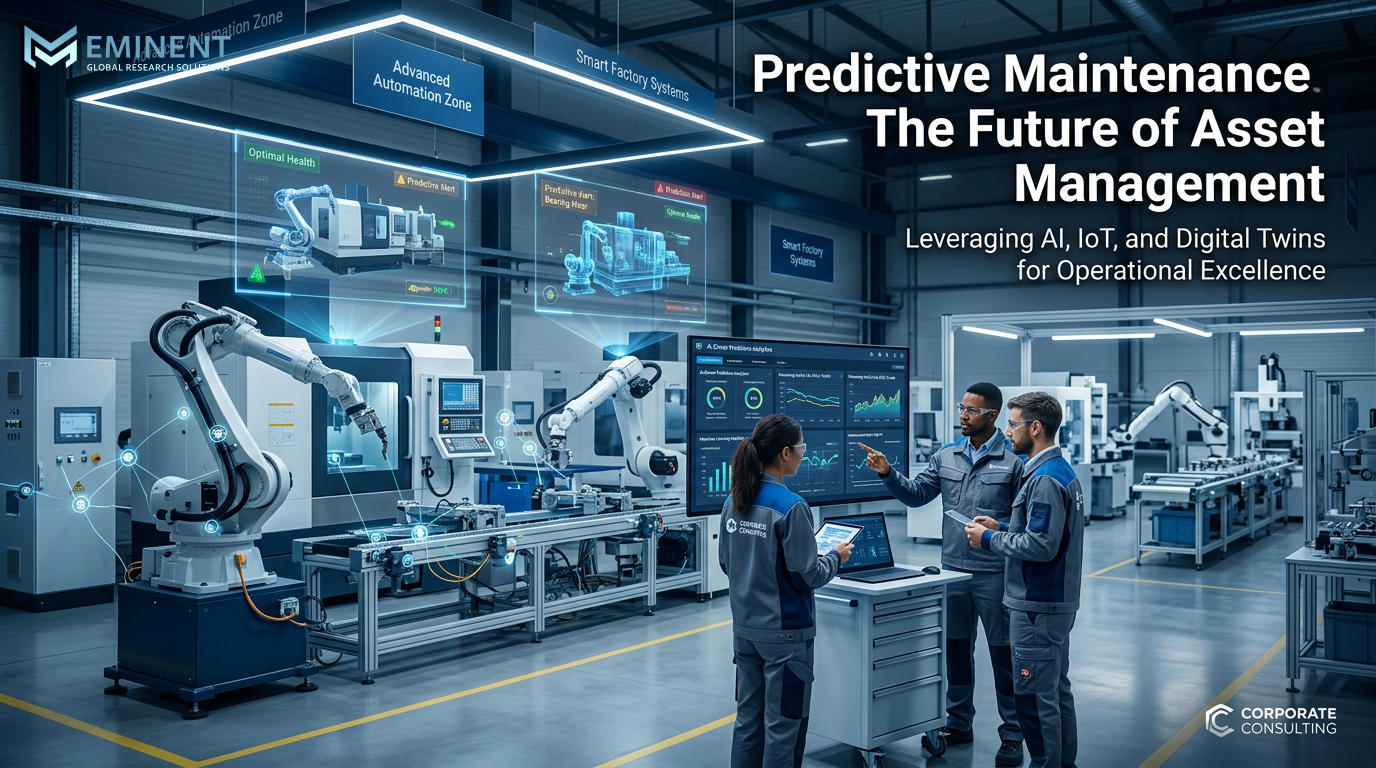
In today’s increasingly competitive industrial landscape, organizations are under constant pressure to maximize operational efficiency, reduce downtime, and extend the lifespan of critical assets. Traditional maintenance approaches—whether reactive or preventive—have long served as the foundation of asset management strategies. However, advances in artificial intelligence (AI), Industrial Internet of Things (IIoT), machine learning, and real-time analytics are driving a fundamental shift toward predictive maintenance.
As industries embrace digital transformation, predictive maintenance is emerging as one of the most impactful innovations in asset management. By enabling organizations to anticipate equipment failures before they occur, predictive maintenance has the potential to significantly reduce costs, improve reliability, and optimize operational performance.
The question is no longer whether predictive maintenance works. The real question is whether predictive maintenance will become the standard model for asset management in the future.
The Evolution of Maintenance Strategies
Historically, industrial maintenance has evolved through three primary stages.
Reactive maintenance, often referred to as “run-to-failure,” involves repairing equipment only after a breakdown occurs. While this approach minimizes maintenance planning, it often results in costly downtime, emergency repairs, production disruptions, and safety risks.
Preventive maintenance represented a significant improvement by scheduling inspections and servicing activities at predetermined intervals. Although preventive maintenance reduces unexpected failures, it can also lead to unnecessary maintenance activities and increased operating costs when equipment is serviced regardless of its actual condition.
Predictive maintenance introduces a more intelligent and data-driven approach. Instead of relying on fixed schedules, organizations continuously monitor asset health using sensors, analytics platforms, and AI algorithms. Maintenance activities are then performed only when indicators suggest a potential failure is likely to occur.
This transition from time-based maintenance to condition-based maintenance is redefining how organizations manage critical assets.
How Predictive Maintenance Works
Predictive maintenance leverages connected technologies to collect and analyze operational data from equipment in real time.
Sensors installed on machinery monitor key performance indicators such as:
- Temperature
- Vibration
- Pressure
- Energy consumption
- Acoustic signals
- Lubrication quality
- Operational efficiency
The collected data is transmitted to analytics platforms where machine learning algorithms identify anomalies, degradation patterns, and potential failure indicators.
Rather than waiting for equipment to fail, maintenance teams receive early warnings that allow them to intervene before a breakdown occurs.
This proactive approach transforms maintenance from a reactive cost center into a strategic operational capability.
The Business Benefits of Predictive Maintenance
The growing adoption of predictive maintenance is driven by its ability to deliver measurable business value.
Reduced Downtime
Unplanned downtime remains one of the most expensive challenges facing industrial operations. Equipment failures can disrupt production schedules, delay deliveries, and negatively impact customer satisfaction.
Predictive maintenance helps organizations identify potential issues before they lead to operational disruptions, significantly reducing unexpected downtime.
Lower Maintenance Costs
Traditional preventive maintenance often results in replacing components that still have useful life remaining.
Predictive maintenance enables organizations to service equipment only when necessary, reducing labor costs, spare parts consumption, and unnecessary maintenance activities.
Extended Asset Lifespan
By detecting wear and performance degradation early, companies can address issues before significant damage occurs.
This proactive intervention helps maximize equipment lifespan and improve return on capital investments.
Improved Safety
Equipment failures can create serious workplace safety risks.
Predictive maintenance reduces the likelihood of catastrophic failures, supporting safer working environments and helping organizations meet compliance requirements.
Better Resource Allocation
Maintenance teams can prioritize activities based on actual asset conditions rather than predefined schedules.
This improves workforce productivity and enables more effective allocation of maintenance resources.
AI and IoT Are Accelerating Adoption
The rapid growth of predictive maintenance is closely tied to advancements in AI and Industrial IoT technologies.
Connected sensors have become more affordable and easier to deploy across industrial environments. At the same time, cloud computing platforms enable organizations to process massive volumes of operational data in real time.
AI-driven analytics provide deeper insights into asset behavior by identifying complex patterns that would be difficult for human operators to detect.
These technological advances are making predictive maintenance increasingly accessible across industries including:
- Manufacturing
- Energy and Utilities
- Oil and Gas
- Transportation
- Mining
- Aerospace
- Logistics
- Pharmaceuticals
As AI models become more sophisticated, predictive maintenance systems are expected to deliver even greater accuracy and reliability.
Challenges to Implementation
Despite its advantages, predictive maintenance is not without challenges.
Organizations must often overcome barriers related to:
- Data quality and integration
- Legacy equipment compatibility
- Initial technology investments
- Cybersecurity concerns
- Workforce training requirements
- Change management initiatives
Successful implementation requires more than technology deployment. Companies must develop digital capabilities, establish clear asset management strategies, and ensure cross-functional collaboration between operations, maintenance, and IT teams.
Organizations that approach predictive maintenance as part of a broader digital transformation strategy are often better positioned to achieve sustainable results.
The Future of Asset Management
The future of asset management is likely to become increasingly predictive, autonomous, and data-driven.
Emerging technologies such as digital twins, edge computing, advanced robotics, and generative AI will further enhance predictive maintenance capabilities.
Future asset management systems may be able to:
- Predict failures months in advance
- Automatically schedule maintenance activities
- Optimize spare parts inventory
- Simulate asset performance scenarios
- Recommend operational improvements
- Coordinate maintenance across multiple facilities
This evolution will shift maintenance functions from reactive operational support toward strategic business value creation.
Organizations that invest early in predictive maintenance capabilities may gain significant advantages in operational efficiency, cost reduction, and competitive performance.
Conclusion
Predictive maintenance is rapidly becoming one of the most transformative developments in modern asset management. By combining AI, IoT, and advanced analytics, organizations can move beyond traditional maintenance models and unlock new levels of reliability, efficiency, and operational intelligence.
While implementation requires investment and organizational commitment, the long-term benefits can be substantial.
As industries continue their digital transformation journeys, predictive maintenance is poised to become a cornerstone of future asset management strategies.
For business leaders, the opportunity is clear: organizations that embrace predictive maintenance today may be better prepared to compete in an increasingly data-driven industrial future.