

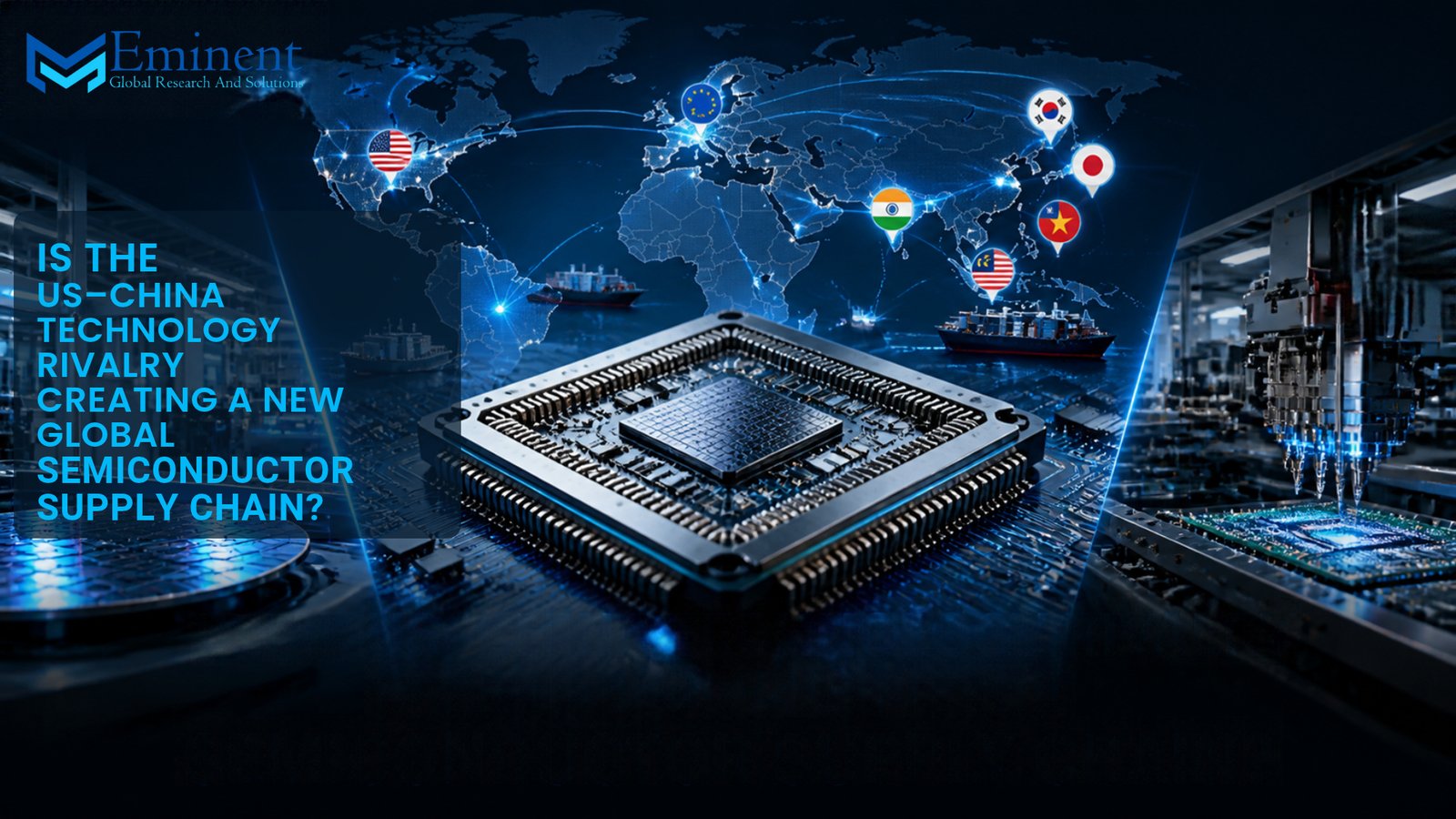
Is the US–China Technology Rivalry Creating a New Global Semiconductor Supply Chain?
Published Date: 21 November 2026
Category: Electronics & IT | Semiconductors | Global Trade | Geopolitical Risk
Introduction
The global semiconductor industry is undergoing a major transformation as competition between the United States and China increasingly influences international technology trade, manufacturing investment, and supply-chain strategies.
Semiconductors are essential to modern economies. They power artificial intelligence (AI), smartphones, electric vehicles, cloud computing, telecommunications, defence systems, and industrial automation. As demand for advanced chips increases, access to semiconductor technology has become an important factor in national security and economic competitiveness.
The United States has introduced export restrictions targeting advanced computing chips and semiconductor manufacturing technologies, while China is accelerating investment in domestic chip production to reduce its dependence on foreign suppliers.
Recent developments in November 2026 have further intensified this competition. New US export-control measures have expanded licensing requirements for certain advanced semiconductor transactions, while major manufacturers including Taiwan Semiconductor Manufacturing Company (TSMC) and Samsung Electronics have reportedly suspended selected shipments to Chinese customers while seeking regulatory clarification and approvals.
These developments are encouraging companies to reconsider their manufacturing locations, supplier relationships, and international investment strategies.
The result is a changing global semiconductor landscape in which countries such as Taiwan, South Korea, Japan, India, Malaysia, and Vietnam could play increasingly important roles.
1. Why Is the US–China Technology Rivalry Intensifying?
The United States and China are competing for leadership in several strategic technology sectors, particularly artificial intelligence, advanced computing, semiconductor manufacturing, and telecommunications.
Semiconductors are at the centre of this competition because advanced chips determine the computing performance of AI systems, military technologies, and next-generation digital infrastructure.
Three major factors are driving the rivalry.
US Restrictions on Advanced Semiconductor Technology
The United States has introduced export controls to limit China’s access to selected advanced semiconductor technologies.
These restrictions affect advanced AI processors, semiconductor manufacturing equipment, and technologies used to develop high-performance computing systems.
On 19 November 2026, the US Department of Commerce introduced additional rules addressing remote access to advanced semiconductors through overseas data centres. The measures also introduced licensing requirements affecting certain semiconductor exports to Indonesia, Malaysia, Singapore, Thailand, and Brazil, alongside additional controls on manufacturing and packaging activities.
These developments demonstrate that export-control policies are increasingly focused not only on physical chip shipments but also on access to computing infrastructure and potential diversion through third countries.
China’s Push for Semiconductor Independence
China is responding by investing in domestic chip design, manufacturing facilities, semiconductor equipment, and industrial research.
Its objective is to develop a more self-reliant semiconductor ecosystem and reduce dependence on foreign suppliers.
Chinese companies are working to strengthen capabilities in processors, memory, chip fabrication, and semiconductor manufacturing technologies.
However, achieving technological independence remains challenging because advanced semiconductor production requires specialised equipment, electronic design software, precision materials, and highly developed manufacturing processes.
Competition for Critical Minerals and Materials
Semiconductor manufacturing depends on a complex network of raw materials, including silicon wafers, specialty chemicals, industrial gases, and selected critical minerals.
China has significant influence in several mineral-processing and refining supply chains.
Restrictions or disruptions involving these materials can affect semiconductor manufacturers and electronics producers across multiple countries.
Consequently, critical minerals are becoming an increasingly important part of global semiconductor trade and industrial strategy.
2. How Large Is the Global Semiconductor Market?
Despite geopolitical uncertainty, the global semiconductor market continues to expand, supported by AI infrastructure, cloud computing, advanced electronics, automotive technology, and industrial automation.
According to the Semiconductor Industry Association (SIA), worldwide semiconductor sales reached US$517.7 billion in the third quarter of 2026, representing a 24.1% increase compared with the second quarter of 2026.
September 2026 semiconductor sales reached approximately US$172.6 billion, increasing 7.9% compared with August 2026.
The September figures also showed substantial year-on-year growth across major regional markets.
Global Semiconductor Industry: Key Statistics
| Indicator | Reported figure |
|---|---|
| Global semiconductor sales, Q3 2026 | US$517.7 billion |
| Quarter-on-quarter sales growth, Q3 2026 | 24.1% |
| Global semiconductor sales, September 2026 | US$172.6 billion |
| Month-on-month growth, September 2026 | 7.9% |
| Year-on-year growth in Americas sales, September 2026 | 191.7% |
| Year-on-year growth in China sales, September 2026 | 124.9% |
| Year-on-year growth in Asia-Pacific/Other sales, September 2026 | 141.4% |
Source: Semiconductor Industry Association, 3 November 2026. Monthly sales are based on a three-month moving average.
Deloitte’s 2026 Global Semiconductor Industry Outlook had projected annual global semiconductor sales of approximately US$975 billion for 2026, reflecting strong demand from AI infrastructure and advanced computing.
These figures illustrate the industry’s growing economic importance. However, rising sales also increase competition for manufacturing capacity, advanced packaging, specialised materials, and reliable international suppliers.
3. How Are New US Export Controls Reshaping Semiconductor Manufacturing?
One of the most significant developments occurred on 19 November 2026, when new US semiconductor export-control rules took effect.
The US Department of Commerce’s Bureau of Industry and Security (BIS) introduced additional restrictions concerning advanced semiconductor exports and access to computing infrastructure.
The measures include:
- Additional licensing requirements for selected advanced semiconductor transactions involving overseas data centres.
- Restrictions on certain advanced computing chips destined for Indonesia, Malaysia, Singapore, Thailand, and Brazil.
- Additional due-diligence requirements for data centres, semiconductor manufacturers, and chip exporters.
- Changes to licensing presumptions affecting certain advanced-node semiconductor manufacturing and packaging activities.
The rules are designed to reduce the risk of restricted computing technology reaching entities in countries of concern through overseas infrastructure or intermediary arrangements.
Impact on TSMC and Samsung Electronics
The regulatory changes are already affecting major semiconductor manufacturers.
On 19 November 2026, Reuters reported that TSMC had instructed certain Chinese chip designers to halt affected orders using manufacturing processes of 16 nanometres and below unless the required US export licences were obtained.
The reported guidance generally limited affected customers to older 28nm and 40nm technologies, subject to conditions involving high-bandwidth memory and advanced packaging.
Samsung Electronics has also reportedly suspended selected shipments to Chinese customers following the new restrictions.
These developments highlight the increasing importance of export-control compliance in international semiconductor manufacturing.
For companies operating across multiple countries, customer verification, ownership checks, end-use monitoring, and regulatory documentation are becoming more important parts of supply-chain management.
4. Which Countries Could Benefit from Semiconductor Supply-Chain Diversification?
As companies seek to reduce dependence on individual manufacturing locations, several countries are becoming strategically important.
United States: Strengthening Domestic Manufacturing
The United States is investing in domestic semiconductor production to strengthen its position in advanced chip manufacturing and reduce exposure to overseas supply-chain disruptions.
Its strengths include semiconductor design, AI processors, manufacturing equipment, electronic design automation, and advanced technology research.
Domestic fabrication investment and advanced packaging development could create opportunities for equipment manufacturers, industrial suppliers, and technology companies.
However, establishing advanced semiconductor facilities requires substantial capital, specialised infrastructure, and a highly skilled workforce.
Taiwan: Maintaining Leadership in Advanced Chip Manufacturing
Taiwan remains one of the most important locations in the global semiconductor industry.
TSMC is a leading contract semiconductor manufacturer and produces advanced processors for major international technology companies.
The island’s manufacturing capabilities are particularly important for AI processors, high-performance computing, and advanced semiconductor packaging.
However, Taiwan’s central position also makes the global electronics industry sensitive to geopolitical and regional disruptions.
South Korea: Expanding Memory and AI Semiconductor Capabilities
South Korea is a major participant in the global semiconductor market, particularly in DRAM, NAND flash, and high-bandwidth memory.
Samsung Electronics and SK Hynix are important suppliers to the international technology industry.
Growing demand for AI processors is creating opportunities in advanced memory technologies and packaging solutions.
However, Korean semiconductor manufacturers must manage changing export regulations and the risks associated with operating across different geopolitical markets.
Japan: Strengthening Semiconductor Materials and Equipment
Japan has a well-established position in semiconductor materials, specialty chemicals, precision equipment, and manufacturing technologies.
Its industrial ecosystem supplies important inputs required for advanced chip production.
As companies diversify their manufacturing networks, Japanese suppliers may benefit from increased demand for semiconductor materials and specialised production equipment.
India: Emerging as a Semiconductor Manufacturing Destination
India is developing its semiconductor ecosystem through government incentives, electronics manufacturing initiatives, and international technology partnerships.
The country’s opportunities include:
- Semiconductor assembly and testing.
- Outsourced semiconductor assembly and test (OSAT).
- Chip design and engineering services.
- Electronics manufacturing.
- Semiconductor packaging.
- Industrial infrastructure and equipment supply.
India’s large domestic electronics market and technology workforce could support long-term semiconductor investment.
However, the development of competitive fabrication facilities will require continued investment in industrial utilities, skilled labour, research, and supplier networks.
Malaysia and Vietnam: Expanding Electronics Manufacturing
Malaysia has an established semiconductor assembly, testing, and packaging ecosystem.
Vietnam is strengthening its position in electronics manufacturing and attracting investment in semiconductor-related activities.
Both countries could benefit from companies seeking additional manufacturing locations outside China.
However, moving towards higher-value semiconductor activities will require stronger local supplier networks, advanced infrastructure, and specialised workforce development.
5. Is the China-Plus-One Strategy Reshaping Semiconductor Manufacturing?
The China-Plus-One strategy involves maintaining existing operations in China while developing additional manufacturing capacity in another country.
Rather than completely relocating production, companies diversify their operations to reduce exposure to trade restrictions, geopolitical uncertainty, and supply-chain disruptions.
This approach is becoming increasingly relevant to semiconductor and electronics manufacturers.
Companies may expand selected operations in India, Vietnam, Malaysia, Japan, South Korea, or the United States while continuing to serve customers through their existing Chinese facilities.
The strategy offers several potential benefits:
- Reduced dependence on a single manufacturing location.
- Improved supply-chain resilience.
- Greater flexibility in serving international markets.
- Access to regional investment incentives.
- Better management of geopolitical and regulatory risks.
However, semiconductor manufacturing is more complex than conventional electronics assembly.
Advanced fabrication facilities require specialised machinery, reliable electricity, water treatment, cleanroom infrastructure, and highly trained engineers.
Therefore, diversification is likely to take place gradually across different stages of the semiconductor value chain.
6. Why Is Complete Semiconductor Supply-Chain Separation Difficult?
Although the United States and China are attempting to strengthen their domestic semiconductor industries, complete separation would be extremely difficult.
The semiconductor value chain depends on international cooperation and specialised suppliers.
A single advanced computing system may contain processors, memory components, substrates, connectors, power-management systems, cooling equipment, and other components sourced from different countries.
Several challenges make complete separation difficult.
High Capital Investment
Advanced semiconductor fabrication facilities require billions of dollars in investment.
Companies must purchase specialised equipment, develop cleanroom infrastructure, establish production processes, and maintain highly controlled operating environments.
International Technology Dependencies
No single country controls every stage of advanced semiconductor manufacturing.
The industry depends on international suppliers of lithography equipment, electronic design software, specialised chemicals, silicon wafers, and precision manufacturing components.
Skilled Workforce Requirements
Semiconductor production requires highly specialised engineers, researchers, technicians, and process-development teams.
Developing these capabilities requires long-term investment in education, training, and industrial research.
Global Customer Dependencies
Semiconductor manufacturers supply customers across multiple regions and industries.
Sudden changes in trade regulations can affect manufacturing schedules, product availability, and the financial performance of businesses throughout the supply chain.
These factors suggest that the global semiconductor industry is more likely to become diversified and strategically segmented rather than completely divided into two independent systems.
7. What Business Opportunities Are Emerging from Semiconductor Supply-Chain Diversification?
The changing global semiconductor landscape is creating opportunities for manufacturers, technology providers, investors, and industrial service companies.
Semiconductor Manufacturing Equipment
Companies supplying lithography equipment, wafer-processing machinery, inspection systems, and precision manufacturing tools may benefit from increased fabrication investment.
Advanced Packaging and Chip Testing
Growing demand for AI processors is increasing the importance of advanced packaging, chiplet integration, high-bandwidth memory integration, and semiconductor testing technologies.
Semiconductor Materials and Chemicals
Suppliers of silicon wafers, specialty gases, photoresists, ultrapure chemicals, and other industrial materials may benefit as manufacturers diversify their production networks.
Electronics Manufacturing Services
Contract manufacturers and electronics assembly providers in India, Vietnam, Malaysia, and other markets may gain opportunities as international companies develop additional production locations.
Industrial Infrastructure
Semiconductor manufacturing requires reliable electricity, water treatment, precision cooling, cleanroom systems, and specialised industrial equipment.
This creates potential opportunities for engineering companies and industrial infrastructure providers.
Supply-Chain Consulting and Risk Assessment
Businesses may require specialised support with supplier mapping, geopolitical risk analysis, export-control compliance, market entry, and international sourcing strategies.
These services are becoming increasingly relevant as companies manage more complex global manufacturing networks.
8. What Risks Should Semiconductor Companies Monitor?
Supply-chain diversification also introduces new risks that companies must consider when developing international manufacturing strategies.
Export-Control Uncertainty: Changes in regulations can affect access to processors, manufacturing equipment, software, and specialised materials.
Geopolitical Tensions: Political developments between major economies may create disruptions to trade and manufacturing operations.
Critical Mineral Dependencies: Restrictions on rare earth elements and other industrial materials can affect electronics production and semiconductor equipment supply.
Manufacturing Costs: Establishing production capacity outside established semiconductor hubs can require substantial capital investment.
Supplier Concentration: Dependence on a limited number of manufacturers or technology providers can increase operational vulnerability.
Regulatory Complexity: Companies operating internationally must comply with different export-control, investment, trade, and industrial policies.
Managing these risks will become an important part of long-term semiconductor business strategy.
9. What Does the Future Hold for the Global Semiconductor Supply Chain?
The future semiconductor industry is likely to become more geographically diversified, technologically competitive, and strategically important.
The United States is expected to continue focusing on advanced chip technologies, AI processors, domestic manufacturing, and export controls.
China is likely to continue investing in domestic semiconductor production, manufacturing equipment, and technology research to reduce external dependencies.
Meanwhile, Taiwan, South Korea, Japan, India, Malaysia, and Vietnam could strengthen their positions in different parts of the semiconductor value chain.
The competition will also extend beyond chip manufacturing into advanced packaging, high-bandwidth memory, semiconductor materials, critical minerals, and AI computing infrastructure.
For businesses, the most important strategic consideration will be developing supply chains that balance cost efficiency, technological capability, regulatory compliance, and geopolitical resilience.
The industry is unlikely to move towards two completely independent semiconductor ecosystems in the near future. Instead, companies may increasingly operate through diversified international networks designed to reduce dependence on individual countries and suppliers.
10. How Eminent Global Research Solutions Supports Businesses
At Eminent Global Research Solutions, we help organisations understand changing global industry conditions and identify opportunities across semiconductor, electronics, manufacturing, and technology markets.
Our research capabilities include:
- Market Research & Analysis: Evaluating global semiconductor markets, manufacturing capacity, technology demand, and regional industry developments.
- Industry Forecasting: Assessing future demand for AI processors, semiconductor equipment, advanced packaging, and electronic components.
- Competitive Intelligence: Analysing major semiconductor manufacturers, technology providers, suppliers, and competitive positioning.
- Supply Chain Analysis: Mapping manufacturing networks, identifying supplier dependencies, and evaluating geographical diversification opportunities.
- Geopolitical Risk Assessment: Understanding the impact of export controls, trade restrictions, tariffs, and international technology policies.
- Technology Assessment: Evaluating advanced semiconductor manufacturing, chiplet architecture, high-bandwidth memory, and packaging technologies.
- Market Entry & Expansion Strategy: Supporting businesses exploring semiconductor manufacturing and electronics investment opportunities across international markets.
Through data-driven research and strategic insights, we help organisations understand emerging market developments, evaluate business risks, and make informed investment decisions.
Conclusion
The US–China technology rivalry is changing the structure of the global semiconductor industry.
Export controls, domestic manufacturing investment, critical mineral dependencies, and growing demand for AI processors are encouraging companies to reconsider their international supply-chain strategies.
Countries such as Taiwan, South Korea, Japan, India, Malaysia, and Vietnam are becoming increasingly important in different stages of semiconductor manufacturing and electronics production.
However, the complexity of semiconductor technology makes complete supply-chain separation difficult. International suppliers, specialised materials, advanced manufacturing equipment, and global customers remain deeply interconnected.
The next phase of the semiconductor industry will therefore be shaped by a combination of technological innovation, geopolitical developments, and strategic supply-chain diversification.
The key question for global businesses is no longer simply where semiconductors can be manufactured, but how they can build reliable, competitive, and resilient supply chains in an increasingly divided technology landscape.
Post a Comment