
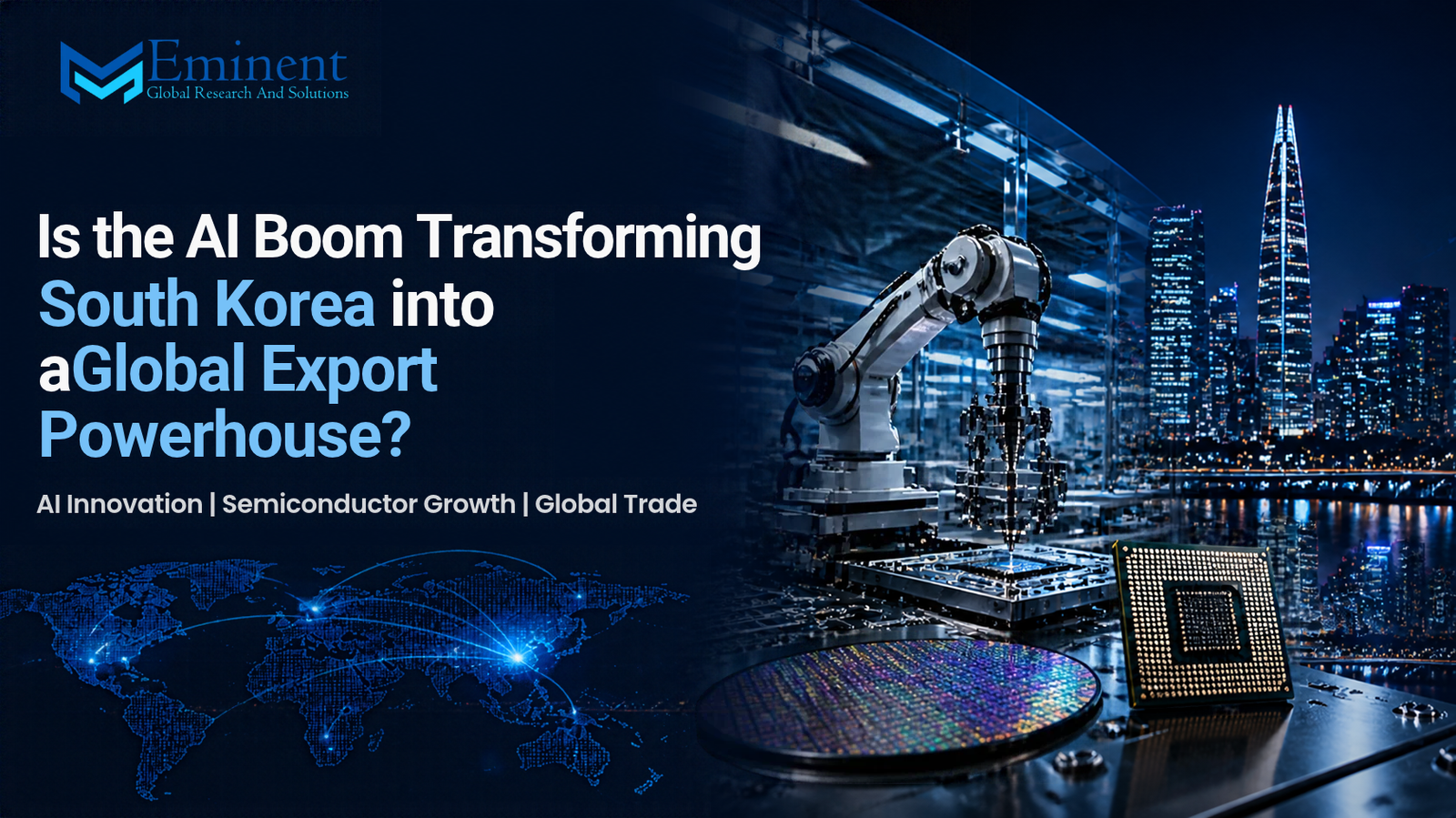
Is the AI Boom Transforming South Korea into a Global Export Powerhouse?
Published Date: 19 November 2026
Category: Electronics & IT | Semiconductors | Global Trade
Introduction
Artificial intelligence is changing the global technology industry, creating new demand for semiconductors, advanced computing systems, data centres, and high-performance memory chips. As businesses and governments increase their investments in AI infrastructure, countries with strong semiconductor manufacturing capabilities are gaining new opportunities in international markets.
South Korea is among the countries benefiting from this growing demand. On 19 November 2026, the country achieved a major economic milestone when its cumulative exports crossed US$1 trillion for the first time. Strong semiconductor shipments, particularly those supporting AI infrastructure, played a significant role in this achievement.
This development highlights how AI is influencing international trade and reshaping the position of technology-driven economies. It also raises an important question: Can South Korea maintain this export momentum and strengthen its position as a global manufacturing and technology powerhouse?
How Is the AI Boom Driving South Korea’s Export Growth?
The global expansion of artificial intelligence has increased demand for advanced semiconductor components. AI data centres require powerful processors, high-capacity memory, storage systems, and specialised electronic components to handle increasingly complex workloads.
South Korea has an established position in semiconductor manufacturing, supported by major technology companies and a developed industrial ecosystem. As international technology companies expand their AI infrastructure, demand for South Korean memory chips and related products has increased.
According to reported trade figures, semiconductor exports reached approximately US$396.8 billion during January–October 2026, accounting for around 42.7% of South Korea’s total exports during that period.
This growth demonstrates how developments in the AI industry are creating opportunities beyond software and digital services. Semiconductor manufacturers, equipment suppliers, electronics companies, and logistics providers are also benefiting from rising investment in AI infrastructure.
The Role of Semiconductor Manufacturers in Global Trade
South Korea’s semiconductor industry is central to its growing influence in international markets. Companies such as Samsung Electronics and SK Hynix are important suppliers in the global memory semiconductor market.
As AI models become more advanced, demand for high-bandwidth memory (HBM), DRAM, NAND storage, and other specialised semiconductor products continues to attract industry attention.
Several factors are supporting this growth:
- AI Infrastructure Investment: Technology companies are increasing spending on data centres and computing infrastructure.
- High-Performance Memory Demand: Advanced AI systems require faster and more efficient memory solutions.
- Data Centre Expansion: Growing cloud computing and AI workloads are increasing demand for storage and semiconductor components.
- Manufacturing Capabilities: South Korea’s established semiconductor ecosystem supports large-scale production and technology development.
- Global Technology Competition: Companies are investing in advanced chips to improve computing performance and strengthen their market positions.
These developments are creating opportunities for South Korean manufacturers while increasing the country’s importance in global technology supply chains.
Beyond Semiconductors: Other Industries Supporting Export Growth
Although semiconductors have been the strongest driver of recent export growth, South Korea’s international trade performance is not limited to the electronics industry.
Several other sectors are contributing to its export economy.
Automotive and Industrial Manufacturing
South Korea has a well-developed automotive manufacturing industry with established international markets. Vehicle manufacturers and their suppliers continue to play an important role in the country’s industrial ecosystem.
However, automotive exports face challenges from changing trade policies, international competition, and the transition towards electric and software-defined vehicles.
Shipbuilding and Heavy Engineering
South Korea remains an important player in global shipbuilding and marine engineering. Demand for specialised vessels, LNG carriers, and advanced maritime technologies creates opportunities for shipbuilders and industrial suppliers.
Cosmetics and Consumer Goods
South Korean cosmetics, skincare products, and other consumer goods have gained international attention. Growing interest in Korean brands is supporting export opportunities across Asia, North America, Europe, and other markets.
Pharmaceuticals and Biotechnology
The pharmaceutical and biotechnology industries are also becoming important areas of export development. Demand for advanced healthcare products, biopharmaceutical manufacturing, and specialised medical technologies offers opportunities for companies seeking to expand internationally.
Diversification across these sectors could help South Korea reduce its dependence on semiconductor exports over the longer term.
How Is AI Reshaping South Korea’s Manufacturing Industry?
Artificial intelligence is influencing more than semiconductor demand. It is also changing how manufacturers design products, manage production, maintain equipment, and organise supply chains.
South Korean manufacturers are increasingly operating in an environment where digital technologies and industrial capabilities are closely connected.
Some important developments include:
Smart Manufacturing: AI-powered systems can help manufacturers monitor production processes, identify inefficiencies, and improve operational performance.
Predictive Maintenance: Machine-learning applications can analyse equipment data to identify potential failures before they disrupt production.
Industrial Robotics: Automation technologies are helping manufacturers improve precision, productivity, and production consistency.
Digital Supply Chains: Data analytics and AI-based forecasting can support inventory planning, logistics management, and demand forecasting.
Advanced Quality Control: AI-powered inspection systems can identify manufacturing defects and improve product quality.
These technologies could strengthen South Korea’s industrial competitiveness while creating opportunities for technology providers, automation companies, and industrial equipment manufacturers.
What Opportunities Does South Korea’s Export Growth Create for Global Businesses?
South Korea’s expanding export activity creates opportunities across multiple industries and international markets.
For businesses and investors, the development of its AI-driven semiconductor ecosystem presents several areas worth monitoring.
- Semiconductor Equipment: Growing chip production creates demand for advanced manufacturing equipment and specialised components.
- Materials and Chemicals: Semiconductor fabrication requires specialised chemicals, gases, wafers, and other production materials.
- Data Centre Infrastructure: AI expansion creates opportunities in servers, storage systems, cooling technologies, power equipment, and networking solutions.
- Industrial Automation: Manufacturers may increase investment in robotics, sensors, and intelligent production systems.
- Logistics and Supply Chain Services: Higher international shipments create opportunities for shipping, warehousing, and supply chain management providers.
- Technology Partnerships: International businesses may explore partnerships with South Korean manufacturers and technology companies.
For international suppliers, understanding South Korea’s industrial ecosystem can help identify potential customers, technology partnerships, and emerging investment opportunities.
Major Challenges Facing South Korea’s Export Economy
Despite its strong export performance, South Korea faces several challenges that could influence its future economic position.
Heavy Dependence on Semiconductor Exports
The semiconductor industry represents a substantial share of the country’s export earnings. This creates exposure to changes in global chip demand, pricing, and technology investment cycles.
If AI infrastructure investment slows or semiconductor prices decline, export growth could face pressure.
Global Trade Uncertainty
Changing tariffs, trade restrictions, and geopolitical tensions can affect international supply chains. Export-dependent manufacturers must continue adapting to changing trade conditions and market requirements.
Increasing International Competition
Countries across Asia, North America, and Europe are investing heavily in semiconductor manufacturing and advanced technologies. South Korean companies will need to maintain their technological advantages to remain competitive.
Uneven Economic Benefits
Strong export figures do not automatically translate into higher household income or stronger domestic consumption. The challenge will be ensuring that export growth creates wider economic benefits through employment, investment, and regional development.
Technology and Supply Chain Risks
Semiconductor production depends on specialised equipment, materials, energy, and international suppliers. Disruptions in any part of this ecosystem can affect production schedules and manufacturing costs.
Addressing these challenges will be important for maintaining long-term export competitiveness.
What Does the Future Hold for South Korea’s Global Export Position?
The future of South Korea’s export economy will be closely connected to the development of artificial intelligence, semiconductor manufacturing, and advanced industrial technologies.
Continued investment in AI data centres and high-performance computing could support demand for advanced memory chips and related electronic products.
At the same time, South Korea may need to strengthen other industries to maintain a more balanced export structure. Biotechnology, defence manufacturing, nuclear technology, electric vehicles, shipbuilding, and consumer products could become important areas of future growth.
Investment in research and development, skilled professionals, domestic supply chains, and international partnerships will also influence the country’s ability to compete in global markets.
The recent US$1 trillion export milestone represents a significant achievement, but maintaining this performance will require more than strong semiconductor demand. Long-term competitiveness will depend on innovation, industrial diversification, and the ability to respond to changing global market conditions.
What Eminent Global Research Solutions Provides
At Eminent Global Research Solutions, we help businesses and investors understand changing market conditions and identify opportunities across the global technology and manufacturing landscape.
Our research capabilities include:
- Market Research & Analysis: Understanding global semiconductor demand, industry developments, and market opportunities.
- Industry Forecasting: Evaluating future trends in AI infrastructure, electronics, and advanced manufacturing.
- Competitive Intelligence: Assessing major industry players, competitive positioning, and market strategies.
- Technology Assessment: Analysing developments in AI chips, semiconductor manufacturing, automation, and digital technologies.
- Investment Opportunity Assessment: Identifying emerging investment areas across semiconductor equipment, materials, and industrial infrastructure.
- Supply Chain Analysis: Evaluating sourcing strategies, manufacturing dependencies, and international supply chain developments.
- Strategic Consulting: Supporting business decisions related to market entry, expansion, partnerships, and long-term growth.
Through data-driven research and industry insights, we support organisations in making informed decisions in an increasingly competitive global business environment.
Conclusion
South Korea’s achievement of crossing US$1 trillion in cumulative exports reflects the growing influence of artificial intelligence on global trade. Strong semiconductor demand and expanding investment in AI infrastructure have helped strengthen the country’s position in the international technology market.
However, the long-term outlook will depend on how effectively South Korea manages semiconductor market fluctuations, international competition, trade uncertainty, and its dependence on a relatively concentrated group of export industries.
For global businesses and investors, South Korea’s changing export landscape offers important opportunities across semiconductors, advanced manufacturing, AI infrastructure, and industrial technologies.
As artificial intelligence continues to reshape the global economy, South Korea’s ability to combine technological innovation with industrial diversification will be an important factor in determining its future as a global export powerhouse.
Post a Comment