

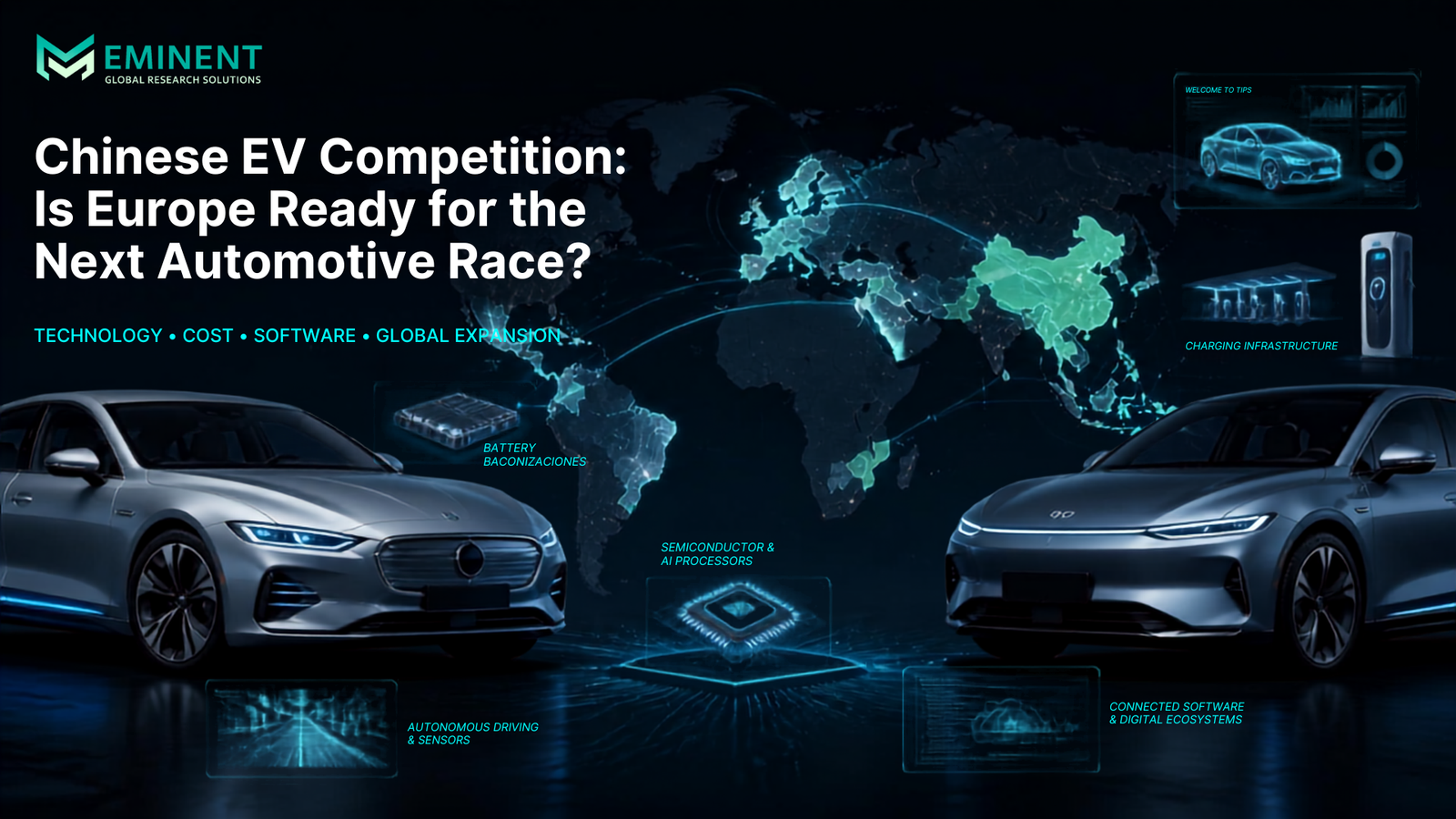
The global automotive industry is entering a period of structural change. Electric vehicles (EVs), battery technology, software-defined vehicles, connected mobility, and increasingly competitive Asian manufacturers are reshaping the traditional automotive value chain.
Among the most important developments is the growing international presence of Chinese EV manufacturers. Companies such as BYD, SAIC, Geely, NIO, XPeng, and others have expanded beyond their domestic market, increasing competitive pressure on established European automakers.
For European automotive companies, the challenge extends beyond vehicle pricing. Chinese manufacturers are increasingly competing through battery technology, manufacturing efficiency, product development speed, digital features, and aggressive international expansion.
This raises a critical strategic question:
Will Chinese EV competition force European automakers to fundamentally rethink their global growth strategy?
The answer is increasingly likely to be yes.
From Cost Competition to Technology Competition
Chinese automakers were initially associated primarily with cost advantages. However, their competitive positioning has evolved considerably.
Many Chinese EV manufacturers have developed capabilities across the entire electric vehicle ecosystem, including batteries, power electronics, software, vehicle platforms, and intelligent driving technologies.
This vertical integration can provide advantages in development speed and cost control.
Battery technology is particularly important. Since batteries represent one of the largest components of EV manufacturing costs, access to competitive battery technology and supply chains can materially influence vehicle pricing.
Chinese companies have also demonstrated the ability to launch new models rapidly and respond quickly to changing consumer preferences.
European automakers therefore face competition not simply from lower-cost vehicles, but from companies increasingly capable of competing on technology, design, features, and customer experience.
Europe’s Traditional Automotive Advantage Is Under Pressure
European automakers have historically benefited from strong brands, engineering expertise, premium positioning, established dealer networks, and decades of customer loyalty.
These remain valuable competitive assets.
However, EVs fundamentally change the economics and technology architecture of automobiles.
Electric powertrains contain fewer mechanical components than traditional internal combustion engines. Software is becoming increasingly important to vehicle functionality. Battery performance influences range, charging speed, and cost.
This means some traditional sources of automotive differentiation are becoming less decisive.
The competitive battlefield is shifting toward:
- Battery efficiency
- Software and connectivity
- AI-enabled driving functions
- Vehicle operating systems
- Charging ecosystems
- Manufacturing efficiency
- Digital customer experience
- Speed of innovation
European companies therefore need to determine which legacy capabilities remain strategic and which must be redesigned.
Global Expansion Is Becoming More Complicated
Chinese EV competition also creates a strategic challenge around international market expansion.
European automakers have traditionally operated globally, with strong positions across Europe, China, North America, and other emerging markets.
However, Chinese manufacturers are increasingly pursuing similar geographic opportunities.
This creates a new dynamic: European companies are no longer simply expanding into emerging markets; they may be competing against highly ambitious regional and global EV players in those same markets.
Markets across Southeast Asia, the Middle East, Latin America, and parts of Africa could become particularly important battlegrounds.
For European automakers, geographic strategy therefore needs to move beyond simply asking:
“Where is EV demand growing?”
The more important question is:
“Where can we establish a sustainable competitive advantage?”
This requires detailed analysis of consumer preferences, tariffs, local manufacturing economics, charging infrastructure, regulatory policy, competitive intensity, and supply-chain accessibility.
Market Localization Could Become Essential
A global EV strategy cannot necessarily rely on a single standardized product strategy.
Consumer preferences vary significantly between markets.
Range expectations, vehicle size, pricing, charging infrastructure, government incentives, road conditions, and technology adoption can differ substantially across regions.
European automakers may therefore need to increase localization of:
- Product portfolios
- Pricing strategies
- Manufacturing
- Supply chains
- Partnerships
- Digital services
- Distribution models
Strategic partnerships with local manufacturers, technology providers, battery companies, and charging networks could become increasingly important.
For example, establishing regional production capabilities can potentially reduce logistics costs, improve regulatory alignment, and strengthen market responsiveness.
The winning strategy may therefore combine global technology platforms with localized commercialization models.
The Battery Supply Chain Is a Strategic Battlefield
The EV transition has transformed the battery from a component into a strategic asset.
Access to battery materials, cell manufacturing, battery management systems, and recycling infrastructure can influence the competitiveness of entire automotive portfolios.
European automakers therefore need to consider the resilience of their battery supply chains alongside vehicle development.
Key strategic questions include:
- How secure is access to critical minerals?
- Should battery manufacturing be vertically integrated?
- Which battery technologies offer the strongest cost-performance balance?
- How quickly can alternative chemistries be commercialized?
- Can battery recycling create a strategic advantage?
- How much regional manufacturing capacity is required?
These questions increasingly belong at the corporate strategy level rather than solely within procurement departments.
Software Is Becoming a New Competitive Frontier
Another major shift is the increasing importance of software-defined vehicles.
Future vehicles will increasingly rely on software for infotainment, driver assistance, personalization, connectivity, vehicle management, and potentially autonomous driving.
This creates a challenge for traditional automakers whose organizational structures were historically optimized around mechanical engineering and manufacturing.
Chinese EV manufacturers have demonstrated strong capabilities in integrating digital interfaces, connected services, and intelligent vehicle features.
European automakers may therefore need to accelerate investment in:
AI + software + connected vehicles + digital ecosystems.
The competitive advantage of the future may depend less on who can manufacture the best physical vehicle and more on who can continuously improve the vehicle after it leaves the factory.
Pricing Pressure Could Reshape Premium Segments
European brands have traditionally commanded premium prices based on engineering, brand heritage, quality, and design.
However, Chinese manufacturers are increasingly offering advanced EV features at competitive price points.
This creates a difficult strategic dilemma.
European automakers could respond through aggressive price competition, but doing so may damage margins and weaken premium brand positioning.
Alternatively, they can differentiate through:
- Superior design
- Safety
- Brand heritage
- Software experience
- Advanced driving technologies
- Premium customer service
- Sustainability
- Product quality
The strategic challenge is identifying which attributes consumers are actually willing to pay for.
This is where market intelligence becomes particularly important.
Regulation Creates Both Risk and Opportunity
Trade policy and regulatory frameworks will play a major role in shaping global EV competition.
Tariffs, local-content requirements, emissions regulations, government incentives, and industrial policies can influence the relative competitiveness of manufacturers.
European automakers therefore need to incorporate regulatory intelligence directly into their international strategy.
Regulatory changes can affect:
- Vehicle pricing
- Market-entry decisions
- Manufacturing locations
- Supply-chain structures
- Battery sourcing
- Investment priorities
Companies that anticipate regulatory changes rather than simply react to them may gain a meaningful strategic advantage.
What Should European Automakers Do?
European automakers should not view Chinese EV competition solely as a threat.
It can also serve as a catalyst for transformation.
A robust strategic response could include five priorities:
1. Strengthen EV cost competitiveness
Improve manufacturing productivity, battery economics, and supply-chain efficiency.
2. Accelerate software capabilities
Develop stronger internal software and AI capabilities while selectively partnering with technology companies.
3. Reevaluate global markets
Prioritize markets based on competitive attractiveness, profitability, regulatory conditions, and long-term EV adoption.
4. Build resilient battery ecosystems
Develop diversified sourcing, regional manufacturing, recycling, and technology partnerships.
5. Strengthen market intelligence
Continuously monitor competitor launches, pricing, consumer preferences, technology developments, regulatory changes, and investment activity.
The Strategic Outlook
Chinese EV competition is unlikely to be a temporary disruption. It represents a structural change in the global automotive competitive landscape.
European automakers still possess significant advantages in engineering, brand equity, safety, design, manufacturing expertise, and global distribution. But maintaining those advantages will require adaptation.
The next phase of automotive competition will be determined by a combination of technology, cost, speed, software, supply-chain resilience, and geographic strategy.
For European automakers, the strategic question is therefore not simply how to defend existing market share.
It is how to redesign the global automotive business for an EV market in which competitive boundaries are changing rapidly.
Companies that combine strong technology capabilities with sophisticated market intelligence and localized commercialization strategies may be best positioned to compete.
For Eminent Global Research Solutions, this represents a significant opportunity for strategic advisory across market intelligence, competitive intelligence, technology intelligence, IP intelligence, market entry, and commercialization strategy.
The future automotive winners may not necessarily be the companies with the longest history.
They may be the companies that can adapt fastest to the new competitive landscape.