

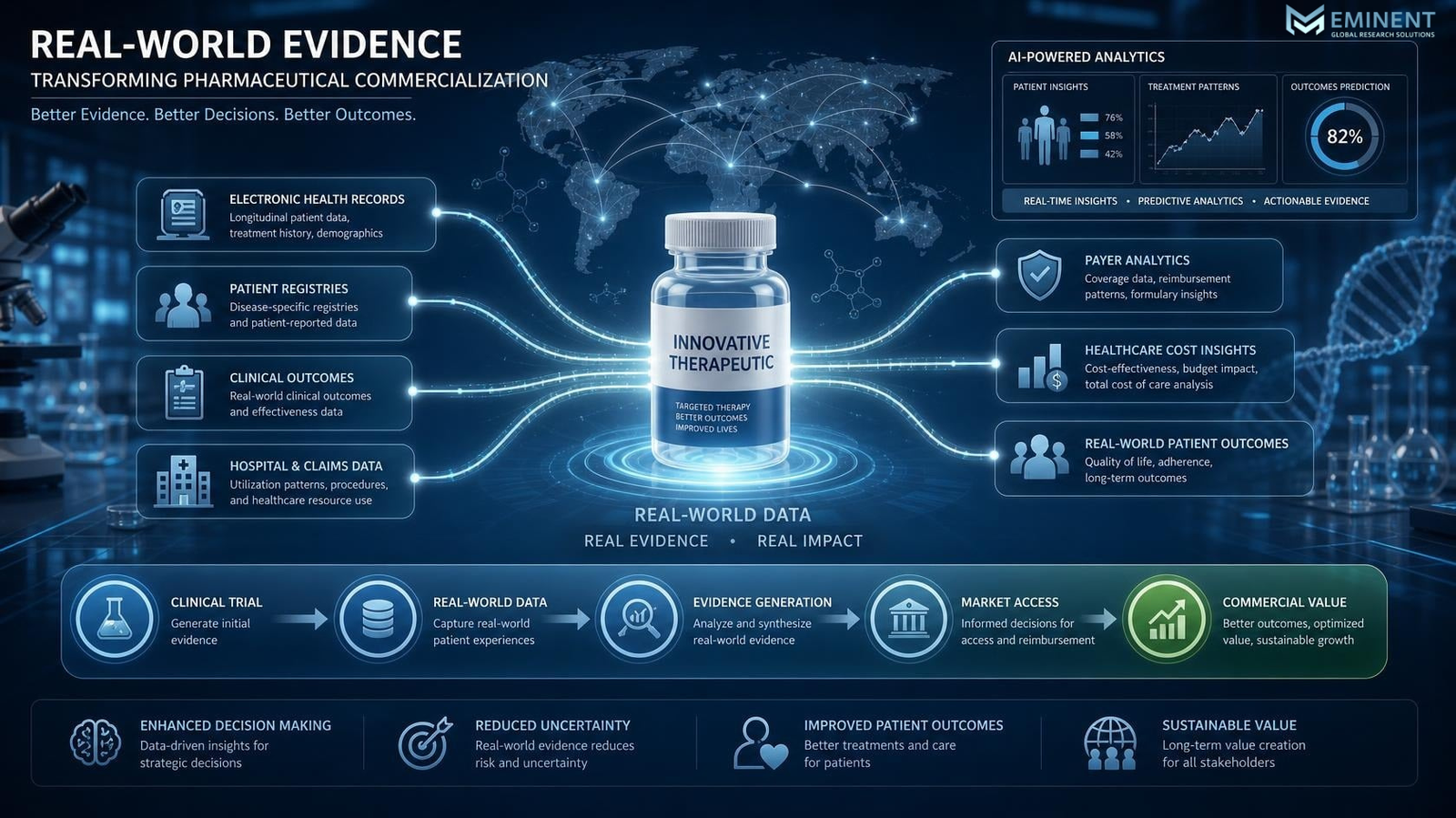
The pharmaceutical industry is entering an era where clinical trial data alone may no longer be sufficient to demonstrate the full value of a medicine.
For decades, randomized controlled trials have remained the gold standard for demonstrating safety and efficacy. They provide the controlled evidence required to support regulatory decisions and establish whether a treatment works under defined clinical conditions.
But pharmaceutical commercialization does not take place in a controlled clinical trial environment.
Once a medicine reaches the real world, patients differ, treatment patterns change, healthcare systems vary, and long-term outcomes become increasingly important. This is where Real-World Evidence (RWE) is becoming strategically important.
Real-World Evidence generated from real-world data can provide insights into how therapies perform across broader patient populations, how physicians use them, how patients respond over time, and what value they create for healthcare systems.
As healthcare becomes increasingly focused on outcomes, value, and cost-effectiveness, RWE is evolving from a supporting source of information into a potential commercial asset.
For pharmaceutical companies, the question is no longer simply whether they have enough clinical data. The more strategic question is whether they can transform real-world data into actionable evidence that supports regulatory decisions, market access, reimbursement, and commercial growth.
From Clinical Efficacy to Real-World Value
Traditional clinical trials answer an essential question: Does the therapy demonstrate safety and efficacy under controlled conditions?
Commercial stakeholders increasingly need answers to additional questions:
How does the therapy perform across diverse patient populations?
Does it reduce hospitalization or other healthcare utilization?
How does it affect treatment adherence?
Can it improve quality of life?
Does it deliver economic value to healthcare systems?
How does it perform compared with existing standards of care?
RWE can help address these questions.
By analyzing healthcare databases, electronic health records, insurance claims, patient registries, digital health platforms, and other sources, pharmaceutical companies can develop a more comprehensive understanding of treatment performance outside traditional trials.
This information can become particularly valuable for therapies targeting complex diseases, chronic conditions, rare diseases, and patient populations that may be underrepresented in conventional trials.
Why RWE Is Becoming Commercially Important
The growing importance of RWE is closely connected to the changing economics of healthcare.
Healthcare payers are under increasing pressure to manage expenditure while improving patient outcomes. As innovative therapies become more sophisticated—and often more expensive—payers increasingly want evidence demonstrating long-term value.
A strong clinical trial result may establish efficacy, but commercial stakeholders often need broader evidence to understand economic and practical impact.
RWE can help pharmaceutical companies demonstrate value across several dimensions:
Clinical outcomes
Healthcare resource utilization
Treatment persistence
Patient adherence
Comparative effectiveness
Quality-of-life outcomes
Healthcare cost implications
This makes RWE increasingly relevant to pricing and reimbursement strategies.
For pharmaceutical companies launching innovative therapies, the ability to generate credible evidence beyond the clinical development program can strengthen the overall value proposition.
RWE Across the Pharmaceutical Lifecycle
Another reason RWE is becoming strategically important is its applicability across the entire product lifecycle.
During early development, real-world data can help companies understand disease populations, treatment patterns, unmet needs, and potential patient segments.
During clinical development, RWE can support trial design and patient identification while providing insights into treatment pathways.
Following regulatory approval, evidence generated from routine clinical practice can help companies understand how their products perform in broader populations.
Later in the product lifecycle, RWE can support label expansion strategies, market access discussions, comparative effectiveness assessments, and portfolio decisions.
This creates an important shift: evidence generation is no longer limited to the period immediately preceding regulatory approval.
Instead, pharmaceutical companies can build continuous evidence-generation strategies throughout a product’s lifecycle.
Market Access May Become the Biggest RWE Opportunity
One of the most important applications of RWE is market access.
Obtaining regulatory approval does not automatically guarantee commercial success. A medicine must also secure reimbursement, demonstrate value to payers, and achieve adoption among healthcare providers.
This is particularly important for high-cost therapies such as specialty medicines, biologics, cell and gene therapies, and precision medicines.
For these products, payers may want to understand long-term outcomes that are difficult to capture within relatively short clinical trials.
RWE can help build this evidence base.
Pharmaceutical companies that develop market access strategies early—and align evidence generation with payer requirements—may be better positioned to reduce reimbursement uncertainty.
This represents a major opportunity for pharmaceutical strategy teams.
Instead of asking what evidence is required after approval, companies can begin asking much earlier:
What evidence will stakeholders need to adopt, reimburse, and continue using this therapy?
That shift can fundamentally change commercialization planning.
The Growing Role of Data and Technology
The expansion of RWE is also being accelerated by advances in data infrastructure and analytics.
Healthcare systems are generating enormous volumes of information through electronic health records, claims databases, registries, wearable devices, digital therapeutics, and patient engagement platforms.
Artificial intelligence and advanced analytics can increasingly identify patterns within these datasets that would be difficult to detect through traditional analysis.
However, more data does not automatically mean better evidence.
Data quality, interoperability, patient privacy, statistical methodology, bias, and representativeness remain significant challenges.
Pharmaceutical companies therefore need sophisticated capabilities to determine which datasets are appropriate for specific strategic questions and how evidence should be generated and validated.
Challenges Pharma Companies Must Address
Despite its potential, RWE comes with significant challenges.
Different healthcare systems generate different types of data, making cross-market comparisons difficult. Data may also contain inconsistencies, missing information, or population biases.
Privacy and data governance are equally important.
Companies must ensure that data is collected, processed, and analyzed according to applicable regulatory and ethical requirements.
Another challenge is credibility.
Not every real-world dataset produces evidence strong enough to influence regulatory or reimbursement decisions. Pharmaceutical organizations must therefore invest in robust methodologies, transparent study designs, and appropriate analytical frameworks.
The competitive advantage will increasingly belong to companies that can distinguish between simply possessing data and generating decision-grade evidence.
What This Means for Pharmaceutical Strategy
The rise of RWE has important implications for pharmaceutical organizations.
First, evidence generation should become more closely integrated with commercial strategy.
Second, market access teams should work alongside clinical, regulatory, medical affairs, and data science functions much earlier in the product lifecycle.
Third, companies should identify the evidence gaps that could limit adoption before a product reaches the market.
Finally, pharmaceutical organizations should view RWE as an ongoing strategic capability rather than a one-time post-launch exercise.
The winners may not simply be companies with the largest datasets. They will be organizations capable of converting complex healthcare information into credible insights that influence decisions.
The Future of Pharmaceutical Commercialization
Real-World Evidence is unlikely to replace randomized clinical trials. Instead, it is becoming a complementary evidence layer that can help explain what happens when medicines move from controlled research environments into everyday healthcare.
As healthcare systems increasingly focus on value, outcomes, affordability, and patient-centered care, the importance of real-world evidence will continue to grow.
For pharmaceutical companies, RWE can support a more complete commercialization strategy—from clinical development and regulatory planning to pricing, reimbursement, market access, and lifecycle management.
The strategic opportunity is therefore much larger than data collection.
It is about building an evidence-driven commercialization model.
Companies that develop the ability to generate, interpret, and operationalize high-quality RWE may be better positioned to demonstrate product value, strengthen market access, optimize portfolios, and compete in an increasingly evidence-driven pharmaceutical market.
In the next generation of pharmaceutical commercialization, the most valuable asset may not simply be the medicine itself.
It may be the evidence that proves its value in the real world.