

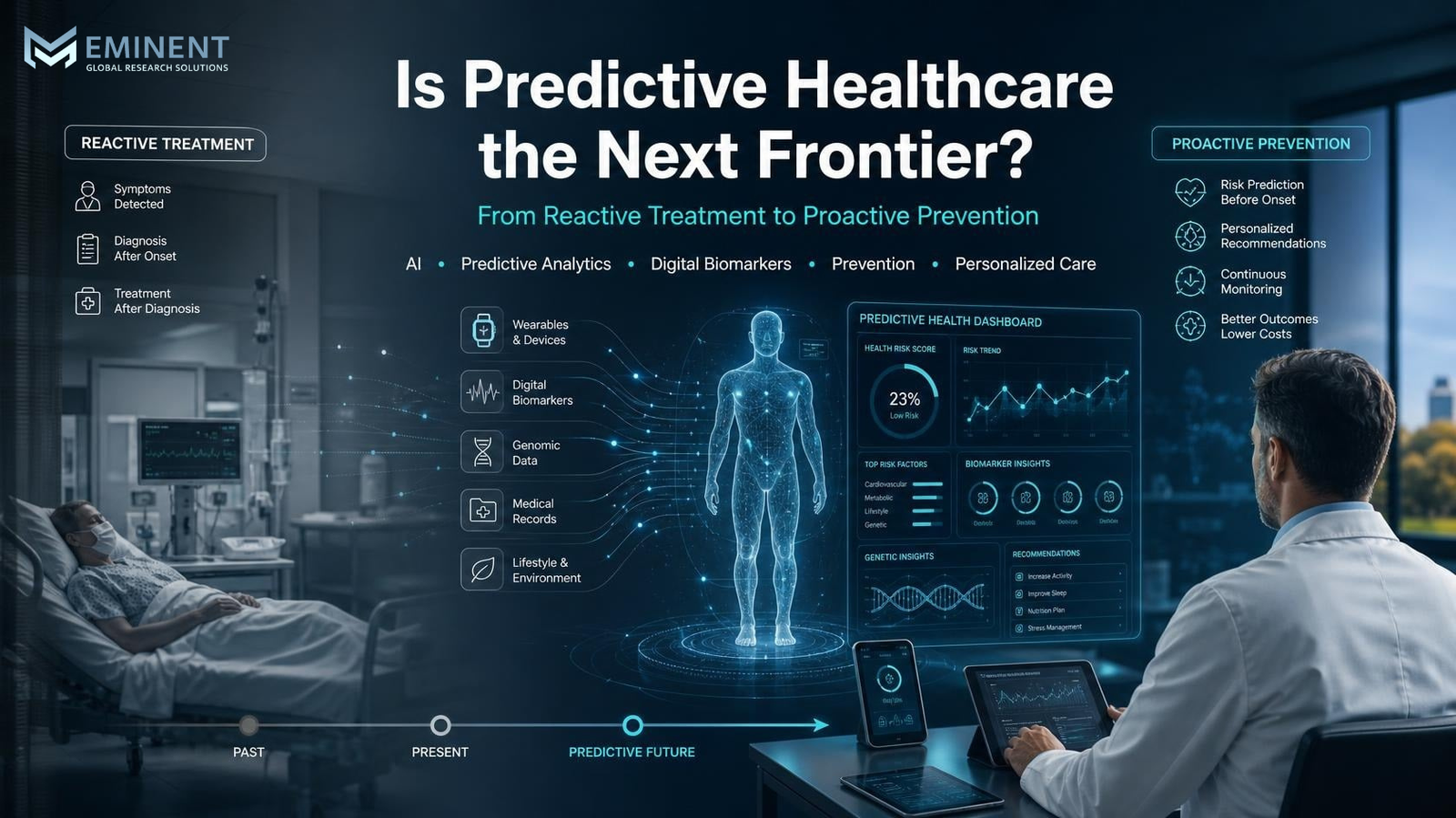
Healthcare is undergoing a fundamental shift from treating disease after it appears to identifying risks before they become serious clinical problems. Advances in artificial intelligence, predictive analytics, wearable technologies, digital biomarkers, genomics, and real-world data are creating the foundation for a new healthcare model: predictive healthcare.
Rather than relying exclusively on traditional diagnosis and treatment, predictive healthcare uses data to identify the probability of future health events and support earlier intervention.
This transformation has implications far beyond clinical practice. It could reshape healthcare commercialization by creating new markets around prevention, continuous monitoring, personalized interventions, and data-driven patient management.
For pharmaceutical companies, medical device manufacturers, digital health businesses, healthcare providers, insurers, and technology companies, predictive healthcare could become one of the most important growth opportunities of the next decade.
From Reactive Healthcare to Predictive Healthcare
Traditional healthcare is predominantly reactive.
A patient develops symptoms, visits a healthcare provider, undergoes diagnostic testing, receives a diagnosis, and then begins treatment. While this model remains essential, it often means that intervention occurs after a disease has already progressed.
Predictive healthcare introduces a different approach.
By analyzing multiple sources of information, including electronic health records, wearable devices, laboratory results, imaging data, genetic information, lifestyle patterns, and environmental factors AI systems can identify patterns associated with future health risks.
The objective is not simply to predict disease.
It is to enable healthcare organizations and patients to act earlier.
For example, predictive technologies could potentially identify individuals at elevated risk of cardiovascular complications, diabetes progression, hospital readmission, or other adverse outcomes. Earlier identification can create opportunities for preventive interventions, closer monitoring, lifestyle changes, or targeted treatment.
This changes the economic equation of healthcare.
The value proposition increasingly moves from treating expensive complications to preventing them.
Why Predictive Healthcare Is Becoming Commercially Attractive
The commercialization potential of predictive healthcare comes from the enormous economic burden associated with chronic diseases and avoidable healthcare events.
Healthcare systems worldwide face rising costs, aging populations, increasing chronic disease prevalence, and shortages of healthcare professionals.
Predictive technologies can potentially address several of these pressures simultaneously.
For healthcare providers, predictive analytics may improve resource allocation and patient management.
For insurers, it can support risk management and potentially reduce avoidable healthcare expenditure.
For pharmaceutical companies, predictive models can help identify patient populations that may benefit from earlier intervention or specific therapies.
For medical technology companies, predictive algorithms can create additional value around connected devices and monitoring platforms.
For digital health companies, predictive healthcare creates opportunities for subscription-based monitoring, personalized wellness services, and continuous patient engagement.
The result is an expanding commercial ecosystem rather than a single product category.
AI Is Becoming the Intelligence Layer of Healthcare
Artificial intelligence is central to this transformation because healthcare generates enormous volumes of complex data.
Traditional analytical methods often struggle to identify relationships across thousands or millions of data points. Modern AI systems can analyze large datasets and detect patterns that may be difficult to identify through conventional approaches.
The combination of AI with healthcare data could enable:
Earlier disease-risk identification
Personalized patient monitoring
Predictive hospital management
Clinical decision support
Remote patient monitoring
Personalized treatment strategies
Population health forecasting
However, successful commercialization will depend on more than algorithmic performance.
AI solutions must demonstrate clinical usefulness, integrate into existing workflows, meet regulatory expectations, and provide measurable economic value.
This is where technology commercialization becomes critical.
A technically impressive healthcare AI product may fail commercially if physicians do not use it, patients do not trust it, or healthcare organizations cannot integrate it into their existing infrastructure.
Wearables Are Expanding the Predictive Healthcare Ecosystem
The rapid growth of wearable devices is another important factor accelerating predictive healthcare.
Smartwatches, fitness trackers, continuous glucose monitors, connected medical devices, and other sensors can generate health-related information continuously rather than only during periodic clinical appointments.
This creates a fundamentally different healthcare data model.
Instead of receiving a snapshot of a patient’s health during a doctor’s visit, healthcare organizations could increasingly access longitudinal information reflecting changes over time.
Continuous data could help identify deviations from an individual’s baseline and potentially trigger earlier investigation.
For businesses, this creates opportunities to develop new services around monitoring, analytics, personalized recommendations, and preventive interventions.
The healthcare value chain could therefore evolve from episodic interactions toward continuous digital engagement.
Predictive Healthcare Could Reshape Pharmaceutical Commercialization
Pharmaceutical companies may be among the organizations most significantly affected by predictive healthcare.
Traditional pharmaceutical commercialization often focuses on identifying diagnosed patient populations and optimizing treatment adoption.
Predictive healthcare could expand the addressable market by identifying patients earlier in the disease journey.
This creates opportunities for pharmaceutical companies to develop broader patient-support ecosystems around their therapies.
Potential areas include:
Earlier patient identification
Digital patient engagement
Companion diagnostics
Remote monitoring
Treatment adherence programs
Real-world evidence generation
Personalized intervention pathways
The integration of predictive analytics with pharmaceutical commercialization could also strengthen evidence-generation strategies.
Companies could potentially use real-world data to understand treatment outcomes, identify unmet needs, and improve patient segmentation.
This could shift pharmaceutical commercialization from a product-centric model toward a more comprehensive patient-outcome-centric model.
The Market Access Opportunity
Predictive healthcare may also influence how healthcare technologies are evaluated by payers.
Historically, healthcare reimbursement has often focused on treatments and procedures delivered after a condition has been identified.
Predictive technologies challenge this framework because their value may come from preventing an event that never occurs.
That creates an important question:
How should healthcare systems pay for prevention?
To unlock the full commercial potential of predictive healthcare, companies may need to demonstrate economic outcomes such as reduced hospitalizations, improved treatment adherence, earlier diagnosis, or lower long-term healthcare costs.
This creates opportunities for outcomes-based reimbursement models and value-based healthcare partnerships.
Companies that can demonstrate measurable economic impact may have a stronger position when negotiating with healthcare providers, insurers, and government healthcare systems.
Trust, Privacy, and Regulation Will Determine Adoption
Predictive healthcare also introduces significant challenges.
Healthcare data is highly sensitive, and patients need confidence that their information is being handled responsibly.
Organizations must consider:
Data privacy
Cybersecurity
Algorithmic bias
Clinical validation
Regulatory compliance
Explainability
Patient consent
Data interoperability
Predictive models must also be carefully validated to ensure that predictions are clinically meaningful and do not create unnecessary interventions.
Trust will become a critical commercial asset.
Healthcare organizations that successfully combine technological innovation with transparency, security, and clinical credibility may gain stronger adoption than companies focused solely on technical capabilities.
What Should Healthcare Companies Do Now?
Organizations should begin evaluating predictive healthcare not simply as an emerging technology but as a potential transformation of their business models.
A strategic assessment should consider four areas.
First, identify high-value use cases. Companies should determine where prediction can create measurable clinical or economic value.
Second, evaluate data capabilities. Predictive healthcare depends on access to high-quality, interoperable data.
Third, develop commercialization pathways. Companies need clear strategies for clinical adoption, reimbursement, partnerships, and market access.
Fourth, build regulatory and trust frameworks early. Compliance, privacy, and clinical validation should be incorporated into product development from the beginning.
The companies that move beyond experimentation and develop scalable commercialization strategies may gain a significant first-mover advantage.
The Future of Healthcare Commercialization
Predictive healthcare could ultimately become one of the defining pillars of the next healthcare economy.
The industry is moving toward a model where healthcare becomes more continuous, personalized, data-driven, and preventive.
The winners will not necessarily be the companies with the most sophisticated algorithms.
They will be the organizations capable of connecting technology with clinical workflows, patient needs, regulatory requirements, and measurable economic outcomes.
For pharmaceutical companies, MedTech organizations, healthcare providers, insurers, and digital health businesses, predictive healthcare represents an opportunity to create new revenue models while improving healthcare efficiency.
The strategic question is therefore no longer whether predictive healthcare will influence the industry.
The more important question is:
Which companies will successfully commercialize it at scale?
For Eminent Global Research Solutions, this emerging market creates opportunities for organizations to evaluate technology landscapes, identify high-growth applications, assess competitive positioning, develop market-entry strategies, and build commercialization roadmaps for the predictive healthcare economy.