

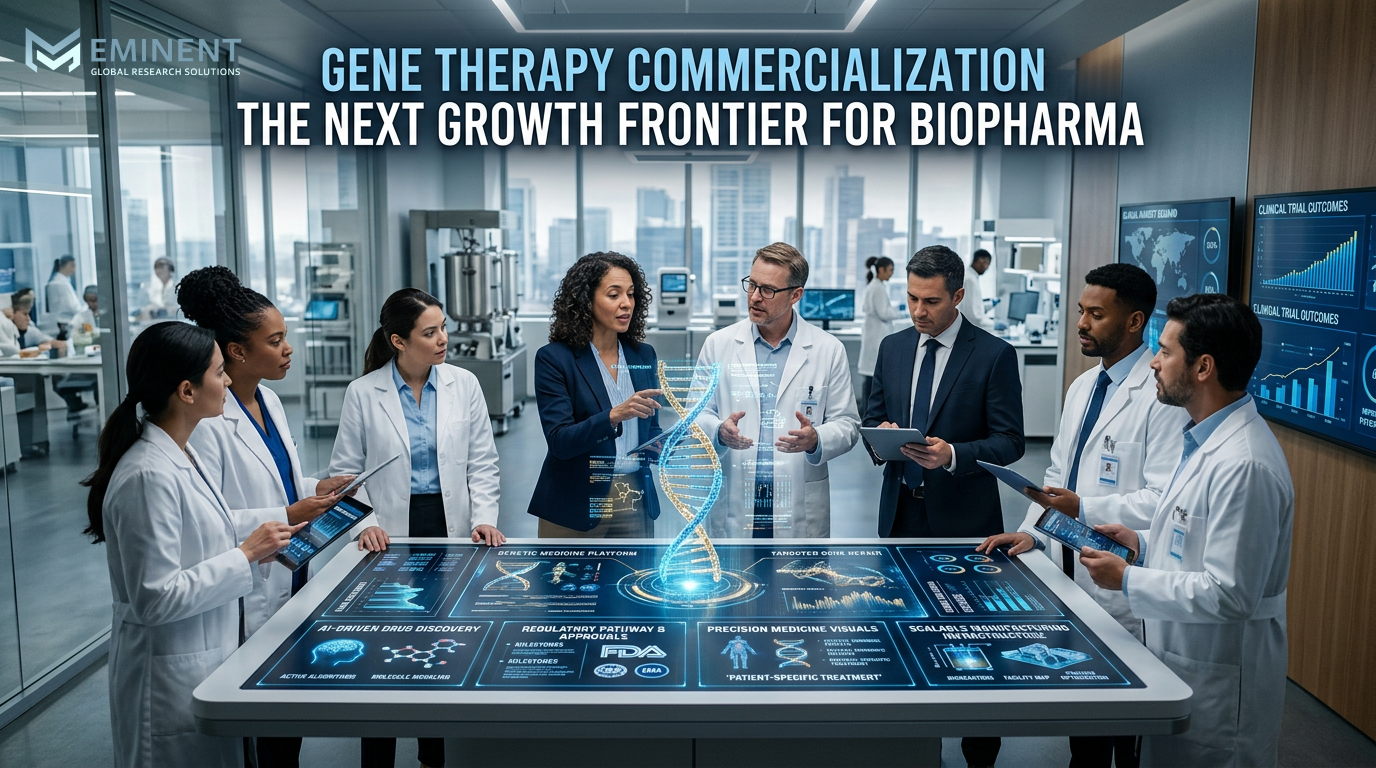
Is Gene Therapy Commercialization the Next Growth Frontier for Biopharma Companies?
For decades, the pharmaceutical industry has primarily focused on developing treatments that manage diseases rather than eliminate them. Patients with chronic conditions often rely on lifelong medications, creating established treatment pathways and predictable revenue models. Today, however, advances in genetic medicine are challenging this paradigm.
Gene therapy is emerging as one of the most transformative innovations in healthcare, offering the potential to address diseases at their genetic root. Instead of continuously treating symptoms, gene therapies aim to correct or replace faulty genes responsible for disease progression. The result is a new class of treatments that could deliver long-term, and in some cases potentially curative, outcomes through a single administration.
While the scientific promise of gene therapy has been discussed for years, recent regulatory approvals and clinical successes suggest that commercialization is becoming the industry’s next major challenge—and opportunity. For biopharma companies, the question is no longer whether gene therapy will become a significant market. The real question is whether organizations are prepared to commercialize these innovations at scale.
From Scientific Breakthrough to Commercial Reality
Gene therapy has moved beyond the experimental stage. Multiple therapies targeting rare genetic disorders, blood diseases, and inherited conditions have received regulatory approvals across major markets.
This progress demonstrates that scientific barriers are gradually being overcome. Improvements in viral vector technology, manufacturing processes, genomic research, and clinical trial design have accelerated the development pipeline significantly.
However, bringing a breakthrough therapy to market requires far more than scientific excellence. Commercial success depends on a company’s ability to navigate regulatory pathways, establish manufacturing capabilities, secure reimbursement, and ensure patient access.
Historically, many biotechnology companies focused heavily on research and development while relying on larger pharmaceutical partners for commercialization. As gene therapy matures, organizations increasingly need integrated strategies that combine innovation with operational execution.
The companies that successfully bridge this gap may become leaders in the next era of precision medicine.
Why Gene Therapy Represents a Unique Market Opportunity
Several factors make gene therapy particularly attractive from a long-term growth perspective.
First, many target indications involve significant unmet medical needs. Rare genetic disorders often have limited treatment options, creating strong demand from patients, healthcare providers, and advocacy organizations.
Second, gene therapies can potentially generate substantial clinical value. By addressing the underlying cause of disease, they may reduce long-term healthcare costs associated with chronic treatment, hospitalizations, and disease complications.
Third, demographic and technological trends continue to support market expansion. Advances in genomic sequencing, artificial intelligence, biomarker identification, and precision medicine are accelerating the identification of new therapeutic targets.
As a result, the potential application of gene therapy extends far beyond rare diseases. Future opportunities may include oncology, neurological disorders, cardiovascular diseases, ophthalmology, and metabolic conditions.
For biopharma companies, this creates a multi-billion-dollar growth opportunity that could redefine healthcare delivery over the next decade.
Commercialization Challenges Cannot Be Ignored
Despite its promise, gene therapy commercialization remains highly complex.
One of the most significant challenges is manufacturing.
Unlike traditional pharmaceuticals, gene therapies require sophisticated production processes involving viral vectors, cell engineering, specialized facilities, and rigorous quality controls. Manufacturing capacity remains limited, and scaling production efficiently continues to be a major industry hurdle.
Companies must also navigate complex regulatory requirements. Because gene therapies are relatively new, regulatory agencies continue refining frameworks to evaluate safety, efficacy, and long-term outcomes.
This environment rewards organizations that invest early in regulatory expertise and compliance infrastructure.
Another challenge involves market access.
Many gene therapies carry exceptionally high upfront costs due to extensive research, development, and manufacturing expenses. While these treatments may deliver long-term healthcare savings, healthcare systems often struggle with the immediate budget impact.
This creates ongoing discussions around innovative reimbursement models, outcomes-based contracts, and long-term value assessments.
Companies that proactively address these challenges are more likely to achieve sustainable commercial success.
The Shift Toward Value-Based Healthcare
Gene therapy is accelerating a broader transition toward value-based healthcare.
Traditional pharmaceutical pricing models are generally based on repeated product usage over time. Gene therapies disrupt this approach because their value is concentrated into a single treatment event.
This forces healthcare systems, insurers, and pharmaceutical companies to rethink how innovation is evaluated and reimbursed.
Increasingly, stakeholders are exploring payment structures tied to long-term patient outcomes. Under these models, reimbursement may depend on whether a therapy continues delivering clinical benefits over a defined period.
Such arrangements align financial incentives with patient outcomes and may help expand access to advanced therapies.
For biopharma companies, demonstrating real-world value is becoming just as important as demonstrating clinical efficacy.
Manufacturing Will Become a Competitive Differentiator
As more gene therapies move toward commercialization, manufacturing capabilities are emerging as a critical competitive advantage.
The industry is already experiencing increasing demand for specialized production facilities, viral vector manufacturing, cold-chain logistics, and advanced quality management systems.
Companies that establish scalable manufacturing ecosystems early may benefit from:
Faster product launches
Greater supply chain reliability
Improved cost efficiency
Enhanced regulatory compliance
Stronger market positioning
Many organizations are investing heavily in internal manufacturing infrastructure while also forming strategic partnerships with contract development and manufacturing organizations (CDMOs).
Over time, manufacturing excellence may become one of the primary factors separating market leaders from emerging competitors.
The Importance of Strategic Partnerships
No single company possesses all the capabilities required for successful gene therapy commercialization.
As a result, strategic partnerships are becoming increasingly important across the value chain.
Biopharma companies are collaborating with:
Academic research institutions
Biotechnology innovators
Manufacturing specialists
Healthcare providers
Diagnostic companies
Technology firms
These partnerships accelerate innovation, reduce development risk, and support faster market entry.
Organizations that build strong ecosystems around their gene therapy platforms may gain significant advantages as competition intensifies.
Looking Ahead
Gene therapy represents one of the most significant opportunities in modern healthcare. Scientific progress has brought the industry to a point where commercialization is becoming the next defining challenge.
Success will require more than breakthrough science. Companies must build capabilities in manufacturing, regulatory strategy, reimbursement planning, market access, and patient engagement.
The future winners in genetic medicine are unlikely to be those with the most promising technologies alone. Rather, they will be the organizations capable of transforming scientific innovation into scalable, accessible, and commercially sustainable healthcare solutions.
For biopharma leaders, gene therapy commercialization is not simply another product opportunity—it may represent the next major growth frontier shaping the future of the global pharmaceutical industry.
As healthcare increasingly moves toward precision medicine and potentially curative treatments, the companies that establish commercialization leadership today could define the competitive landscape for years to come.