

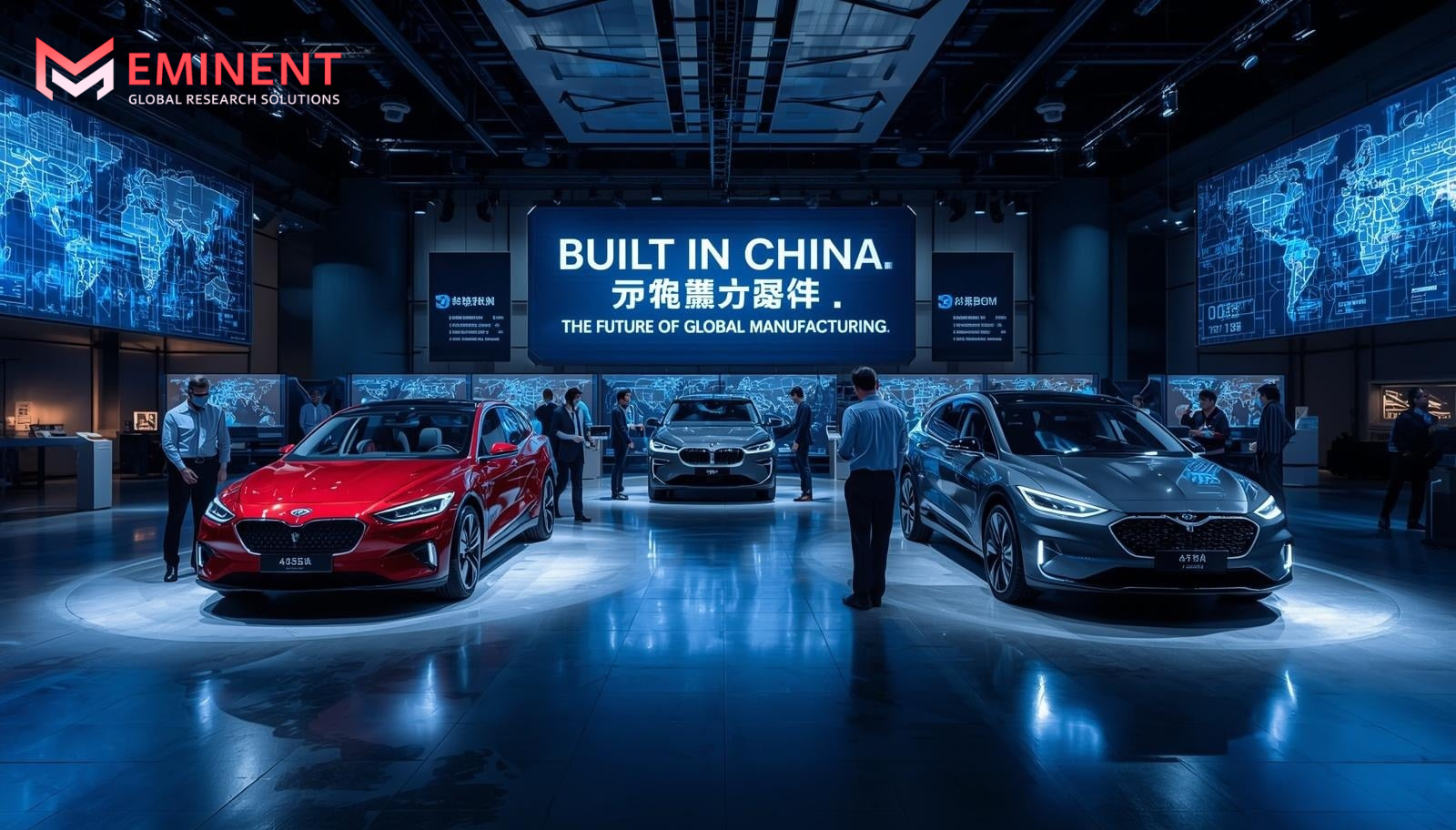
The Rise of a New Manufacturing Doctrine
For decades, global automotive manufacturing followed a relatively predictable model: design and engineering in headquarters markets (primarily the US, Germany, and Japan), followed by cost-optimized production in emerging economies. China, initially seen as a volume market, was largely treated as an extension of global demand—not as a center of innovation.
That model has fundamentally shifted.
Today, China is not just the world’s largest automotive market—it is also a leader in electric mobility, battery technology, smart vehicle ecosystems, and digital integration. The convergence of these factors has turned China into a global innovation hub, compelling multinational companies to rethink their operational strategies.
The messaging at the Beijing Auto Show made this clear: localization is no longer tactical—it is strategic.
“In China, For China”—What It Really Means
The phrase “in China, for China” represents more than just domestic manufacturing. It reflects a deeper transformation across three layers:
1. Product Development Localization
Global brands are increasingly designing vehicles specifically tailored to Chinese consumer preferences. These include:
- Advanced infotainment systems integrated with local digital ecosystems
- AI-powered driving assistance adapted to urban congestion patterns
- Luxury features aligned with younger, tech-savvy buyers
China’s consumers are among the most digitally mature in the world, demanding vehicles that behave more like smartphones than traditional automobiles.
2. Supply Chain Reinvention
China’s robust ecosystem—particularly in EV batteries, semiconductors, and rare earth materials—has enabled automakers to localize supply chains more efficiently than anywhere else.
This reduces:
- Production lead times
- Dependency on global logistics disruptions
- Exposure to geopolitical volatility
3. Speed to Market
Perhaps the most critical advantage is speed. Chinese manufacturers have set new benchmarks in product development cycles—sometimes launching new models in under 18 months.
Global OEMs are now adapting to this pace, establishing R&D centers within China to stay competitive.
Expanding the Vision: “For the World”
What makes this shift particularly significant is the extension of the strategy beyond domestic consumption.
China is now emerging as an export base for global markets, especially in electric vehicles.
Why China is Becoming a Global Export Hub:
- Cost-competitive EV production
- Advanced battery manufacturing capabilities
- Highly digitized production facilities
- Government support for clean mobility ecosystems
Companies like Ford are leveraging Chinese production lines to serve markets in Southeast Asia and Europe, while BMW continues to expand its export-oriented manufacturing footprint.
This marks a reversal of traditional flows—where innovation and exports once originated from the West and moved eastward.
The EV Revolution as a Catalyst
The global transition to electric vehicles is accelerating this manufacturing shift.
China accounts for a dominant share of:
- Global EV sales
- Battery production capacity
- Charging infrastructure deployment
This ecosystem creates a powerful incentive for global brands to anchor their EV strategies within China.
Moreover, domestic competitors such as BYD, NIO, and XPeng have raised the competitive bar, forcing international players to innovate faster and localize deeper.
Strategic Implications for Global Businesses
The “in China, for China and the world” model is not limited to the automotive sector—it signals a broader transformation applicable across industries.
1. Localization as a Competitive Advantage
Companies that fail to localize risk becoming irrelevant in high-growth markets.
2. Distributed Innovation Models
Innovation is no longer centralized. Leading firms are adopting multi-hub R&D strategies, with China as a critical node.
3. Supply Chain Resilience
Diversification is important—but so is depth. China’s integrated ecosystem offers a level of vertical efficiency that is difficult to replicate.
4. Market-Driven Product Design
Products are increasingly shaped by local consumer behavior rather than global standardization.
Challenges and Considerations
While the opportunity is immense, the strategy comes with complexities:
- Geopolitical tensions affecting trade policies
- Regulatory differences across markets
- Intellectual property considerations
- Balancing global brand identity with local adaptation
Companies must navigate these carefully while maintaining operational agility.
The Road Ahead
The announcements and positioning at the Beijing Auto Show signal a long-term shift—not a temporary trend.
China is evolving from:
- A manufacturing base → to an innovation hub
- A consumption market → to a global export engine
- A follower → to a leader in next-generation mobility
For global automakers, the question is no longer whether to localize—but how deeply and how quickly.
Eminent Global Research Solutions Perspective
At Eminent Global Research Solutions, we view this transformation as a defining moment in global industrial strategy.
The automotive sector is offering a blueprint for:
- Agile localization
- Innovation decentralization
- Market-driven product ecosystems
Organizations that embrace this shift will gain not only operational efficiency but also long-term strategic relevance in a rapidly evolving global economy.