

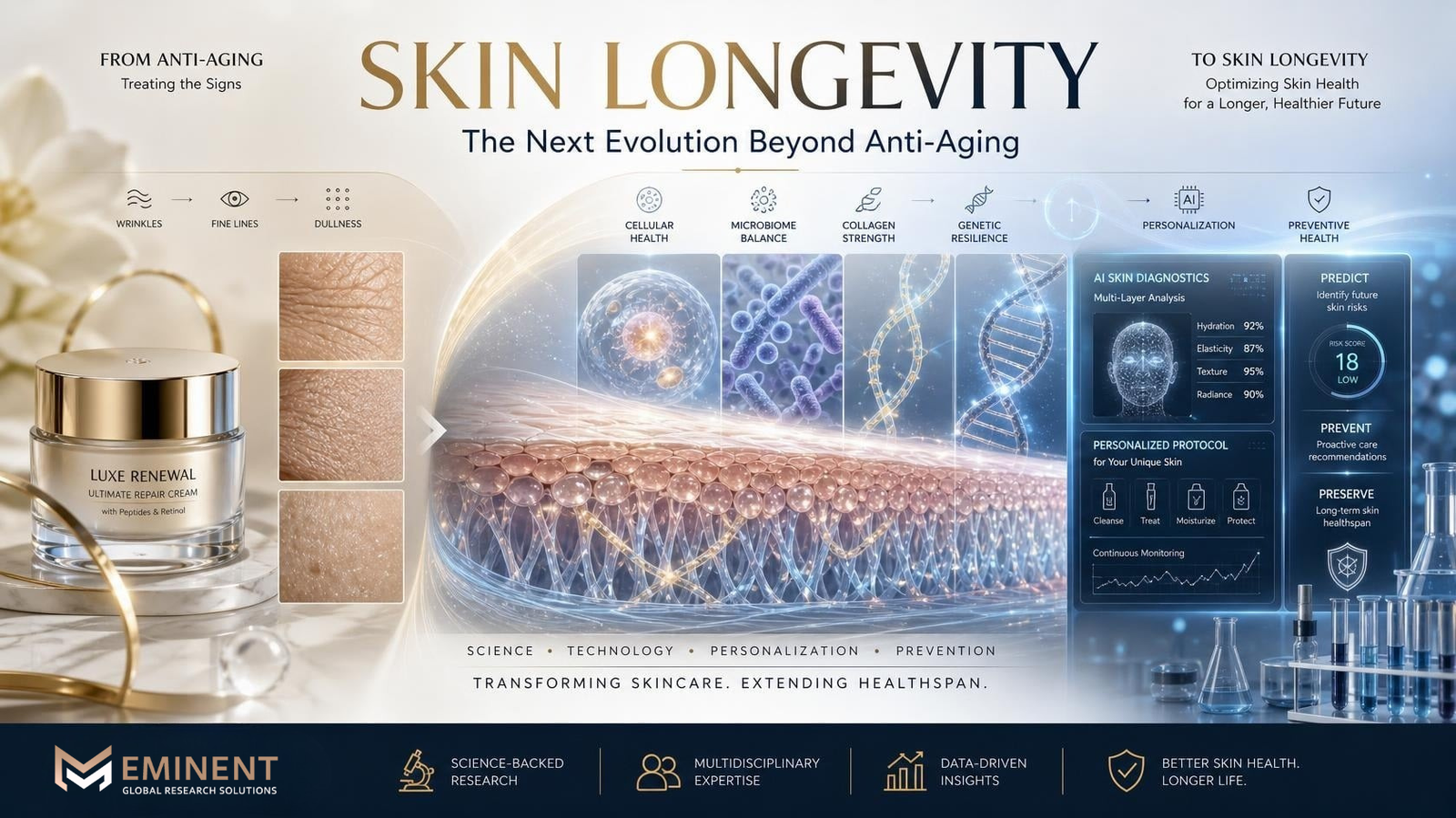
For decades, the beauty industry has been built around one dominant promise: anti-aging.
From wrinkle-reducing creams to collagen supplements and aesthetic procedures, much of the market has focused on reversing or concealing visible signs of aging. But consumer expectations are changing. A new concept is emerging that could reshape the industry: skin longevity.
Rather than asking how to make older skin look younger, consumers are increasingly interested in how to maintain healthy, resilient skin for longer.
This shift represents more than a change in terminology. It could signal the emergence of a new beauty category sitting at the intersection of skincare, biotechnology, preventive healthcare, nutrition, diagnostics, and wellness.
For beauty companies, ingredient manufacturers, investors, and healthcare innovators, the opportunity is significant. The brands that successfully transition from an “anti-aging” proposition toward measurable long-term skin health may be positioned to capture the next phase of premium beauty growth.
From Reversing Aging to Managing Skin Health
Traditional anti-aging products are largely centered on visible outcomes: reducing wrinkles, improving firmness, minimizing pigmentation, and restoring hydration.
Skin longevity takes a broader approach.
The objective is not necessarily to eliminate signs of aging but to support the biological processes that contribute to healthy skin over time.
This includes areas such as:
Skin barrier function
Cellular health
Collagen and elastin preservation
Oxidative stress
Inflammation
Skin microbiome balance
Environmental damage
Cellular senescence
Regenerative processes
This broader framework aligns closely with the growing longevity movement in healthcare and wellness.
Consumers are increasingly interested in extending their healthspan rather than simply increasing lifespan. The same philosophy is now moving into beauty: maintaining healthier skin for longer rather than waiting for visible aging and attempting to reverse it.
Why Skin Longevity Could Become a Major Beauty Opportunity
The traditional anti-aging market is already highly developed and competitive. Thousands of products make similar claims, making differentiation increasingly difficult.
Skin longevity provides companies with an opportunity to move beyond conventional product positioning.
Instead of simply selling a moisturizer or serum, brands could potentially build comprehensive skin health ecosystems around long-term maintenance.
These ecosystems could combine:
Advanced skincare + diagnostics + personalized recommendations + nutrition + digital monitoring + clinical research.
Such an approach could create recurring consumer relationships rather than individual product purchases.
For example, a future skin longevity platform could assess a consumer’s skin condition, environmental exposure, lifestyle factors, and biological indicators before recommending a personalized routine.
This creates opportunities for premium products, subscriptions, diagnostic services, personalized formulations, and digital engagement.
Biotechnology Could Accelerate the Transition
One of the biggest catalysts behind skin longevity is biotechnology.
Advances in biotechnology are enabling researchers to investigate the biological mechanisms behind skin aging with increasing precision.
Areas of interest include cellular senescence, regenerative biology, peptides, growth factors, microbiome science, epigenetics, and advanced delivery technologies.
These developments could lead to a new generation of cosmetic ingredients designed not merely to improve appearance but to support specific biological pathways associated with healthy skin.
For ingredient suppliers, this represents a major opportunity.
Instead of competing primarily on commodity ingredients, companies can develop differentiated, science-backed actives supported by laboratory research, clinical evidence, and measurable biological outcomes.
This could significantly increase the value of specialized cosmetic ingredients.
The Skin Microbiome Adds Another Dimension
The skin microbiome is becoming an increasingly important area of research.
The skin hosts complex communities of microorganisms that interact with the skin barrier and broader biological processes. Advances in microbiome research are creating opportunities for beauty companies to develop products focused on maintaining microbial balance rather than simply treating visible symptoms.
This could lead to new categories such as:
Microbiome-friendly skincare
Prebiotic formulations
Postbiotic ingredients
Personalized microbiome solutions
Microbiome diagnostics
The commercial potential is substantial because microbiome science allows companies to differentiate products through scientific platforms rather than traditional cosmetic claims.
It also strengthens the connection between beauty and healthcare.
Personalization Could Become the Next Competitive Advantage
Skin longevity is unlikely to be a one-size-fits-all market.
Skin aging varies significantly between individuals due to genetics, lifestyle, environmental exposure, nutrition, stress, sleep, and other factors.
This creates an opportunity for personalized skincare.
AI-powered skin analysis, digital diagnostics, imaging technologies, and potentially biomarker-based testing could help brands understand individual skin conditions and recommend targeted interventions.
Instead of selling the same anti-aging serum to millions of consumers, companies could eventually provide personalized skin longevity programs.
This could fundamentally change the consumer journey.
The model could move from:
Product → Purchase → Occasional Use
toward:
Assessment → Personalization → Treatment → Monitoring → Optimization
For brands, this creates stronger engagement and potentially higher customer lifetime value.
Premiumization Through Scientific Credibility
Consumers are increasingly willing to pay premium prices when they perceive meaningful scientific value.
Skin longevity could accelerate this premiumization trend.
Products supported by clinical studies, advanced biotechnology, diagnostic capabilities, and measurable outcomes may command higher prices than conventional skincare products.
However, scientific positioning also creates greater responsibility.
Companies will need to ensure that claims are supported by appropriate evidence and that communication does not overstate biological benefits.
Regulatory strategy, clinical research, ingredient substantiation, and transparent consumer communication will therefore become increasingly important.
For beauty companies, science can create differentiation—but only when credibility accompanies the claim.
Beauty and Healthcare Are Moving Closer Together
Perhaps the biggest implication of skin longevity is the potential convergence between beauty and healthcare.
Historically, these industries operated largely independently.
Healthcare focused on disease prevention and treatment, while beauty focused primarily on appearance.
Skin longevity sits between these two worlds.
It addresses appearance, but through the lens of biological health and long-term maintenance.
This creates opportunities for partnerships among:
Beauty companies
Biotechnology firms
Dermatology organizations
Pharmaceutical companies
Research institutions
Diagnostic technology providers
Nutrition and wellness companies
These partnerships could accelerate innovation and create entirely new consumer health categories.
What Should Beauty Companies Do Now?
Companies looking to participate in the skin longevity market should consider several strategic priorities.
1. Invest in Skin Biology Research
Understanding the biological mechanisms of skin aging will become increasingly important for product differentiation.
2. Build Science-Backed Ingredient Platforms
Proprietary or clinically supported ingredients can provide stronger competitive positioning than traditional formulation differentiation.
3. Explore Personalized Solutions
Companies should evaluate AI diagnostics, skin analysis, personalization engines, and digital health technologies.
4. Strengthen Clinical and Regulatory Capabilities
As beauty moves closer to healthcare, scientific substantiation and regulatory expertise will become increasingly important.
5. Develop Ecosystem-Based Business Models
Rather than focusing solely on individual products, brands should consider broader skin health platforms that generate recurring consumer engagement.
The Strategic Outlook
Will skin longevity replace anti-aging?
Probably not immediately.
Anti-aging will remain an important commercial category because consumers will continue to care about visible signs of aging. However, the language and underlying science of the market may evolve.
Skin longevity could become the larger strategic umbrella, with anti-aging becoming one component within a broader skin health ecosystem.
This evolution creates an important opportunity for the beauty industry.
The winners may not simply be the companies with the most effective anti-wrinkle products. They may be the organizations that understand how to combine biotechnology, diagnostics, personalized skincare, preventive health, and consumer experience into a credible long-term skin health proposition.
For Eminent Global Research Solutions, this represents a compelling area for market intelligence and strategic consulting. Companies entering the skin longevity space will need to understand emerging technologies, consumer behavior, competitive landscapes, regulatory considerations, ingredient innovation, and commercialization opportunities.
The beauty industry is moving from “How can we make skin look younger?” toward a much broader question:
“How can we help skin remain healthier for longer?”
That question could define the next major chapter of beauty innovation.