

By Eminent Global Research Solutions | Market Intelligence • Healthcare Innovation • Commercialization Strategy
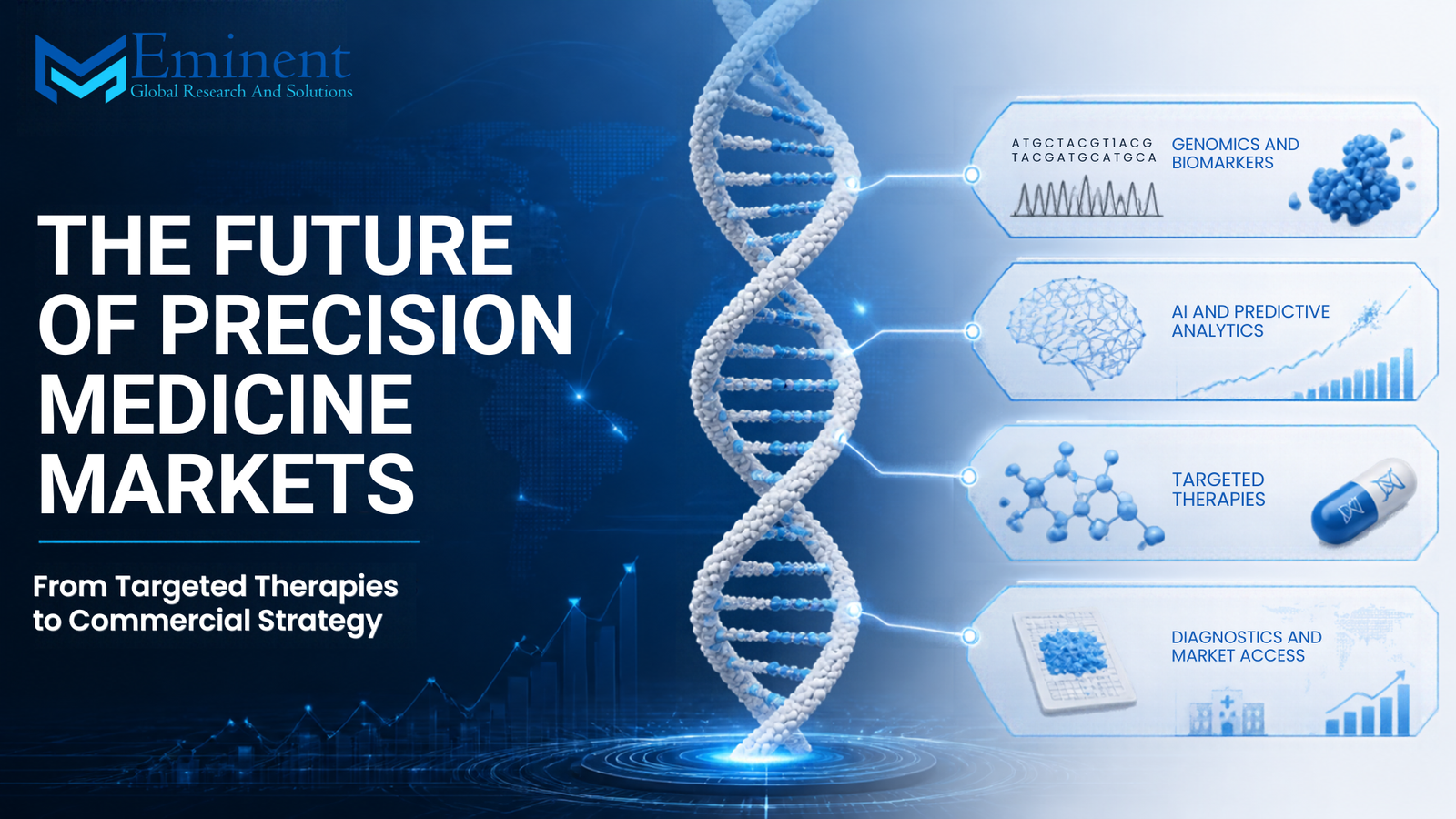
The Future of Precision Medicine Markets: From Personalized Treatment to a New Healthcare Business Model
Precision medicine is reshaping how healthcare companies discover therapies, develop diagnostic tools, identify patient populations, and build commercialization strategies. Rather than relying exclusively on treatments designed for broad patient groups, precision medicine uses genetic information, biomarkers, clinical characteristics, and other patient-specific data to guide prevention, diagnosis, and treatment decisions.
What makes this transformation strategically important is that precision medicine is not simply a scientific advancement. It is changing the economics of pharmaceutical development, the relationship between diagnostics and therapeutics, and the way healthcare companies compete for market share.
As genomic technologies, artificial intelligence (AI), molecular diagnostics, and real-world data capabilities mature, precision medicine is creating new opportunities across pharmaceuticals, biotechnology, medical devices, diagnostics, and digital health.
However, the market’s future will depend on more than scientific breakthroughs. Companies must demonstrate clinical utility, establish sustainable reimbursement models, navigate evolving regulatory requirements, and translate complex data into commercially viable healthcare solutions.
1. The Shift From Blockbuster Drugs to Targeted Therapies
Traditional pharmaceutical business models have often prioritized treatments that can serve large patient populations. Precision medicine introduces a different approach: identifying patient subgroups most likely to benefit from a specific therapy.
Oncology provides a prominent example. Biomarker testing can help identify patients whose tumors carry particular genetic alterations, enabling clinicians to select therapies based on molecular characteristics rather than relying exclusively on tumor location or conventional clinical criteria.
Similar principles are being applied in rare diseases, inherited disorders, immunology, and selected cardiovascular and neurological conditions.
This shift creates several strategic implications:
More targeted development: Biomarker-defined populations can help researchers identify patients more likely to respond to an investigational therapy.
Potentially stronger differentiation: A therapy designed for a clearly defined population may offer a more specific clinical value proposition.
Smaller but more identifiable markets: Commercial success may depend on accurate patient identification rather than broad market penetration.
New evidence requirements: Clinical outcomes, biomarker validity, and patient selection strategies become central to demonstrating product value.
For pharmaceutical companies, the challenge is to determine whether a smaller, well-defined market can support the investment required for research, clinical development, manufacturing, and commercialization.
2. Diagnostics Are Becoming Strategic Commercial Assets
Precision medicine increasingly depends on the relationship between a therapeutic product and the diagnostic test used to identify appropriate patients.
Companion diagnostics can determine whether a patient has a biomarker associated with treatment eligibility or potential response. In some cases, access to the relevant diagnostic test is essential for a therapy to deliver its intended clinical benefit.
This creates a more interconnected healthcare market in which pharmaceutical companies, diagnostic developers, laboratories, technology providers, and healthcare systems must coordinate their activities.
The commercial implications are significant.
A promising targeted therapy may struggle to reach its potential if testing is unavailable, turnaround times are too long, or clinicians lack clear guidance on interpreting results. Conversely, a diagnostic platform with strong clinical utility may support adoption across multiple therapies or disease indications.
Companies should therefore evaluate diagnostic access, laboratory infrastructure, reimbursement, and testing adoption early in the development process.
Strategic takeaway: The competitive position of a precision medicine therapy may depend as much on its patient-identification ecosystem as on the drug itself.
3. AI and Multi-Omics Will Expand Market Opportunities
The next phase of precision medicine will be shaped by the integration of AI with genomic, proteomic, transcriptomic, metabolomic, and clinical data.
Historically, researchers have often investigated individual biomarkers or relatively narrow datasets. Multi-omics approaches can combine several biological layers to develop a more comprehensive understanding of disease mechanisms and treatment response.
AI can help researchers identify patterns across these datasets, prioritize candidate biomarkers, stratify patient populations, and generate hypotheses for further investigation. These applications may improve research efficiency and support the development of more targeted therapeutic strategies.
However, predictive performance does not automatically translate into clinical utility. Models must be validated in relevant populations, evaluated for bias, and assessed for reproducibility. Data interoperability, privacy, and the availability of high-quality clinical datasets will remain important constraints.
For technology providers and life sciences companies, this creates opportunities in:
AI-enabled biomarker discovery and validation.
Multi-omics data integration platforms.
Computational pathology and molecular diagnostics.
Patient stratification and clinical trial optimization.
Real-world data analytics and treatment-response monitoring.
The commercial opportunity will increasingly favor companies that can connect sophisticated analytical capabilities with validated clinical applications and clear economic value.
4. Market Growth Will Depend on Reimbursement and Healthcare Economics
The scientific promise of precision medicine is substantial, but its commercial sustainability depends on whether healthcare systems can afford, reimburse, and implement these solutions.
According to Grand View Research’s 2026 market report, the global precision medicine market was estimated at approximately $135 billion in 2026, with a projected value of about $405 billion by 2033. These figures represent one market-research firm’s estimates and forecasts, rather than a definitive measure of the entire sector.

Growth projections must be interpreted alongside significant economic challenges. Advanced molecular tests, complex therapies, specialized manufacturing, and data-intensive infrastructure can increase costs across the healthcare value chain.
Payers and healthcare providers will increasingly examine whether precision medicine produces meaningful improvements in outcomes, reduces avoidable treatment costs, or enables more efficient care pathways.
For manufacturers, this means that clinical efficacy alone may be insufficient to secure widespread adoption. Companies must develop evidence that connects the therapy or diagnostic intervention to measurable patient and economic outcomes.
Key commercialization priorities include:
Establishing health-economic value propositions.
Generating comparative clinical and real-world evidence.
Understanding payer requirements before launch.
Evaluating diagnostic reimbursement independently and alongside treatment access.
Designing market-access strategies for different healthcare systems.
The strategic question is no longer simply whether a treatment can be personalized. It is whether personalization can deliver sufficient value to justify its cost.
5. Regional Markets Will Follow Different Growth Paths
Precision medicine will not develop uniformly across geographies. Differences in healthcare expenditure, diagnostic infrastructure, genomic data availability, regulatory requirements, and reimbursement systems will shape regional adoption.
North America
Established biotechnology ecosystems, pharmaceutical investment, specialized laboratories, and clinical research capabilities support a mature precision medicine market. Competition will increasingly center on differentiated therapies, diagnostic partnerships, evidence generation, and access to patients.
Europe
Adoption will depend on national reimbursement decisions, healthcare-system priorities, data governance, and the ability to integrate genomic testing into routine clinical practice. A scientifically successful product may still encounter different access conditions across individual countries.
Asia-Pacific
The region offers opportunities linked to expanding healthcare infrastructure, biotechnology investment, population-scale genomics, and growing diagnostic capabilities. Market development will vary substantially between countries, making localized regulatory and commercial intelligence essential.
For companies entering new markets, a single global launch strategy may be inadequate. Market selection should consider addressable patient populations, testing capacity, physician adoption, reimbursement feasibility, competitive intensity, and local partnership opportunities.
6. Intellectual Property Will Shape Competitive Advantage
As precision medicine advances, intellectual property (IP) strategy will become increasingly important across biomarkers, diagnostic methods, therapeutic platforms, genomic technologies, software, and data-analysis capabilities.
Companies must understand not only what they can protect, but also where competitors are investing and which technologies may create barriers to entry.
Patent landscaping can help identify crowded technology areas, emerging research clusters, potential licensing opportunities, and underserved indications. Technology scouting can reveal external capabilities that complement internal R&D programs.
Nevertheless, patent activity alone does not establish commercial value. A strong assessment should integrate IP analysis with scientific validation, freedom-to-operate considerations, regulatory feasibility, market demand, and competitive positioning.
Strategic partnerships may be particularly important when a company has a promising therapy but lacks the diagnostic infrastructure, data capabilities, or regional commercial relationships required for successful adoption.
For consulting and research organizations, this creates an opportunity to connect patent intelligence, technology scouting, market intelligence, and commercialization planning into a unified decision-making framework.
7. Key Risks That Could Slow Market Development
Despite the growth opportunity, several structural barriers remain.
Data privacy and governance: Genomic and health information requires rigorous controls and responsible data use.
Unequal access: Advanced testing and therapies may remain concentrated in well-resourced healthcare systems.
Clinical validation: Biomarkers and AI models must demonstrate reliable performance in the populations where they will be used.
Reimbursement uncertainty: Payers may disagree on evidence requirements, eligible populations, and acceptable pricing.
Fragmented infrastructure: Inconsistent testing access and incompatible data systems can delay adoption.
Regulatory complexity: Diagnostic and therapeutic components may require coordinated development and regulatory strategies.
The FDA emphasizes the importance of reliable genetic testing and recognizes the role of next-generation sequencing in precision medicine. Its companion-diagnostic framework also highlights the relationship between diagnostic tests and the safe, effective use of corresponding therapies.
These challenges make early coordination across R&D, regulatory affairs, diagnostics, market access, and commercial strategy increasingly important.
8. What Should Life Sciences Companies Do Next?
Companies seeking to compete in precision medicine should move beyond technology-led investment decisions and adopt an integrated market-development strategy.
Five priorities stand out:
Identify unmet clinical needs: Focus on patient populations where current treatment pathways leave meaningful gaps.
Validate the market opportunity: Estimate biomarker-positive populations, diagnostic availability, competitor pipelines, and realistic treatment uptake.
Build diagnostic partnerships early: Align therapeutic development with the tests and infrastructure required to identify eligible patients.
Strengthen evidence and market access: Integrate clinical, economic, and real-world evidence planning into development strategy.
Monitor the competitive landscape: Track patent filings, licensing agreements, clinical trials, regulatory decisions, and emerging technologies.
For executives, the objective is to allocate capital toward opportunities that combine scientific differentiation with clinical relevance, operational feasibility, and a credible route to market.
Conclusion: Precision Medicine Is Becoming a Market-Design Challenge
The future of precision medicine will be determined by more than advances in genomics or the number of targeted therapies entering development. It will depend on how effectively companies connect biological insights, diagnostics, clinical evidence, reimbursement, intellectual property, and commercialization.
The strongest market participants are likely to be those that understand the entire value chain—from identifying a relevant biomarker to ensuring that eligible patients can access the right test and treatment.
For pharmaceutical, biotechnology, diagnostics, and healthcare technology companies, the strategic priority is clear: identify where precision medicine can create measurable clinical value, determine whether that value can be commercialized sustainably, and build the partnerships and evidence required to deliver it.
For Eminent Global Research Solutions, this evolving landscape creates a compelling opportunity to help organizations assess emerging markets, map competitive and patent landscapes, identify technology white spaces, and develop evidence-based commercialization strategies.
The next competitive advantage in precision medicine will not come from personalization alone. It will come from turning personalization into accessible, differentiated, and commercially sustainable healthcare.
Post a Comment