

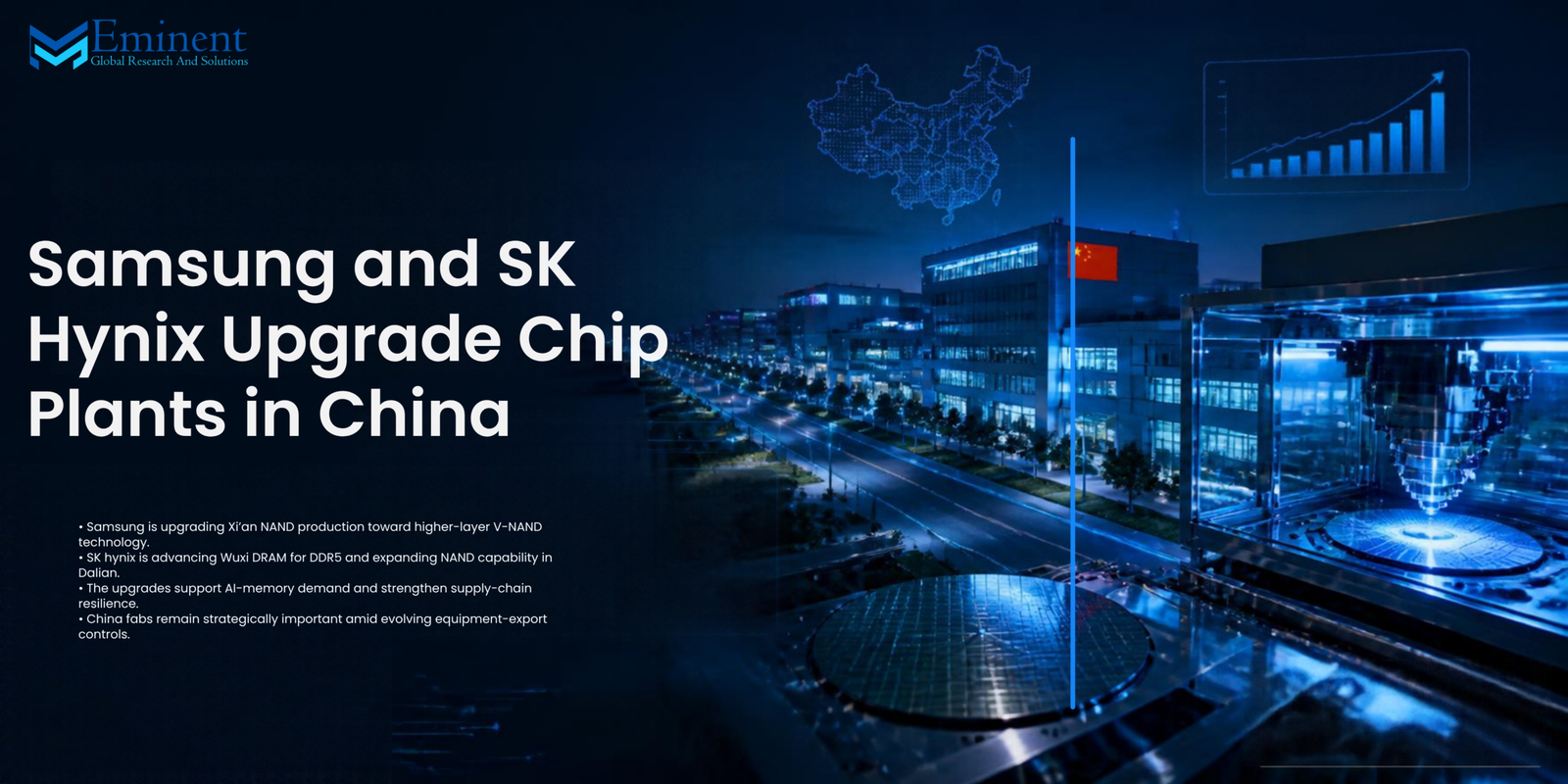
Samsung and SK Hynix Upgrade Their China Chip Plants as AI Demand Grows
Published: 21 October 2026
Category: Technology & Electronics
AI boom pushes chipmakers to upgrade factories in China
The rapid growth of artificial intelligence is changing the semiconductor industry, and two of its biggest players, Samsung Electronics and SK Hynix, are responding by upgrading their manufacturing facilities in China.
According to a Reuters report, the South Korean companies are preparing to produce more advanced NAND flash memory chips at their Chinese plants. These chips are essential for storing the enormous amounts of data used by smartphones, computers, cloud platforms and AI data centres.
As demand for AI services continues to grow, companies need storage technologies that can handle more data efficiently. For Samsung and SK Hynix, upgrading their factories is one way to remain competitive in an increasingly demanding market.
What are the companies planning?
Samsung is reportedly preparing its facility in Xi’an, China, to manufacture its more advanced V9 NAND memory chips, which use 286 layers. Meanwhile, SK Hynix is planning upgrades at its Dalian facility to move towards NAND technology with 240 or more layers.
In simple terms, adding more layers allows manufacturers to store more information in a smaller physical space. This can help improve storage capacity and production efficiency, making the technology increasingly valuable as AI infrastructure expands.
Why does AI matter so much?
AI systems rely on vast amounts of data. Training models, running AI applications and maintaining cloud services all require reliable, high-capacity storage.
As businesses invest more heavily in AI, demand for memory and storage products is also increasing. Semiconductor manufacturers are therefore under pressure to improve their technology, increase efficiency and deliver products that meet the needs of a rapidly evolving market.
This demand is creating opportunities for established chipmakers, but it is also intensifying competition across the industry.
US restrictions add another layer of complexity
Expanding advanced chip production in China is not straightforward. The United States has introduced restrictions on certain semiconductor manufacturing equipment supplied to China, meaning companies such as Samsung and SK Hynix must navigate export-control requirements when upgrading their facilities.
Reuters reported that the companies were consulting with Washington over their plans, although the full extent of the required approvals remained unclear.
For manufacturers, this creates a difficult balancing act: they need to keep pace with technological progress while complying with regulations that can affect equipment access, investment decisions and long-term production plans.
China’s domestic chip industry is becoming more competitive
Samsung and SK Hynix are also facing growing competition from Chinese semiconductor manufacturers, including Yangtze Memory Technologies (YMTC).
As China invests in developing its domestic chip industry, local companies are working to strengthen their technology and market position. This could make the global memory-chip market more competitive in the years ahead.
For international manufacturers, staying ahead will depend not only on production capacity but also on technological innovation, operational efficiency and the ability to adapt to changing trade policies.
What could this mean for the global market?
The factory upgrades highlight several important developments in the semiconductor industry:
- Growing AI demand: Data centres and AI applications are increasing the need for advanced storage.
- More investment in manufacturing: Chipmakers must continually upgrade their facilities to remain competitive.
- Changing global supply chains: Geopolitical tensions are influencing where companies invest and how they source equipment.
- Stronger competition: Chinese manufacturers are working to gain a larger share of the domestic semiconductor market.
Looking ahead
Samsung and SK Hynix’s reported plans show how closely connected AI growth, semiconductor innovation and international trade have become. The demand for advanced memory is creating new opportunities, but manufacturers must also deal with regulatory uncertainty and increasing competition.
How successfully the companies manage these challenges could influence not only their future growth but also the wider semiconductor supply chain that supports AI, cloud computing and consumer electronics.
Post a Comment