

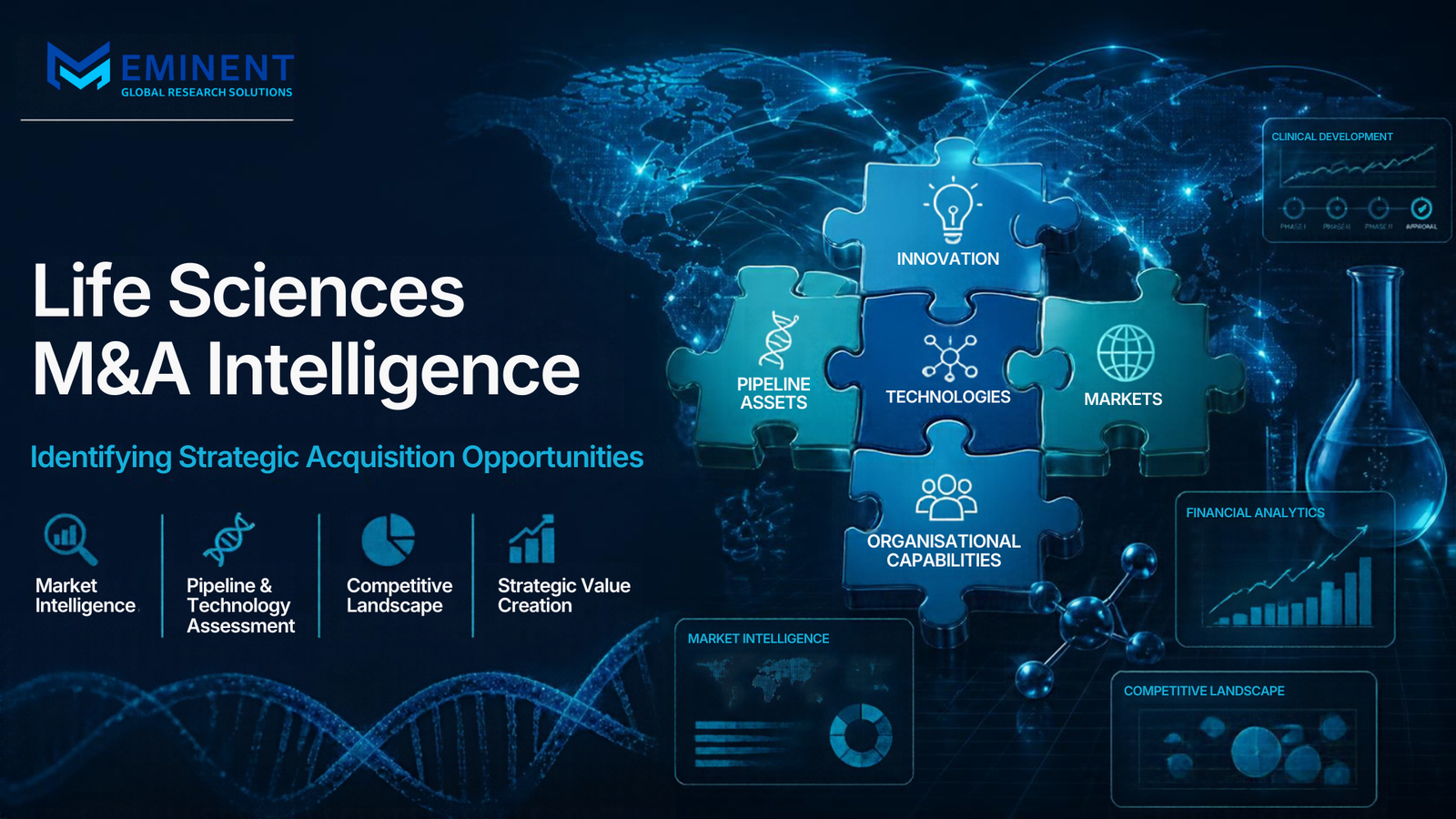
Introduction: Beyond Deal Size, Toward Strategic Value
Mergers and acquisitions (M&A) have become an important strategic mechanism for life sciences companies seeking to strengthen their product pipelines, acquire differentiated technologies, enter new markets, and accelerate innovation. In an industry characterized by long development timelines, substantial R&D investment, complex regulatory requirements, and uncertain commercialization outcomes, acquisitions can offer an alternative to developing every capability internally.
However, a successful transaction is not simply about identifying a company with promising assets or negotiating an attractive valuation. The real challenge is determining whether an acquisition will deliver sustainable strategic value.
A biotechnology company may possess a promising clinical-stage asset but lack the manufacturing infrastructure to scale it. A pharmaceutical company may have strong commercial capabilities but face a weakening pipeline. A medical technology business may own differentiated intellectual property but lack the distribution network needed to reach its target markets.
These situations create potential acquisition opportunities—but only when the strategic fit, technical feasibility, commercial potential, and financial implications are properly evaluated.
This is where life sciences M&A intelligence becomes essential. By integrating market intelligence, competitive intelligence, patent analysis, technology assessment, and commercial evaluation, organizations can move beyond reactive dealmaking toward a more systematic approach to identifying, prioritizing, and executing strategic acquisitions.
1. Why Life Sciences Companies Pursue Strategic Acquisitions
Acquisition strategies in life sciences are shaped by several interconnected business pressures.
Pipeline renewal and patent exposure. Pharmaceutical companies must continually replenish their development pipelines as products approach loss of exclusivity, competition increases, or clinical programs fail. Acquiring a company with promising assets can help address pipeline gaps, although development risk and remaining intellectual property protection must be evaluated carefully.
Access to differentiated technologies. Advances in cell and gene therapy, antibody engineering, RNA-based therapeutics, precision medicine, and AI-enabled drug discovery create opportunities to acquire capabilities that may be difficult or time-consuming to build internally.
Expansion into new markets. Acquisitions can provide access to new geographies, therapeutic areas, customer segments, distribution channels, and regulatory capabilities.
Competitive positioning. Acquiring a competitor, complementary platform, or emerging innovator may strengthen a company’s market position, provided the transaction creates defensible value and can be integrated effectively.
Capability acquisition. In many cases, the most valuable acquisition target is not a company with a single promising product, but one with reusable technologies, specialized talent, proprietary datasets, manufacturing expertise, or a platform that supports multiple future opportunities.
The central question is therefore not simply, Which company is available for acquisition? It is, Which acquisition would improve our strategic position more effectively than the alternatives?
2. The Role of M&A Intelligence in Target Identification
Traditional deal sourcing often begins with investment banking relationships, industry networks, conferences, and publicly announced transactions. These channels remain useful, but they may not reveal the full universe of strategically relevant targets.
M&A intelligence expands the search by systematically identifying companies whose technologies, assets, capabilities, or market positions align with a buyer’s strategic priorities.
A structured target-identification process can examine five dimensions:
Technology fit: Does the target own a differentiated platform, technology, or development capability?
Pipeline fit: Do its assets complement the acquirer’s portfolio or address a defined pipeline gap?
Market fit: Does it provide access to an attractive market, unmet need, or customer segment?
IP position: Are the relevant patents enforceable, strategically meaningful, and supported by a defensible freedom-to-operate position?
Strategic fit: Can the buyer realistically integrate and commercialize the acquired assets?
These dimensions help distinguish between companies that appear attractive in isolation and companies that offer a meaningful strategic advantage to a specific acquirer.
For example, a biotechnology company developing a targeted therapeutic may be a more valuable acquisition candidate for a pharmaceutical company with complementary clinical expertise and established market access than for a buyer lacking the necessary development infrastructure.
Target attractiveness is therefore buyer-specific, strategy-dependent, and time-sensitive.
3. Assessing the Commercial and Scientific Potential of Targets
An acquisition target must be evaluated across both scientific and commercial dimensions. Strong scientific results alone do not guarantee commercial success.
Scientific and development assessment
Key questions include:
How robust and reproducible is the available preclinical or clinical evidence?
What are the principal safety, efficacy, and development risks?
How differentiated is the mechanism of action or underlying technology?
What additional studies, regulatory milestones, or manufacturing investments are required?
How transferable is the technology to the acquirer’s development and production infrastructure?
The level of scrutiny should reflect the target’s development stage. An early-stage biotechnology company may require greater emphasis on scientific validity, translational evidence, and platform reproducibility, whereas a late-stage asset demands deeper analysis of pivotal evidence, regulatory readiness, and launch requirements.
Commercial assessment
Commercial diligence should evaluate the addressable patient or customer population, competing therapies or technologies, treatment patterns, reimbursement constraints, pricing dynamics, and likely adoption barriers.
The analysis should also consider the competitive response. A target may appear attractive because few alternatives exist today, but its long-term potential could be constrained by competing clinical programs, patent challenges, emerging technologies, or changes in standards of care.
A credible acquisition thesis connects scientific differentiation to a realistic path toward market adoption and sustainable economics.
4. Patent Intelligence: Understanding the Defensibility of an Acquisition
Intellectual property (IP) can materially influence the strategic value of a life sciences acquisition. However, the number of patents held by a target is not a reliable measure of the strength of its competitive position.
A robust patent intelligence assessment should examine:
Patent portfolio quality: Claim scope, legal status, remaining term, geographic coverage, and ownership.
Freedom to operate: Potential conflicts with third-party patents and other relevant intellectual property.
Competitive patent activity: Competing organizations’ filings, emerging technology directions, and potential areas of overlap.
Technology white spaces: Opportunities where the target’s capabilities could support differentiated products or future development programs.
IP dependencies: Licensing obligations, co-development agreements, ownership disputes, and restrictions that may affect commercialization.
In biotechnology, for example, the value of a therapeutic platform may depend on a combination of composition-of-matter patents, manufacturing processes, delivery technologies, and proprietary know-how. Each component can affect the buyer’s ability to develop, protect, and commercialize the acquired technology.
Patent intelligence can also reveal risks that conventional financial screening may overlook. A target may have promising technology but limited protection in commercially important markets, or its future development plans may depend on access to third-party intellectual property.
The strategic objective is to determine whether the acquired capabilities are defensible, usable, and commercially relevant—not merely whether patents exist.
5. Competitive Intelligence and Acquisition Timing
Timing can influence acquisition economics as much as target selection.
Companies that enter a competitive process after a technology has attracted widespread attention may face higher valuations and reduced negotiating flexibility. Conversely, identifying a promising company before a major clinical milestone or broader market recognition can create an opportunity to engage earlier.
Competitive intelligence helps buyers understand:
Which competitors are pursuing similar technologies or assets.
Where venture capital, strategic partnerships, and licensing activity are concentrated.
Which therapeutic areas or technology platforms are attracting increased investment.
What comparable transactions suggest about market expectations.
Which companies may become strategically relevant as their pipelines or capabilities mature.
This analysis should not rely on deal announcements alone. Clinical trial activity, patent filings, licensing agreements, scientific publications, hiring patterns, regulatory milestones, and corporate strategy updates can provide complementary signals.
For instance, increasing patent activity around a specific drug-delivery technology, combined with new clinical programs and strategic partnerships, may indicate that the field is becoming more competitive. A buyer can use these signals to reassess its acquisition priorities before a target becomes a widely recognized strategic asset.
Importantly, early signals are not proof that a company will become an attractive acquisition target. They are inputs for further investigation, validation, and prioritization.
6. From Target Screening to Due Diligence
An effective M&A intelligence framework connects market-level analysis with company-specific evaluation.
Stage 1 — Strategic definition
Define portfolio gaps, technology priorities, target markets, acquisition objectives, and investment constraints.
Stage 2 — Market mapping and screening
Map relevant companies and assets using market, pipeline, competitive, patent, and partnership intelligence.
Stage 3 — Target prioritization
Assess scientific differentiation, commercial potential, IP defensibility, strategic fit, and execution requirements.
Stage 4 — Due diligence
Validate key assumptions through scientific, regulatory, legal, financial, commercial, and operational diligence.
Stage 5 — Value creation and integration
Translate the acquisition thesis into integration priorities, development milestones, resource allocation, and measurable outcomes.
This framework creates a consistent process for comparing potential targets and identifying the assumptions that require the greatest scrutiny.
It also prevents a common strategic mistake: allowing an attractive asset or competitive bidding process to dictate acquisition priorities before the buyer has established what it actually needs.
7. Valuation, Risk, and Value Creation
Valuation should reflect both the target’s potential and the uncertainty associated with realizing that potential.
For clinical-stage biotechnology assets, risk-adjusted net present value (rNPV), scenario analysis, and probability-weighted development outcomes can help assess potential value. Commercial-stage businesses may require additional analysis of revenue durability, margins, customer concentration, and competitive positioning.
The assessment should account for:
Development and regulatory risk.
Remaining clinical, manufacturing, and commercialization investment.
Patent expiry and potential competitive entry.
Market access, pricing, and reimbursement uncertainty.
Integration costs and organizational complexity.
Synergies that can be realistically achieved.
Synergies deserve particular scrutiny. Combining R&D capabilities, manufacturing infrastructure, distribution networks, or complementary technologies can create value, but projected savings and revenue gains should be supported by a clear operational rationale.
Buyers should also distinguish between standalone value and buyer-specific strategic value. A platform may have limited immediate revenue but offer substantial value to an acquirer with the infrastructure and expertise needed to develop multiple products from it. That additional value must still be weighed against the costs, risks, and alternatives.
A disciplined acquisition decision compares the transaction with other routes to the same strategic objective, including licensing, partnerships, internal R&D, and targeted capability development.
8. How AI and Data Analytics Can Strengthen M&A Intelligence
AI-enabled research and analytics can improve the speed and breadth of target screening by helping teams organize large volumes of scientific publications, patent records, clinical trial data, company disclosures, and transaction information.
Potential applications include identifying emerging technology clusters, comparing development pipelines, detecting relationships between companies and assets, and monitoring changes in competitive activity.
However, AI-generated insights require validation. Inconsistent datasets, incomplete disclosures, misleading correlations, and outdated information can produce inaccurate target assessments. Confidentiality, data licensing, and the protection of commercially sensitive information also require careful management.
The most effective model combines technology-enabled screening with expert scientific, commercial, regulatory, IP, and financial judgment. AI can help identify patterns and prioritize research; it cannot independently establish whether a transaction is strategically sound.
9. The Future of Life Sciences M&A Intelligence
As life sciences innovation becomes increasingly specialized, acquisition decisions will require a more integrated understanding of science, intellectual property, market demand, competitive positioning, and commercial execution.
The most attractive opportunities may not always be the largest companies or the most visible assets. They may be businesses with a differentiated technology, an underappreciated platform, strategically valuable IP, or capabilities that address a clearly defined gap in an acquirer’s portfolio.
Organizations that develop systematic M&A intelligence capabilities can improve their ability to identify such opportunities, evaluate risks earlier, and direct resources toward transactions with a credible path to value creation.
For leadership teams, the objective should be to move beyond deal volume and focus on strategic outcomes: stronger pipelines, differentiated capabilities, sustainable competitive advantage, and improved returns on investment.
Conclusion
Life sciences M&A intelligence is not simply a tool for finding acquisition targets. It is a decision-support capability that connects innovation strategy with investment decisions.
By integrating market intelligence, competitive intelligence, patent landscaping, technology assessment, and commercial diligence, companies can build a more defensible acquisition strategy—one grounded in evidence rather than market excitement alone.
For organizations seeking their next growth opportunity, the key question is no longer just which company should we acquire? It is which acquisition will create the greatest sustainable strategic value, and what evidence supports that decision?
Eminent Global Research Solutions supports strategic decision-making through market intelligence, competitive intelligence, IP intelligence, technology scouting, and commercialization research.
Post a Comment