
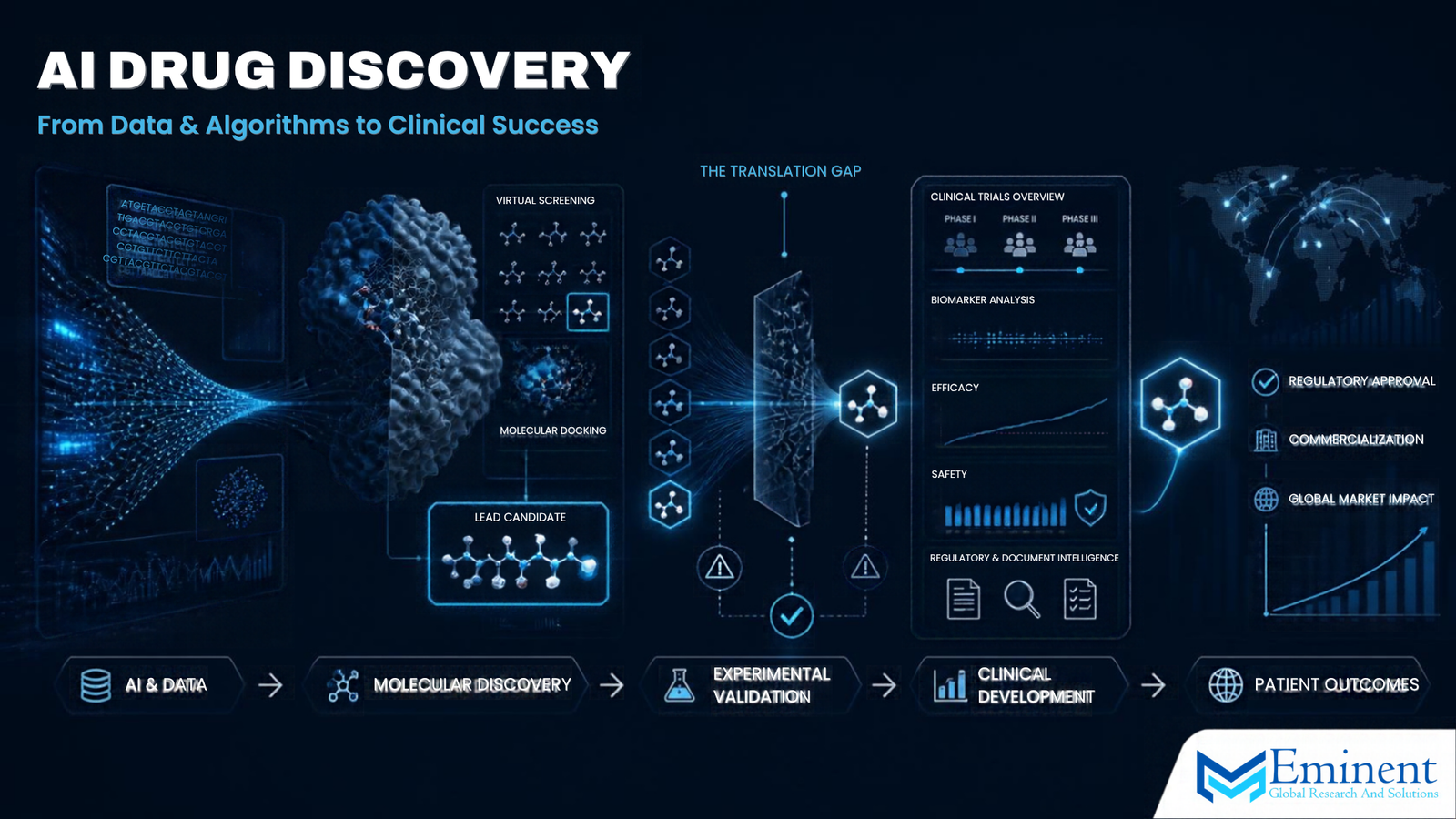
Artificial intelligence is rapidly changing how pharmaceutical companies identify targets, design molecules, predict properties, and prioritize drug candidates. From protein-structure prediction and virtual screening to de novo molecular design and multimodal analysis, AI can compress parts of the discovery process that traditionally required years of experimentation.
But a critical question is becoming increasingly important:
Can computational acceleration actually translate into better clinical outcomes?
The answer is not yet clear.
A 2026 Nature Reviews Drug Discovery perspective concluded that evidence of clinically relevant impact from AI in drug discovery remains limited, despite substantial advances in AI methods. The key challenge is not simply whether AI can make better predictions, but whether those predictions remain useful when confronted with biological complexity, heterogeneous patients, clinical trial realities, and regulatory requirements.
For pharma companies, this creates a strategic shift: the next competitive advantage may not come from having the most sophisticated AI model, but from building an AI-to-clinic translation strategy.
From Computational Prediction to Clinical Reality
AI is already being applied across multiple stages of drug discovery.
It can support:
- Target identification and validation
- Protein and molecular structure prediction
- Virtual screening
- De novo molecule generation
- Drug–target interaction prediction
- ADMET and toxicity prediction
- Biomarker discovery
- Patient stratification
- Drug repurposing
- Clinical trial design and patient recruitment
The opportunity is significant.
However, success at one stage does not automatically transfer to the next.
A model can identify a molecule with desirable computational characteristics, but that molecule still needs to demonstrate appropriate pharmacokinetics, safety, target engagement, biological activity, dosing feasibility, and ultimately meaningful clinical benefit.
This creates a fundamental distinction:
AI can optimize what is measurable computationally, but clinical development depends on what is biologically and clinically meaningful.
Recent reviews continue to identify data quality, model interpretability, patient heterogeneity, regulatory adaptation, and the gap between in-silico predictions and wet-lab evidence as major barriers to translation. PubMed
1. The Data Advantage Has a Data-Quality Problem
AI’s effectiveness depends heavily on its training and validation data.
Pharmaceutical datasets are rarely clean.
They can contain:
- Missing clinical information
- Inconsistent experimental protocols
- Different assay conditions
- Small sample sizes
- Publication bias
- Proprietary datasets
- Population bias
- Incompatible data formats
- Limited representation of real-world patient diversity
A model trained on highly controlled datasets may perform extremely well in a benchmark environment but struggle when exposed to heterogeneous clinical populations.
This is particularly important for precision medicine.
A drug candidate might appear highly promising in a molecular dataset, yet patient response can vary because of genetics, disease stage, comorbidities, previous treatments, immune status, environmental factors, and other biological variables.
Therefore, more data does not necessarily mean better clinical prediction.
The strategic issue is increasingly about data relevance, quality, provenance, interoperability, and representativeness.
2. Biology Is More Complex Than the Model
One of AI’s biggest strengths is finding patterns in large datasets.
But biology is not simply a pattern-recognition problem.
Biological systems are dynamic, interconnected, and context-dependent.
A drug interacts with a target, but that interaction occurs within a network of signaling pathways, cellular processes, tissues, immune responses, metabolism, and compensatory mechanisms.
This creates a major translational challenge.
A model might predict strong target binding, but the actual therapeutic effect could be limited because:
- The target is not sufficiently disease-driving.
- The drug cannot reach the relevant tissue.
- The disease pathway compensates through another mechanism.
- The molecule interacts with unintended targets.
- The biological model does not adequately represent human disease.
- Patient populations respond differently.
This is why AI should increasingly be viewed as a decision-support layer within drug discovery, rather than a replacement for experimental biology.
3. The In-Silico-to-Wet-Lab Gap
One of the most important bottlenecks is the transition from computational prediction to experimental validation.
AI can generate thousands of potential candidates.
But laboratories still need to determine which candidates actually work.
That means moving through:
AI prediction → molecular synthesis → biochemical testing → cellular testing → animal studies → pharmacology → toxicology → clinical development
Every transition introduces uncertainty.
Consequently, the value of AI is not necessarily determined by how many molecules it can generate.
A more meaningful question is:
How effectively can AI identify the small number of candidates that deserve expensive experimental validation?
This changes the commercial proposition.
The goal should not be maximum computational output.
It should be higher-quality decision-making per unit of R&D investment.
4. Clinical Validation Is Becoming the Real Test
The industry is entering a phase where AI drug discovery needs to demonstrate more than technical performance.
It needs clinical evidence.
A 2026 analysis of AI in medicine found a major imbalance between preclinical/early clinical research and randomized controlled trials, highlighting the broader evidence gap facing medical AI. Nature
At the same time, there are emerging examples showing that computationally guided molecules can reach human trials.
For example, a 2026 perspective discussed a Phase 2a trial of an AI-supported de novo-designed TNIK inhibitor for idiopathic pulmonary fibrosis. The candidate demonstrated safety, tolerability, and pharmacodynamic target engagement, with an early efficacy signal that requires further validation. Importantly, this represents a proof of translational feasibility—not definitive evidence that AI has solved clinical drug development.
This distinction is crucial.
Clinical progression is not the same as clinical success.
The industry ultimately needs evidence that AI-enabled approaches can improve:
- Probability of technical and regulatory success
- Clinical efficacy
- Safety
- Development timelines
- Patient selection
- Trial efficiency
- R&D productivity
5. AI Could Also Improve the Clinical Trial Stage
The opportunity does not end when a candidate enters clinical development.
AI is increasingly being explored for:
- Patient recruitment
- Trial-site selection
- Patient stratification
- Endpoint identification
- Protocol optimization
- Data monitoring
- External comparator development
- Digital biomarkers
- Trial simulation
- Identification of likely non-responders
A recent Nature Reviews Bioengineering review describes an emerging AI-enabled clinical-trial framework that integrates multimodal data, AI-supported recruitment and monitoring, external comparator approaches, digital twins, and earlier go/no-go decisions. The authors emphasize that these applications require fit-for-purpose validation, regulatory engagement, and human oversight.
This suggests that the future of AI in pharma may not be a standalone “AI drug discovery platform.”
Instead, it may become an integrated AI-enabled R&D operating model.
6. Regulatory Expectations Will Matter
Regulators will also play a critical role.
As AI becomes embedded across drug development, companies will need to demonstrate that AI-supported decisions are:
- Reproducible
- Traceable
- Scientifically justified
- Appropriately validated
- Relevant to the intended use
- Supported by adequate evidence
This is particularly important when AI influences safety assessments, patient selection, clinical endpoints, or major development decisions.
The emerging focus should therefore shift from:
“Can we use AI?”
to:
“Can we demonstrate that this AI application is fit for purpose?”
That distinction could become one of the defining principles of AI-enabled pharmaceutical development.
7. The Strategic Opportunity for Pharma
For pharmaceutical companies, the next phase of AI adoption should be more selective.
Instead of asking:
Where can we apply AI?
companies should ask:
Where can AI materially improve a high-value R&D decision?
This requires connecting several intelligence layers:
Technology Intelligence
Identify emerging AI platforms, computational methods, and enabling technologies.
IP Intelligence
Understand patent landscapes, freedom-to-operate considerations, competitive filings, and emerging technology ownership.
Scientific Intelligence
Evaluate the biological credibility behind AI-generated targets and molecules.
Regulatory Intelligence
Track evolving expectations surrounding AI-supported drug development.
Clinical Intelligence
Assess whether computational predictions are translating into meaningful human evidence.
Market Intelligence
Determine whether an AI-enabled asset addresses a commercially meaningful unmet need.
Commercialization Intelligence
Connect technical differentiation with market access, competitive positioning, and commercial potential.
This integrated approach can help companies distinguish AI-enabled innovation from AI-enabled noise.
The Future: From AI Discovery to AI-Enabled Translation
The next stage of AI drug discovery will not be defined simply by larger models, larger datasets, or more generated molecules.
It will be defined by translation.
The winners may be organizations that successfully connect:
Data → AI → Biology → Experimental Validation → Clinical Evidence → Regulatory Acceptance → Commercialization
That means the real competitive advantage may lie less in owning an AI algorithm and more in building the ecosystem required to turn computational predictions into validated therapeutic assets.
AI has already demonstrated its ability to accelerate parts of discovery.
The harder challenge is proving that acceleration produces better medicines, better decisions, and better outcomes.
For pharma leaders, this creates a strategic imperative:
Don’t measure AI drug discovery only by how fast it generates candidates. Measure it by how effectively it improves the probability that the right candidate reaches the right patient.
Strategic Takeaway for Eminent Global Research Solutions
The emerging AI drug-discovery landscape creates significant opportunities for technology scouting, IP intelligence, competitive intelligence, regulatory intelligence, market intelligence, and commercialization strategy.
At Eminent Global Research Solutions, this is where an integrated intelligence approach can help companies evaluate not only which AI technologies are emerging, but also:
- Which platforms have meaningful translational evidence
- Which companies own strategically important IP
- Which therapeutic areas show the strongest opportunity
- Where competitive white spaces are emerging
- Which regulatory developments could affect adoption
- Which AI-enabled assets have commercialization potential
The future of AI drug discovery may not belong to the companies generating the most predictions. It may belong to the companies that translate the best predictions into validated, differentiated, and commercially viable therapies.