

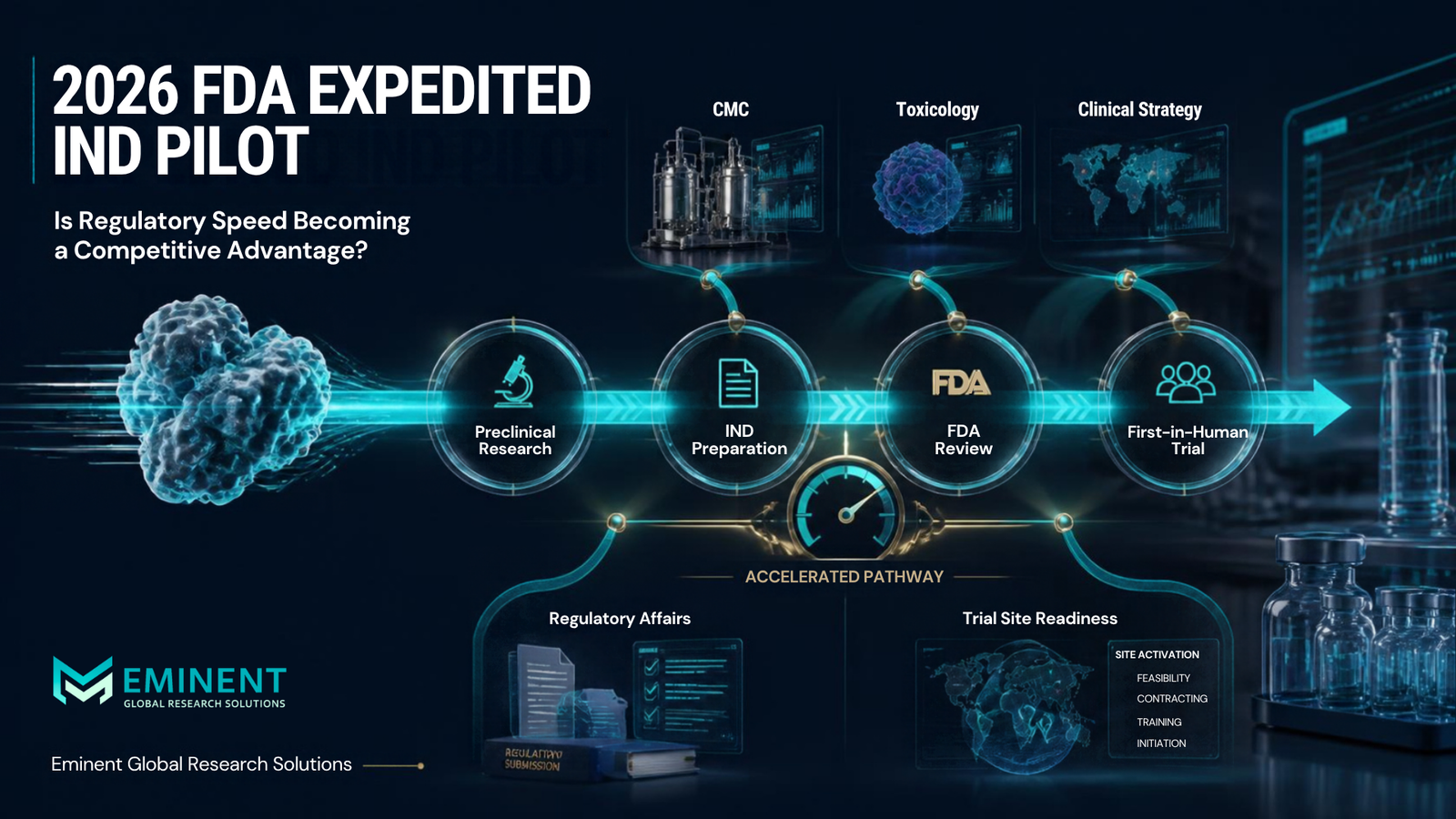
The pharmaceutical industry is entering a period in which regulatory strategy may increasingly influence not only compliance but also the speed and economics of innovation. The U.S. FDA’s 2026 Expedited Investigational New Drug (IND) Pilot Program is an important example of this shift.
Launched on September 15, 2026 under HHS’s Operation TrialBlazer, the pilot is designed to test whether first-in-human clinical development can be accelerated without changing FDA’s standards for participant safety or scientific oversight. The program introduces a more collaborative model in which pharmaceutical sponsors partner with qualified research institutions (QRIs) and submit components of an IND on a rolling basis.
For pharmaceutical and biotechnology companies, the strategic significance extends beyond faster regulatory processing. If the model proves successful, it could influence how companies organize preclinical development, CMC activities, regulatory functions, external partnerships, clinical operations, and investment decisions.
The broader message is becoming clear: regulatory execution is evolving from a compliance function into a potential source of competitive advantage.
What Is the FDA Expedited IND Pilot?
Before a new investigational drug can generally begin clinical testing in the United States, the sponsor must provide FDA with sufficient information to support initiating human studies.
Preparing for a first-in-human IND can require coordination across pharmacology and toxicology, clinical development, chemistry, manufacturing and controls (CMC), and other disciplines.
The Expedited IND Pilot introduces a different operating model.
Participating sponsors work with QRIs that may include academic medical centers, healthcare networks, contract research organizations, regulatory advisors, or other qualified research organizations. These partners are intended to provide multidisciplinary scientific input during IND preparation.
Rather than waiting for an entire IND package to be assembled before substantive review, FDA will accept individual components on a rolling basis as they are completed. The pilot is intended to help identify scientific and regulatory issues earlier, potentially reduce late-stage information requests or clinical holds, and make progression toward first-in-human studies more efficient.
Importantly, this is not a relaxation of FDA approval or safety standards. Sponsors remain responsible for their submissions, while FDA retains its regulatory authority, including decisions concerning whether clinical investigations may proceed.
Why This Matters for Pharma Strategy
Traditionally, regulatory affairs can be treated primarily as a function responsible for navigating requirements once development decisions have already been made.
The Expedited IND model reinforces a different approach.
Regulatory strategy can be integrated much earlier into R&D and portfolio planning.
When regulatory, CMC, toxicology, clinical, and external scientific expertise are coordinated from the beginning, companies may identify development risks before they become expensive bottlenecks.
That has potential implications for development economics.
For an emerging biotech company, several months saved before a first-in-human trial could affect financing requirements, cash runway, milestone timing, partnering discussions, and asset valuation.
For larger pharmaceutical companies managing multiple assets, improvements in early-development efficiency could influence portfolio prioritization and capital allocation.
The strategic objective therefore should not simply be “submit an IND faster.”
It should be “build an integrated development system capable of making better decisions earlier.”
Regulatory Readiness Could Become a Competitive Advantage
Drug development competition increasingly involves more than discovering a promising molecule.
Companies compete on their ability to translate scientific discoveries into clinical assets efficiently.
A company may have excellent science but still lose momentum because of fragmented regulatory planning, incomplete CMC readiness, poorly coordinated nonclinical studies, or delays in clinical site activation.
FDA explicitly identifies earlier issue resolution, higher-quality phase-appropriate submissions, reduced potential for Phase 1 clinical holds or information requests, and better coordination of trial-startup activities among the desired outcomes of the pilot.
This makes regulatory readiness increasingly strategic.
Companies should consider developing integrated IND roadmaps much earlier in the asset lifecycle, identifying critical evidence requirements and dependencies across disciplines before approaching first-in-human development.
The QRI Model Could Reshape External Partnerships
One of the most interesting aspects of the pilot is its emphasis on qualified external research institutions.
FDA expects sponsors and prospective QRIs to apply as pairs. The initial cohort is expected to include approximately 8–10 Sponsor-QRI pairs, with applications due October 30, 2026.
This could elevate the strategic importance of CROs, academic medical centers, regulatory specialists, healthcare networks, and other scientific partners.
Historically, external organizations have often been engaged for individual activities.
The emerging model encourages deeper integration.
Rather than simply executing predefined tasks, external partners may increasingly contribute scientific judgment, risk assessment, CMC planning, regulatory strategy, and development sequencing.
Pharma companies may therefore need to evaluate partners based not only on operational capacity but also on scientific depth and their ability to work across multiple development disciplines.
CMC Strategy Moves Earlier
Another important implication involves chemistry, manufacturing and controls.
Manufacturing strategy can sometimes lag discovery-stage decision-making, particularly in emerging biotechnology companies. However, accelerated regulatory pathways increase the importance of having phase-appropriate CMC plans ready earlier.
If regulatory interactions and clinical development accelerate while manufacturing readiness remains unchanged, CMC can become the new bottleneck.
Companies therefore need greater coordination among:
- Regulatory affairs
- Process development
- Manufacturing
- Quality
- Nonclinical development
- Clinical operations
- Supply chain teams
FDA has separately emphasized phase-appropriate CMC expectations as part of its broader effort to modernize clinical development and reduce unnecessary early-stage regulatory burden.
The competitive advantage may therefore belong not simply to organizations with the fastest regulatory teams, but to those capable of synchronizing the entire development system.
Parallelization Could Change Development Timelines
Another strategic element is FDA’s encouragement of activities that traditionally occur sequentially to proceed in parallel where appropriate.
For example, IND development, Institutional Review Board planning, site contracting, and clinical site readiness can potentially be coordinated more closely.
That matters because eliminating idle time between activities can sometimes generate meaningful timeline improvements without changing the underlying science.
This represents an important operational principle for pharmaceutical companies:
Acceleration does not necessarily mean doing less. It can mean sequencing work more intelligently.
Companies should therefore map their development workflows and identify activities that can responsibly proceed concurrently.
Implications for Emerging Biotech Companies
The pilot may be particularly relevant for smaller biotechnology companies.
Emerging companies frequently possess strong scientific platforms but have limited internal regulatory, clinical, manufacturing, and development infrastructure.
FDA itself has acknowledged that navigating early IND requirements can be particularly challenging for smaller companies without large regulatory teams.
A structured external partnership model could help such organizations access specialized expertise without building every capability internally.
However, outsourcing does not eliminate sponsor responsibility.
Biotech companies will still require strong governance, documentation standards, partner selection processes, and internal decision-making capabilities.
The strategic question therefore becomes:
Which development capabilities should remain internal, and which can be accessed through an external innovation ecosystem?
What Pharma Companies Should Do Now
The Expedited IND Pilot is still a pilot, so companies should avoid assuming its structure will automatically become the future standard.
Instead, pharmaceutical and biotechnology leaders can use it as a signal to evaluate their existing development models.
Companies should examine whether regulatory strategy begins early enough, whether CMC planning is synchronized with clinical development, whether external partners provide sufficient multidisciplinary expertise, and whether organizational processes unnecessarily force sequential execution.
They should also assess which pipeline assets could benefit most from accelerated first-in-human development.
The strongest candidates may not necessarily be the assets with the highest scientific novelty. They may be programs where scientific maturity, manufacturing readiness, regulatory strategy, and organizational execution are already sufficiently aligned to capitalize on faster development.
A Broader Shift Toward Regulatory-Enabled Innovation
The Expedited IND Pilot sits within a broader FDA effort to modernize both early- and late-stage clinical development.
For pharma executives, this has an important strategic implication.
Regulatory intelligence should increasingly be incorporated into portfolio strategy, technology assessment, licensing decisions, commercialization planning, and R&D investment decisions.
A promising technology cannot generate commercial value if development bottlenecks prevent it from reaching patients efficiently.
Companies that build regulatory considerations into innovation strategy from the beginning may be able to reduce uncertainty, allocate capital more effectively, and accelerate promising assets toward clinical validation.
For Eminent Global Research Solutions, the development reinforces an increasingly important consulting proposition: market intelligence, regulatory intelligence, technology assessment, and commercialization strategy should not operate independently.
They are becoming interconnected components of a successful pharmaceutical innovation strategy.
In the next era of drug development, scientific innovation may determine what is possible but regulatory and operational execution will increasingly determine how quickly that possibility becomes clinical and commercial reality.