
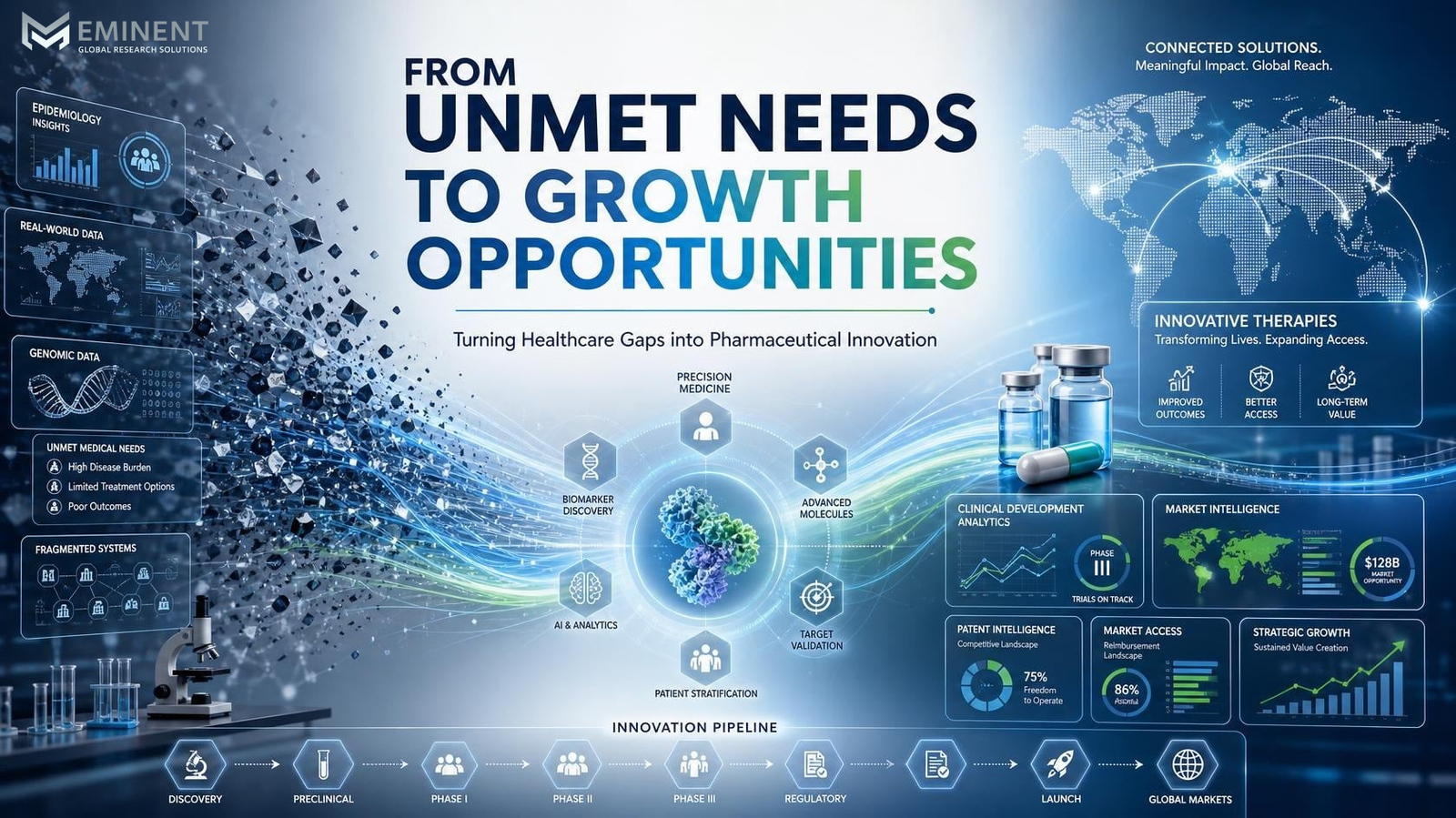
The pharmaceutical industry has traditionally measured growth through blockbuster drugs, large patient populations, and successful product launches. But as competition intensifies in established therapeutic areas, a different opportunity is gaining strategic importance: unmet medical needs.
Conditions with limited treatment options, underserved patient populations, rare diseases, treatment-resistant conditions, and diseases with poor clinical outcomes represent significant challenges for healthcare systems. At the same time, they can create attractive opportunities for pharmaceutical companies capable of developing innovative therapies and building sustainable commercialization strategies around them.
The question is no longer simply whether pharma companies can discover treatments for unmet needs. It is whether they can transform these needs into sustainable, scalable, and commercially viable growth opportunities while delivering meaningful patient value.
Understanding the Opportunity Behind Unmet Needs
An unmet medical need exists when current healthcare solutions fail to adequately address a disease or patient requirement.
This can occur when:
- No effective treatment currently exists
- Existing therapies produce inadequate outcomes
- Treatments create significant side effects
- Patients lack access to appropriate therapies
- Diagnosis remains difficult or delayed
- Treatment options are not suitable for specific patient populations
Historically, pharmaceutical companies often prioritized large markets because they offered greater commercial potential. However, advances in biotechnology, precision medicine, and regulatory science are changing the economics of smaller and underserved markets.
A therapy addressing a relatively small patient population can now represent a significant commercial opportunity when supported by strong clinical differentiation, appropriate pricing, efficient development, and effective market access.
This is particularly visible across rare diseases, oncology, genetic disorders, autoimmune conditions, and specialized neurological diseases.
From Patient Need to Commercial Opportunity
The first step is identifying where meaningful gaps exist.
Market research and healthcare intelligence can help pharmaceutical companies evaluate the difference between market demand and actual patient need.
For example, a disease may have several approved therapies but still represent a major unmet need because patients experience inadequate efficacy, poor tolerability, complex administration requirements, or limited access.
This creates an important strategic distinction:
A crowded market does not necessarily mean a fully served market.
Companies that understand the patient journey in detail can identify opportunities that conventional market sizing may overlook.
Analyzing treatment pathways, physician behavior, patient experiences, clinical outcomes, reimbursement barriers, and competitor pipelines can reveal potential white spaces for innovation.
Precision Medicine Is Expanding the Opportunity
The growth of precision medicine is fundamentally changing how pharmaceutical companies approach unmet needs.
Instead of developing treatments for broad disease categories, companies can increasingly identify specific patient subgroups based on genetic, molecular, or biological characteristics.
This creates opportunities to develop highly targeted therapies with potentially stronger clinical outcomes.
Companion diagnostics, biomarkers, genomic sequencing, and advanced patient stratification can help identify populations most likely to benefit from a particular treatment.
For pharmaceutical companies, this can support:
- More focused clinical development
- Better patient selection
- Stronger clinical differentiation
- Potentially higher response rates
- More targeted commercialization strategies
The result is a shift from “How large is the disease market?” to “Which patient population has the greatest unmet need, and how effectively can we address it?”
Rare Diseases Are Becoming Commercially Relevant
Rare diseases provide a strong example of how unmet medical needs can become strategic growth opportunities.
Although individual rare disease populations may be small, the combined global rare disease landscape is substantial. Furthermore, many rare conditions have historically lacked effective treatments.
Advances in gene therapy, cell therapy, RNA-based medicines, and precision diagnostics are opening new possibilities.
Regulatory incentives can also support development through mechanisms designed to encourage innovation in diseases with limited treatment options.
For pharma companies, the opportunity extends beyond developing a single product.
A successful rare disease strategy can create expertise across regulatory development, specialized manufacturing, patient identification, physician engagement, and market access—capabilities that can potentially be leveraged across multiple programs.
Commercialization Must Begin Earlier
One of the biggest strategic mistakes companies can make is treating commercialization as a late-stage activity.
For therapies addressing unmet needs, commercial strategy should begin during development.
Companies need to understand early:
Who are the patients?
How are they currently treated?
What barriers prevent diagnosis or treatment?
Who makes treatment decisions?
How will payers evaluate the therapy?
What evidence will be required to demonstrate value?
Answering these questions early can influence clinical trial design, evidence generation, pricing strategy, patient support programs, and launch planning.
This is particularly important for innovative therapies where healthcare systems may have limited experience evaluating their clinical and economic value.
Market Access Can Determine Commercial Success
Scientific innovation does not automatically translate into commercial success.
A therapy may demonstrate strong clinical efficacy but still face challenges related to reimbursement, affordability, healthcare infrastructure, or patient identification.
This makes market access a critical component of unmet-needs commercialization.
Pharmaceutical companies increasingly need to demonstrate not only that a treatment works, but also that it creates meaningful value for:
- Patients
- Physicians
- Hospitals
- Insurers
- Governments
- Healthcare systems
Health economics and outcomes research can play an important role in demonstrating long-term value.
For transformative therapies, companies may also need innovative reimbursement models such as outcomes-based agreements, risk-sharing arrangements, or alternative payment structures.
The Role of Competitive Intelligence
As pharmaceutical companies increasingly pursue underserved markets, competition is emerging earlier in the innovation cycle.
A company developing a therapy for an unmet need must understand not only currently marketed products but also the emerging pipeline.
Patent landscapes, clinical trials, scientific publications, licensing activity, startup investments, technology platforms, and strategic partnerships can provide valuable insight into where competitors are heading.
Competitive intelligence can help answer critical questions:
- Which technologies are attracting investment?
- Where are competitors building patent positions?
- Which mechanisms of action are gaining momentum?
- Which patient populations remain underserved?
- Where are potential partnership opportunities?
- Which markets may become crowded in the next five years?
This allows companies to prioritize opportunities before competitors establish strong positions.
Turning Innovation Into Sustainable Growth
The most successful pharma companies will not simply pursue unmet needs because they represent regulatory or social opportunities.
They will build integrated strategies connecting medical need, scientific feasibility, commercial potential, and patient access.
A sustainable growth strategy could involve:
- Identifying high-priority unmet medical needs.
- Mapping existing treatment gaps.
- Assessing emerging technologies.
- Evaluating competitor pipelines and IP landscapes.
- Prioritizing commercially attractive patient segments.
- Developing differentiated clinical strategies.
- Planning market access early.
- Building scalable commercialization capabilities.
This approach transforms unmet need from a research concept into a structured growth strategy.
The Strategic Opportunity for Pharma
The pharmaceutical industry is entering an era where growth will increasingly depend on solving complex healthcare problems rather than simply expanding existing product portfolios.
Unmet medical needs represent an opportunity to align innovation with impact.
Companies that can identify meaningful treatment gaps, develop differentiated technologies, navigate regulatory pathways, demonstrate economic value, and successfully reach patients may create durable competitive advantages.
For Eminent Global Research Solutions, this represents an important strategic intelligence opportunity.
Through market intelligence, competitive intelligence, technology intelligence, IP analysis, and commercialization strategy, pharmaceutical companies can identify where unmet needs intersect with scientific feasibility and commercial potential.
The future winners may not necessarily be the companies pursuing the largest markets.
They may be the companies capable of identifying the most important healthcare problems and solving them better than anyone else.