
Cancer treatment is undergoing one of the most significant transformations in modern healthcare. Traditional oncology has largely relied on treating cancers according to their location in the body and broad disease classifications. Today, advances in genomics, molecular diagnostics, artificial intelligence, targeted therapies, and biomarker-driven drug development are enabling a far more individualized approach.
At the center of this transformation is precision oncology an approach that uses the molecular and genetic characteristics of a patient’s cancer to guide diagnosis, treatment selection, and disease monitoring.
Rather than asking only, “Where did the cancer originate?”, precision oncology increasingly asks, “What biological mechanism is driving this individual tumor, and how can it be targeted?”
This shift has major implications for pharmaceutical companies, biotechnology innovators, diagnostic developers, healthcare providers, and investors. As oncology becomes increasingly biomarker-driven, competitive advantage may depend not only on discovering new therapies but also on integrating diagnostics, patient identification, clinical development, regulatory strategy, and market access into a unified commercialization model.
From One-Size-Fits-All to Molecularly Guided Cancer Care
Cancer is not a single disease. Even patients diagnosed with the same type of cancer can have tumors driven by very different genetic mutations, molecular pathways, and biological mechanisms.
Historically, patients were often treated using standardized combinations of surgery, chemotherapy, and radiation. These approaches remain essential, but treatment responses can vary significantly between individuals.
Precision oncology introduces a more targeted model.
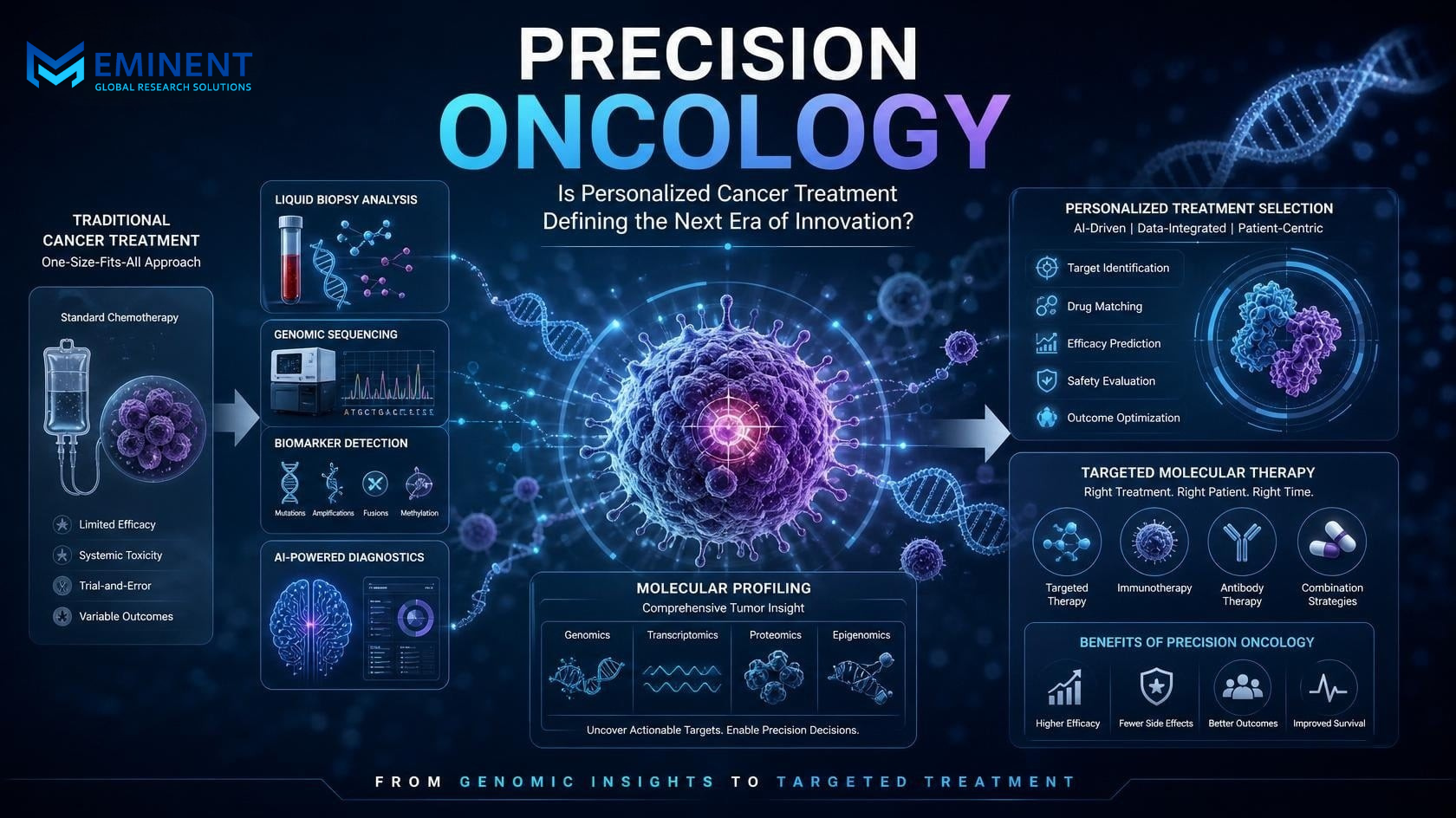
Through technologies such as next-generation sequencing, molecular profiling, liquid biopsy, and advanced biomarker testing, clinicians can identify specific characteristics associated with a patient’s tumor.
These insights can potentially help determine which therapies are most likely to be effective.
This transition is changing oncology from an organ-centered treatment model toward an increasingly biology-driven treatment ecosystem.
For the pharmaceutical industry, this means future oncology innovation will increasingly require deeper integration between therapeutics and diagnostics.
Biomarkers Are Becoming Central to Oncology Innovation
Biomarkers are emerging as one of the foundations of precision oncology.
They can help identify patients who are more likely to respond to particular therapies, enabling pharmaceutical companies to develop more targeted clinical programs.
Instead of developing treatments for extremely broad cancer populations, companies can increasingly focus on molecularly defined patient subgroups.
This approach can create several strategic advantages, including more targeted clinical trial recruitment, stronger patient stratification, clearer therapeutic differentiation, and potentially more efficient development pathways.
However, biomarker-driven drug development introduces new challenges.
A highly effective therapy has limited commercial potential if eligible patients cannot be identified efficiently.
This makes diagnostic availability increasingly important to commercialization.
Pharma and biotech companies may therefore need to consider companion diagnostic strategies much earlier in drug development rather than treating diagnostics as a secondary consideration close to launch.
AI Could Accelerate Precision Oncology
Artificial intelligence is adding another dimension to personalized cancer treatment.
Cancer generates enormous quantities of complex data, including genomic information, pathology images, radiology scans, clinical histories, treatment responses, and real-world patient outcomes.
Analyzing this information manually can be extremely difficult.
AI and machine learning technologies have the potential to identify patterns across these datasets and support researchers and clinicians in areas such as biomarker discovery, patient stratification, treatment response prediction, pathology analysis, and clinical trial design.
One particularly promising opportunity is multimodal oncology.
Instead of analyzing genomic, imaging, and clinical information separately, advanced computational platforms can potentially combine multiple data types to create a more comprehensive understanding of disease.
For pharmaceutical companies, these capabilities could improve R&D productivity by helping identify promising therapeutic targets and more appropriate patient populations earlier.
The strategic opportunity, however, is not simply adopting AI.
Companies need access to high-quality datasets, appropriate validation frameworks, regulatory expertise, and clinical integration capabilities to convert AI insights into meaningful healthcare applications.
Liquid Biopsy Could Transform Cancer Monitoring
Another important innovation supporting precision oncology is liquid biopsy.
Traditional tumor biopsies require tissue samples, which may involve invasive procedures and can sometimes be difficult to repeat frequently.
Liquid biopsy technologies analyze cancer-related biological signals circulating in blood or other body fluids.
Their potential applications include detecting molecular alterations, monitoring treatment response, identifying emerging resistance, and tracking disease progression.
As these technologies mature, oncology care could become more dynamic.
Instead of relying primarily on periodic imaging or tissue biopsies, clinicians may increasingly use molecular information to understand how cancer evolves during treatment.
This matters because tumors can change over time.
A therapy that initially works may become less effective as cancer cells develop resistance mechanisms. Continuous molecular monitoring could potentially help clinicians adapt treatment strategies earlier.
For diagnostics companies, this creates a substantial innovation opportunity at the intersection of testing, data analytics, and personalized treatment.
Targeted Therapies Are Changing Drug Development
Precision oncology is also reshaping how cancer medicines are developed.
Traditional oncology drug development often focused on tumor location. Increasingly, therapies are being designed around specific molecular targets or biomarkers that may appear across multiple cancer types.
This creates opportunities for more sophisticated development strategies.
A molecular alteration found in lung cancer, for example, may also occur in other tumor types. If a therapy effectively targets that biological mechanism, its potential application may extend beyond one traditional disease category.
This evolution is encouraging greater investment in targeted therapies, antibody-drug conjugates, cell therapies, precision immunotherapies, and next-generation combination strategies.
However, competition is becoming increasingly intense.
Multiple companies may pursue similar biological targets simultaneously. As a result, scientific differentiation alone may not guarantee commercial leadership.
Development speed, biomarker strategy, clinical positioning, regulatory execution, and market access are becoming equally important.
Commercialization Is Becoming More Complex
Precision oncology creates significant opportunities, but it also introduces a more complicated commercialization environment.
Traditional pharmaceutical commercialization typically focuses on securing regulatory approval and building physician adoption.
Precision therapies require a broader ecosystem.
Before a patient can receive treatment, they may first need appropriate biomarker testing. This means commercial success can depend on whether diagnostic infrastructure is widely available and whether physicians know when and how to use it.
Companies must therefore consider several interconnected questions:
- Can eligible patients be identified efficiently?
- Is biomarker testing widely accessible?
- Will diagnostic testing be reimbursed?
- Are treatment centers equipped to interpret complex molecular information?
- Can patients access specialized therapies geographically and financially?
- Does the therapy demonstrate sufficient clinical and economic value?
These considerations make precision oncology commercialization an ecosystem challenge rather than simply a product launch challenge.
Market Access Will Be Critical
Advanced oncology therapies can deliver significant clinical benefits, but they can also involve substantial costs.
As precision medicine becomes more specialized, patient populations may become smaller and more molecularly defined.
This creates complex pricing and reimbursement considerations.
Payers increasingly expect companies to demonstrate not only clinical efficacy but also measurable value compared with existing treatment options.
Strong market access strategies may therefore require health economics evidence, real-world outcomes, biomarker-based patient selection, innovative reimbursement approaches, and early payer engagement.
Companies that integrate market access planning during clinical development may be better prepared for successful commercialization than those addressing reimbursement only after regulatory approval.
Precision Oncology Is Creating a New Competitive Landscape
The oncology ecosystem is expanding beyond traditional pharmaceutical companies.
Future competition and collaboration will increasingly involve biotechnology firms, diagnostic companies, genomic sequencing providers, AI developers, digital health platforms, academic research institutions, and specialized healthcare networks.
This convergence creates opportunities for strategic partnerships.
A pharmaceutical company may possess a promising targeted therapy but require diagnostic expertise to identify eligible patients. A technology company may develop advanced AI capabilities but need access to high-quality clinical datasets.
Organizations capable of building strong innovation ecosystems may accelerate development while reducing commercialization barriers.
Consulting Angle: Innovation Alone Will Not Determine the Winners
Precision oncology represents a significant growth opportunity, but scientific innovation alone will not guarantee commercial success.
Companies need an integrated strategy connecting biomarker discovery, companion diagnostics, clinical development, regulatory planning, market access, and commercialization.
For pharmaceutical and biotechnology companies, several strategic priorities are emerging: identifying high-value biomarker opportunities early, building diagnostic partnerships alongside therapeutic development, using competitive intelligence to understand crowded molecular targets, integrating regulatory and market access planning earlier, and developing scalable patient-identification strategies.
This is where strategic market intelligence becomes particularly valuable.
Understanding treatment landscapes, competitor pipelines, emerging biomarkers, unmet patient needs, technology trends, and regional reimbursement environments can help companies prioritize investments before markets become overcrowded.
The Next Phase of Cancer Innovation
Precision oncology is not simply introducing new cancer medicines. It is changing the architecture of cancer treatment itself.
The future of oncology is likely to become increasingly predictive, personalized, biomarker-driven, and data-enabled.
Patients may be matched with treatments based on the unique molecular characteristics of their cancer. AI could support increasingly sophisticated treatment decisions. Liquid biopsies may enable continuous disease monitoring, while advanced diagnostics could identify patients for targeted interventions earlier.
For the life sciences industry, this creates enormous opportunities—but also greater strategic complexity.
The organizations that successfully integrate therapeutics, diagnostics, data, regulatory strategy, and market access may be best positioned to lead the next generation of cancer innovation.
Precision oncology is therefore more than a scientific evolution.
It represents a fundamental shift from treating cancer as a broad disease category toward understanding and targeting the unique biology of each patient’s disease and that shift could define the next era of oncology.