

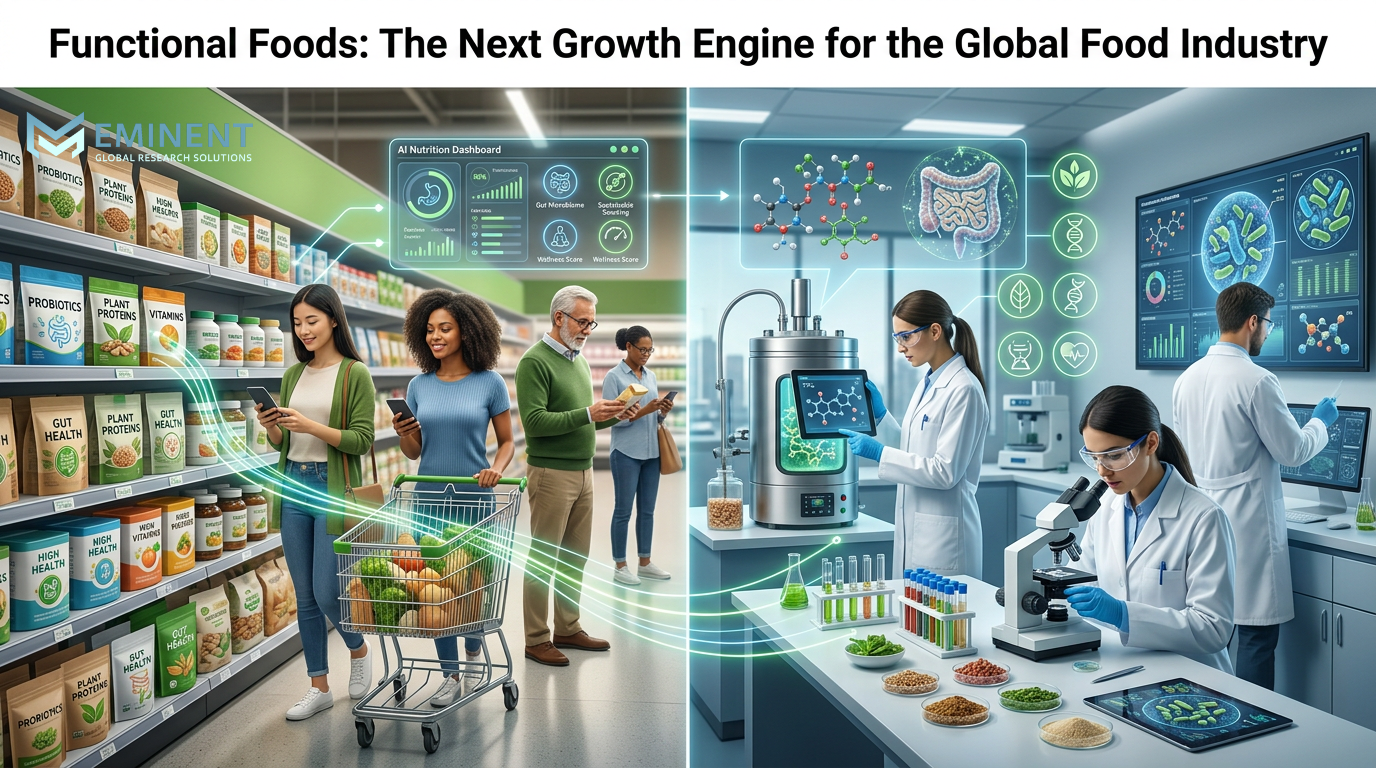
As consumer priorities continue to evolve, the global food industry is undergoing a fundamental transformation. For decades, packaged foods competed primarily on convenience, taste, affordability, and shelf life. Today, a new value proposition is reshaping the market: foods that not only nourish but also contribute to long-term health and wellness.
Functional foods products formulated with ingredients that provide health benefits beyond basic nutrition are rapidly gaining momentum. From probiotics and prebiotics to plant proteins, omega-3 fatty acids, adaptogens, and fortified vitamins, these products are meeting growing consumer demand for preventive healthcare, immunity support, gut health, cognitive wellness, and personalized nutrition.
This shift raises an important strategic question: Can functional foods outpace traditional packaged food growth?
For food manufacturers, ingredient suppliers, retailers, and investors, the answer lies not only in changing consumer behavior but also in the ability to combine scientific credibility, product innovation, and effective commercialization strategies.
The Evolution of Consumer Food Choices
The packaged food industry has historically focused on accessibility, flavor, and convenience. While these factors remain important, modern consumers increasingly expect food products to contribute positively to their overall health.
Several factors are driving this transformation:
- Growing awareness of lifestyle-related diseases
- Increased interest in preventive healthcare
- Rising demand for clean-label products
- Greater focus on immunity and digestive health
- Expansion of fitness and wellness lifestyles
- Improved access to nutritional information
Consumers are no longer asking, “Does this product taste good?” They are increasingly asking:
- Does it improve gut health?
- Does it support immunity?
- Is it high in protein?
- Does it contain natural ingredients?
- Is there scientific evidence behind its claims?
This change in purchasing behavior is creating significant growth opportunities for companies that can deliver both nutrition and measurable health benefits.
Functional Foods Are Moving into the Mainstream
Functional foods were once considered niche products sold primarily in health food stores. Today, they are becoming mainstream across supermarkets, convenience stores, online grocery platforms, and foodservice channels.
The category now includes:
- Probiotic yogurts and fermented beverages
- High-protein snacks
- Fiber-enriched cereals
- Vitamin-fortified beverages
- Plant-based functional foods
- Omega-3 enriched dairy products
- Adaptogen-infused drinks
- Collagen-enhanced nutrition products
Consumers increasingly view these products as part of their daily wellness routine rather than occasional specialty purchases.
This expanding adoption is transforming functional foods from a premium niche into a strategic growth category within the broader packaged food industry.
Preventive Healthcare Is Driving Demand
One of the strongest growth drivers behind functional foods is the increasing emphasis on preventive healthcare.
Healthcare systems worldwide continue to face rising costs associated with chronic diseases such as obesity, diabetes, cardiovascular disease, and digestive disorders.
Consumers are responding by making lifestyle changes that include healthier eating habits.
Rather than waiting for illness to occur, many individuals now seek foods that support long-term wellness through:
- Immune function
- Heart health
- Bone strength
- Brain performance
- Healthy aging
- Digestive wellness
- Energy management
This shift positions food companies as contributors to preventive health rather than simply providers of nutrition.
As food increasingly intersects with healthcare, opportunities for innovation continue to expand.
Science Is Becoming a Competitive Differentiator
Unlike traditional packaged foods, functional foods rely heavily on scientific validation.
Consumers are becoming more skeptical of generic wellness claims and increasingly expect evidence supporting product benefits.
Companies that invest in:
- Clinical research
- Human studies
- Nutritional science
- Ingredient validation
- Regulatory compliance
can build stronger credibility while differentiating themselves in an increasingly competitive marketplace.
Science-backed claims also help strengthen relationships with retailers, healthcare professionals, and regulatory agencies.
As competition intensifies, robust scientific evidence may become one of the industry’s most valuable competitive assets.
Innovation Beyond Ingredients
Successful functional food companies are innovating across multiple dimensions—not just ingredients.
Today’s market leaders are investing in:
Personalized Nutrition
Consumers increasingly seek products tailored to their age, lifestyle, fitness goals, dietary preferences, and health conditions.
Digital health platforms and nutrition apps are making personalized dietary recommendations more accessible than ever.
Advanced Food Technologies
Food technology innovations such as precision fermentation, biotechnology, AI-driven formulation, and microbiome research are accelerating product development.
These technologies enable manufacturers to create highly targeted nutritional solutions while improving sustainability and production efficiency.
Convenient Formats
Consumers want functional benefits without sacrificing convenience.
Ready-to-drink beverages, snack bars, gummies, protein coffees, and meal replacements are making health-focused nutrition easier to incorporate into daily life.
Premiumization Opportunities
Functional foods typically command higher prices than conventional packaged products.
Consumers are often willing to pay premiums for products that offer:
- Clinically supported ingredients
- Clean-label formulations
- Sustainable sourcing
- Personalized health benefits
- Trusted scientific research
This creates opportunities for manufacturers to improve margins while strengthening brand positioning.
However, premium pricing must be supported by transparent communication and demonstrable value.
Brands that overpromise without scientific backing risk damaging consumer trust.
Challenges Facing the Functional Food Industry
Despite strong growth prospects, several challenges remain.
Regulatory Complexity
Health claims are subject to increasing regulatory scrutiny across global markets.
Companies must carefully navigate regional regulations regarding ingredient approvals, labeling, and advertising.
Consumer Education
Many functional ingredients remain unfamiliar to mainstream consumers.
Effective education and transparent communication will be essential for driving adoption.
Supply Chain Resilience
Many functional ingredients require specialized sourcing, advanced manufacturing, and strict quality controls.
Building resilient supply chains will become increasingly important as demand grows.
Scientific Validation
As competition increases, brands will need stronger evidence supporting efficacy.
Investment in research partnerships and clinical studies will become more important.
Strategic Implications for Food Companies
The functional food opportunity extends beyond launching healthier products.
It requires a broader transformation involving:
- Consumer insight development
- Scientific research capabilities
- Ingredient innovation
- Strategic partnerships
- Regulatory expertise
- Commercialization planning
- Brand positioning
Organizations that successfully integrate these capabilities may establish stronger competitive positions in the evolving food ecosystem.
Cross-industry collaboration will also play an increasingly important role.
Partnerships involving food manufacturers, biotechnology firms, nutrition researchers, healthcare providers, and digital health companies may accelerate innovation while improving consumer outcomes.
The Future of Functional Foods
The future food industry will likely be defined by products that deliver measurable health outcomes alongside taste and convenience.
Consumers increasingly expect foods to contribute to wellness rather than simply satisfy hunger.
As advances in nutritional science, biotechnology, AI, and personalized healthcare continue, functional foods are expected to expand across nearly every major food category.
For manufacturers, the strategic question is no longer whether functional foods represent a growth opportunity—it is how quickly they can build the scientific, commercial, and innovation capabilities needed to compete effectively.
Companies that combine clinically supported ingredients, evidence-based health claims, consumer-centric innovation, and scalable commercialization strategies will be better positioned to capture premium market opportunities and build long-term consumer trust.
In the years ahead, functional foods are unlikely to replace traditional packaged foods entirely. Instead, they are poised to redefine what consumers expect from everyday nutrition, making health, functionality, and scientific credibility central drivers of growth across the global food industry.