

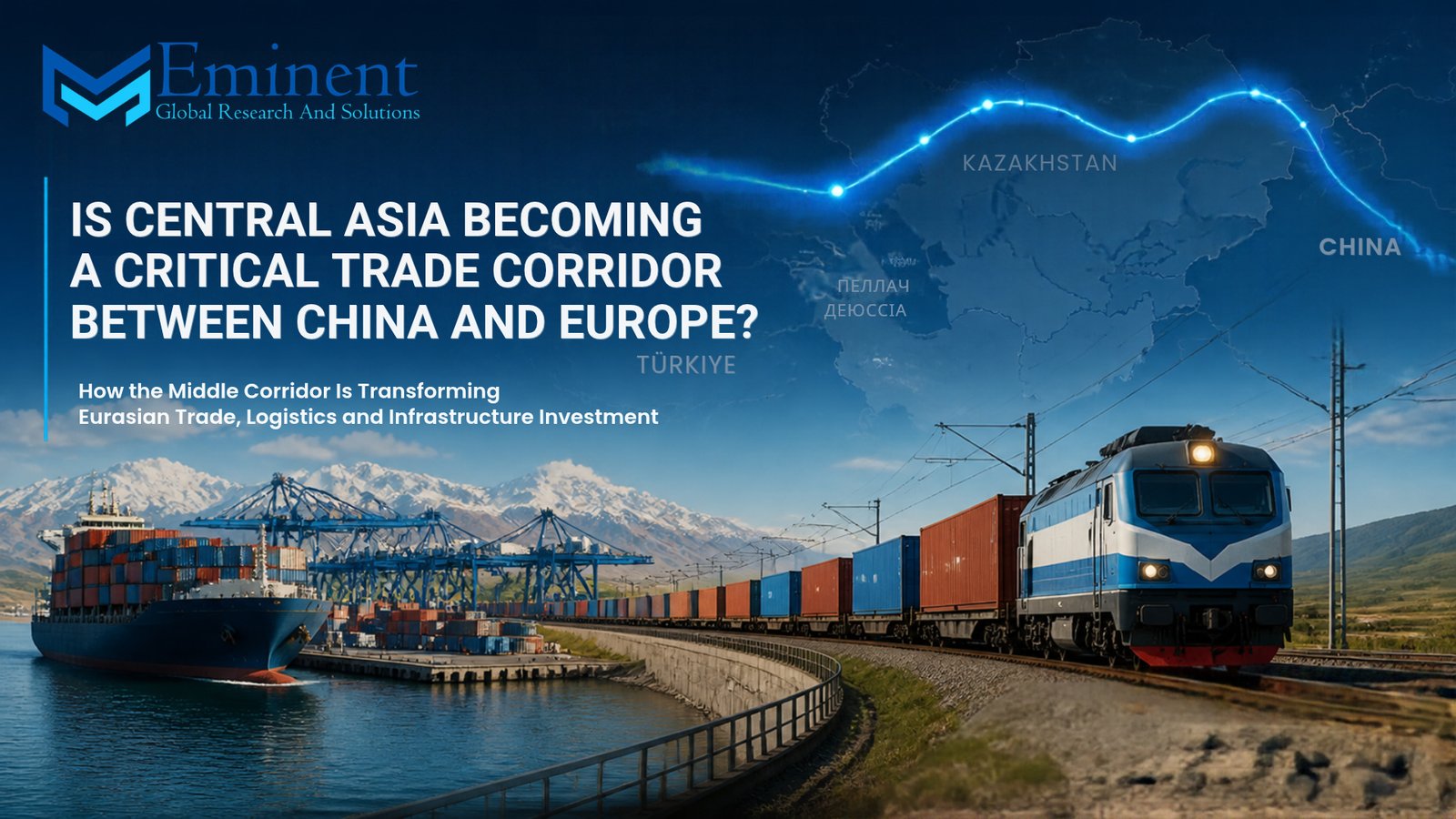
Is Central Asia Becoming a Critical Trade Corridor Between China and Europe?
Published Date: 25 November 2026
Category: Manufacturing & Industrial | Global Trade | Logistics & Supply Chain | Infrastructure
Introduction
Global trade routes are undergoing a significant transformation as businesses and governments look for more diversified, reliable, and efficient ways to move goods between major markets. Against this backdrop, Central Asia is gaining importance as a strategic link between China and Europe.
The Middle Corridor, officially known as the Trans-Caspian International Transport Route (TITR), connects China and Central Asia with European markets through Kazakhstan, the Caspian Sea, Azerbaijan, Georgia, and Türkiye. By combining railways, maritime shipping, ports, and road networks, the corridor offers an additional route for international freight transportation.
Recent developments are increasing its commercial importance. Governments are investing in railway infrastructure, logistics facilities, port capacity, and cross-border connectivity. The World Bank estimates that coordinated investment and reforms could more than triple trade volumes along the corridor and create two million additional jobs by 2040.
At Eminent Global Research Solutions, we examine how these developments are reshaping international trade, infrastructure investment, logistics markets, and business opportunities across emerging economies.
1. Why Is Central Asia Gaining Importance in Global Trade?
Central Asia occupies a strategic geographical position between China, Europe, the Middle East, and South Asia. Its location makes the region important for international transportation, energy exports, mineral supplies, and cross-border commerce.
For decades, much of the China–Europe rail trade relied on northern Eurasian routes. However, changing trade patterns, geopolitical uncertainty, and the need for supply-chain diversification have increased interest in alternative transportation networks.
The Middle Corridor provides another option by connecting Central Asian countries with the South Caucasus and European markets. It also creates opportunities for countries along the route to develop their own logistics, manufacturing, warehousing, and export industries.
This development is not simply about moving containers between two major economies. It is also about strengthening regional economic integration and giving Central Asian businesses improved access to international markets.
2. The Middle Corridor: How Does the Route Work?
The Middle Corridor is a multimodal transportation network rather than a single railway line. It relies on coordination between multiple countries, transport operators, ports, and logistics providers.
Its main transportation route includes:
- China: An important origin market for manufactured goods, electronics, machinery, and consumer products.
- Kazakhstan: The principal Central Asian land connection, linking Chinese border crossings with Caspian ports.
- Caspian Sea: Maritime transportation connects Kazakhstan with Azerbaijan.
- Azerbaijan: Provides a major transit connection through the South Caucasus.
- Georgia: Connects the Caspian region with Black Sea ports and onward European transport networks.
- Türkiye: Provides access to European markets through rail and road infrastructure.
The route’s performance depends on the efficient transfer of cargo between railways, ships, ports, and road networks. This creates opportunities for logistics operators but also introduces operational complexity.
3. Trade Growth Is Strengthening the Region’s Strategic Position
Growing trade between China and Central Asia is supporting investment in regional transportation infrastructure.
According to the Eurasian Development Bank, trade between China and the five Central Asian countries increased from approximately US$23.5 billion in 2020 to nearly US$70 billion in 2025.
The bank also reported that approximately 51 million tonnes of freight moved between China and Central Asia by road and rail in 2025. Kazakhstan accounted for 84% of this freight movement.
An important distinction is that these figures represent broader China–Central Asia freight activity, not exclusively cargo transported along the Middle Corridor.
For the China–Europe–China container routes through Central Asia, the bank reported more than 351,000 TEUs in 2025. Of this total, over 41,000 TEUs moved through the Middle Corridor.
These figures demonstrate the scale of regional trade activity while highlighting the potential for further development of alternative transportation networks.
4. Infrastructure Investment Is Driving Corridor Development
Expanding the Middle Corridor requires substantial investment in physical infrastructure and supporting logistics systems.
The World Bank’s September 2026 report, Integration: World-Class Trade Logistics Along the Trans-Caspian Transport Corridor, estimates that more than US$25 billion will be required for physical infrastructure through 2040.
A further US$30 billion is estimated for enabling investments, including logistics hubs, inland terminals, connecting roads and railways, cargo-handling equipment, rolling stock, and digital systems.
Key investment areas include:
Railway Infrastructure: Upgrading railway lines, increasing freight capacity, improving border connections, and modernizing equipment.
Port Development: Improving cargo-handling capacity and maritime connections across the Caspian Sea.
Logistics and Warehousing: Developing distribution centres, inland terminals, storage facilities, and multimodal logistics hubs.
Digital Infrastructure: Introducing integrated cargo tracking, electronic documentation, data exchange, and coordinated freight management systems.
These investments could generate opportunities for construction companies, engineering firms, railway equipment suppliers, logistics operators, and technology providers.
5. Kazakhstan, Azerbaijan and Georgia: Key Regional Hubs
The development of the Middle Corridor depends on cooperation between several countries, each with a different role in the transportation network.
Kazakhstan: The Eastern Gateway
Kazakhstan connects China with Central Asian railway networks and Caspian Sea transportation facilities. Its railway infrastructure and border crossings are essential for moving freight westward.
The country is also investing in logistics centres and railway connections to improve its position as a regional transportation hub.
Azerbaijan: The Caspian Connection
Azerbaijan provides an important link between Central Asia and the South Caucasus. Its ports, railway networks, and transportation infrastructure support the movement of cargo across the Caspian Sea and towards Europe.
Expanding port capacity and improving connections with neighbouring countries will be important for increasing the corridor’s competitiveness.
Georgia: The Link to European Markets
Georgia connects the South Caucasus with Black Sea transportation networks and onward European routes.
Railway modernization, port development, and improved logistics coordination could strengthen its position in regional trade and international freight services.
Together, these countries form a critical part of the corridor’s operational network.
6. European Interest Is Creating New Investment Opportunities
European interest in Central Asian connectivity is increasing as businesses and policymakers explore additional trade routes and more diversified sources of raw materials.
The European Union’s Global Gateway initiative is one framework supporting international infrastructure and connectivity projects.
Recent developments also indicate growing private-sector interest. In November 2026, reporting by Euronews highlighted cooperation between Kazakhstan, Azerbaijan, and Georgia on plans to increase Middle Corridor freight capacity to approximately 30 million tonnes annually by 2029.
The same report discussed a proposed logistics hub in Kazakhstan involving Belgian companies, with an estimated investment of US$50 million.
Separately, a November 2026 report by AzerNEWS cited an estimated €18.5 billion investment requirement for the full development of the corridor. This figure reflects a separate estimate reported from summit materials and should not be directly added to the World Bank’s investment estimates, which use a different scope.
For European companies, these developments could create opportunities in transportation infrastructure, logistics technology, mineral processing, agricultural supply chains, and industrial services.
7. Business Opportunities Across the Supply Chain
The expansion of the Middle Corridor could create commercial opportunities beyond traditional freight transportation.
Logistics and Freight Management: Companies could expand multimodal freight services, cargo consolidation, customs support, and international shipment management.
Warehousing and Distribution: New logistics hubs could increase demand for storage, cold-chain facilities, inventory management, and distribution services.
Railway and Port Equipment: Infrastructure development could create demand for locomotives, freight wagons, cranes, cargo-handling equipment, and railway maintenance services.
Digital Trade Solutions: Businesses providing shipment tracking, electronic customs documentation, transport management systems, and supply-chain analytics could benefit from greater corridor integration.
Industrial and Mineral Processing: Improved connectivity could support investment in local processing facilities for critical minerals, agricultural products, and other commodities.
Engineering and Infrastructure Services: Construction, project management, consulting, and infrastructure maintenance companies could find opportunities in regional development projects.
For businesses evaluating expansion into Central Asia, understanding local regulations, infrastructure capacity, trade demand, and competitive conditions will be essential.
8. Challenges That Could Limit the Corridor’s Growth
Despite its potential, the Middle Corridor faces several operational and structural challenges.
Multiple Cargo Transfers: Moving goods between railways, ships, and road networks creates additional handling requirements and can increase transportation costs.
Border and Customs Procedures: Differences in customs systems, documentation requirements, and border processes can delay shipments.
Infrastructure Capacity: Railway bottlenecks, port limitations, and insufficient logistics facilities may restrict freight growth.
Cross-Border Coordination: Multiple countries and operators must coordinate schedules, tariffs, documentation, and transportation services.
Cost Competitiveness: The corridor must offer commercially attractive transportation costs and predictable delivery schedules to gain wider adoption.
Digital Interoperability: Different national transport and customs systems need to exchange information efficiently to reduce paperwork and improve shipment visibility.
The OECD’s 2026 assessment of the Trans-Caspian Transport Corridor also highlights uneven infrastructure development and incomplete cross-border digital integration. It emphasizes that stronger connectivity requires both physical infrastructure and improvements in regulations, coordination, and operational performance.
9. Future Outlook: What Could the Corridor Look Like by 2040?
The long-term outlook for the Middle Corridor will depend on the ability of participating countries to combine infrastructure investment with operational reforms.
The World Bank estimates that strategic investments could:
- More than triple trade volumes along the corridor by 2040.
- Reduce transportation times by approximately half.
- Increase GDP across the assessed corridor countries by 3.3%.
- Create approximately two million additional jobs.
If infrastructure investment is combined with reforms to improve trade and transportation efficiency, the report indicates that corridor volumes could quadruple and travel times could fall by approximately two-thirds by 2040.
These are modeled projections rather than guaranteed outcomes. Their realization will depend on investment execution, cross-border cooperation, customs modernization, reliable transport services, and private-sector participation.
For international businesses, the corridor could become an increasingly relevant option for supply-chain diversification, regional distribution, and access to emerging markets.
10. How Eminent Global Research Solutions Supports Business Decisions
As international transportation networks evolve, companies need reliable market intelligence to evaluate new markets, infrastructure investments, and competitive developments.
At Eminent Global Research Solutions, we support businesses through:
- Market Research: Assessing regional logistics demand, infrastructure development, and emerging market opportunities.
- Industry Analysis: Evaluating transportation, warehousing, railway, port, and supply-chain industries.
- Competitive Intelligence: Monitoring infrastructure operators, logistics providers, investment activities, and market participants.
- Investment Research: Identifying potential opportunities across transportation infrastructure and industrial development.
- Strategic Consulting: Supporting market-entry planning, regional expansion, and business growth strategies.
Our research-driven approach helps organizations understand changing market conditions and make informed strategic decisions.
Conclusion
Central Asia is becoming an increasingly important part of the evolving trade network between China and Europe. The Middle Corridor offers an additional transportation route while creating opportunities for regional integration, infrastructure development, and international investment.
However, its long-term competitiveness will depend on more than geographical advantages. Efficient border procedures, coordinated logistics services, modern infrastructure, digital integration, and predictable transportation schedules will determine how successfully the corridor develops.
As investment and regional cooperation continue to advance, Central Asia could strengthen its position in global trade and become a more significant destination for logistics, infrastructure, and industrial investment.
For businesses seeking new opportunities across Eurasia, the development of the Middle Corridor is an important trend to monitor.
Post a Comment