

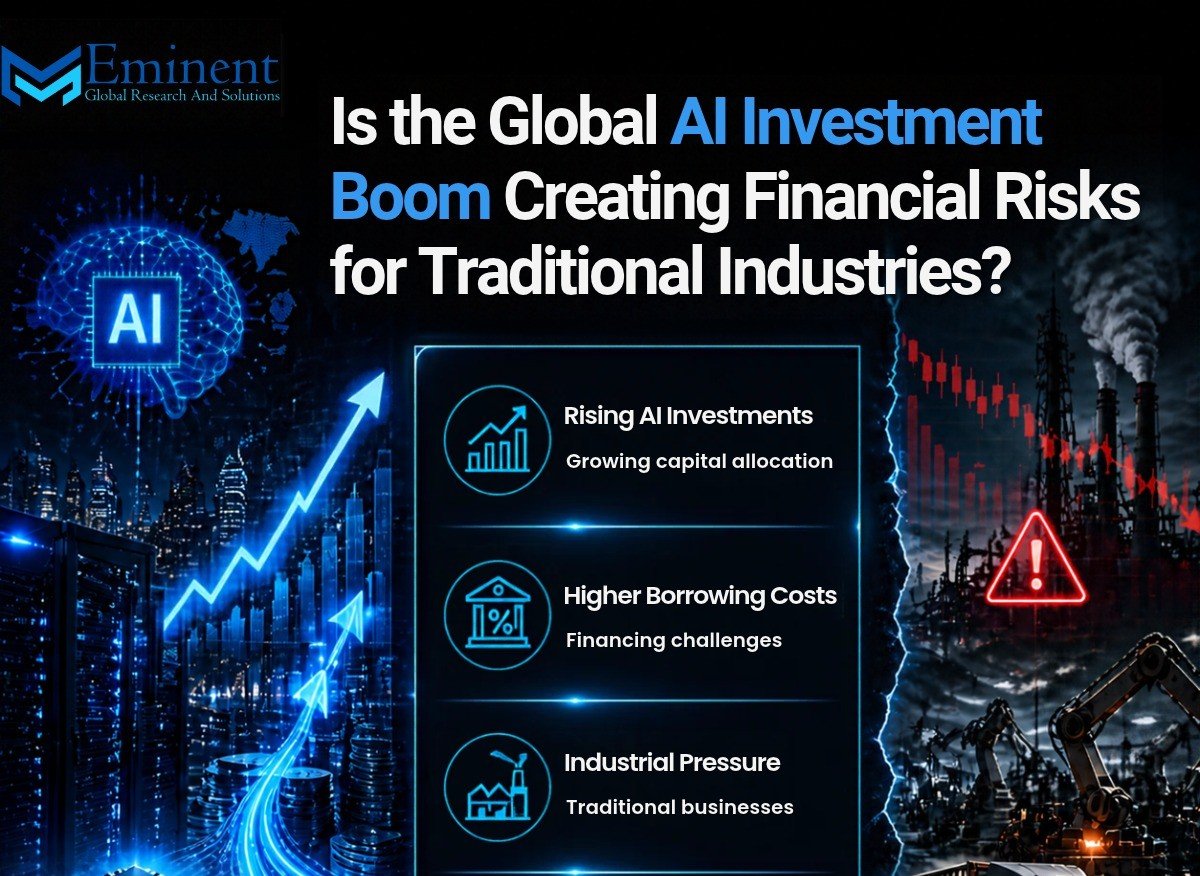
Is the Global AI Investment Boom Creating Financial Risks for Traditional Industries?
Industry: Artificial Intelligence | Manufacturing & Industrial | Banking & Finance | Global Economy
Artificial intelligence is attracting enormous investment from companies, governments and financial institutions around the world. From advanced semiconductor facilities and data centres to AI-powered software and automation, businesses are spending heavily to secure their position in the next generation of technology.
However, an important question is beginning to emerge: could the rapid flow of money into artificial intelligence create financial challenges for industries that are not directly involved in the AI boom?
Recent warnings from financial regulators and central banks suggest that the issue deserves closer attention. As investors increasingly focus on AI companies and infrastructure, traditional sectors such as manufacturing, construction, transportation and energy may face greater competition for investment and more expensive financing.
The challenge is not that AI investment is necessarily harmful. Rather, the speed and concentration of investment could create economic imbalances if other industries struggle to access the capital they need.
Why Is So Much Investment Flowing into Artificial Intelligence?
AI has moved beyond being an experimental technology. It is now influencing business operations, product development, customer services, industrial automation and financial decision-making.
Major technology companies are investing heavily in:
- Data centres and cloud infrastructure.
- Advanced semiconductor chips and memory technologies.
- AI model development and computing systems.
- High-performance networking and storage equipment.
- AI-powered automation and enterprise software.
The growing demand for computing capacity has encouraged companies to expand their infrastructure at an unprecedented pace.
However, these projects require substantial capital. Companies are increasingly using corporate bonds, private credit, bank loans and other financing arrangements to support their expansion.
According to the Reserve Bank of Australia’s October 2026 Financial Stability Review, debt is becoming an increasingly important source of funding for AI-related infrastructure. This raises questions about how financial markets might respond if expected returns do not materialise.
Could AI Investment Put Pressure on Traditional Industries?
One of the biggest concerns is the possibility of capital being concentrated in a relatively small group of technology companies and AI-related projects.
On 3 November 2026, China’s financial regulator warned that excessive concentration of global investment in AI could create a crowding-out effect for traditional industries.
The concern is that when significant amounts of capital move towards technology companies, businesses in other sectors may face higher borrowing costs and increased financial pressure.
Consider a manufacturing company planning to modernise its production facilities. It may need financing to purchase machinery, expand its factory or introduce energy-efficient technologies. If borrowing becomes more expensive, the company could delay these investments.
Similar challenges may affect construction companies, logistics providers, industrial equipment manufacturers and other businesses that depend on external financing.
Over time, this could create an uneven investment environment in which technology-focused businesses receive greater attention while essential industries struggle to fund their development.
Which Industries Could Face the Greatest Pressure?
The impact will not be the same across every sector. Some industries may benefit directly from AI expansion, while others could face greater financing and operational challenges.
1. Manufacturing and Industrial Production
Manufacturing companies require continuous investment in machinery, production facilities, workforce development and technology upgrades.
Higher financing costs could make it difficult for smaller manufacturers to modernise their operations. Companies may postpone factory expansion or delay the adoption of advanced equipment.
At the same time, manufacturers supplying semiconductor equipment, cooling systems, robotics and electrical components may benefit from AI infrastructure demand.
2. Energy and Utilities
AI data centres require substantial electricity and supporting infrastructure.
As data centre construction increases, demand for power generation, electricity distribution, cooling and grid connections is also growing.
Energy companies may find new investment opportunities, but they could also face pressure to expand capacity quickly. Financing these projects requires long-term planning and significant capital.
3. Construction and Real Estate
Data centres are creating new opportunities for construction companies, engineering firms and infrastructure developers.
However, projects that depend heavily on debt financing may become vulnerable if interest rates rise or expected demand for computing capacity falls.
Developers with weak financial positions or concentrated customer bases could face particular challenges.
4. Transportation and Logistics
Transportation companies depend on investment in vehicles, warehouses, fuel management, logistics networks and digital infrastructure.
If financing becomes more expensive, smaller logistics operators may find it harder to expand their fleets or upgrade facilities.
This could affect the wider movement of goods and industrial supply chains.
5. Small and Medium-Sized Enterprises
Smaller businesses may be among the most vulnerable because they often have fewer financing options than large corporations.
They may struggle to compete for investment, manage higher interest expenses or adopt new technologies without additional funding.
This could widen the gap between large companies with strong financial resources and smaller businesses operating with limited capital.
What Happens If AI Investment Does Not Deliver Expected Returns?
Another important concern is whether the financial returns from AI infrastructure will justify the scale of investment.
Building data centres, developing advanced chips and maintaining computing infrastructure requires substantial spending. Investors are making these commitments based on expectations of continued growth in AI adoption and business demand.
But technology markets can change quickly.
If companies adopt AI more slowly than expected, or if the revenue generated by AI products does not match investment forecasts, some infrastructure projects could struggle to generate sufficient returns.
This could create problems for businesses that borrowed heavily to finance expansion.
The IMF’s October 2026 assessment of global financial stability highlighted risks associated with an AI-related market correction, growing leverage and complex financing relationships across the technology sector.
A slowdown would not necessarily lead to a financial crisis. However, it could affect investor confidence, company valuations, lending conditions and investment decisions across connected industries.
Is the Financial System Becoming Too Dependent on AI Investment?
The growing relationship between technology companies, banks, investors and infrastructure developers is another issue worth monitoring.
AI investment is no longer limited to technology companies using their own funds. It increasingly involves financial institutions, private credit providers, bond markets, energy companies and infrastructure developers.
These connections can support innovation and economic growth. However, they can also create risks when several businesses depend on the same investment cycle.
For example, a data centre developer may depend on external financing, an energy provider may invest in new power infrastructure to support that facility, and an equipment manufacturer may expand production based on expected future orders.
If demand weakens or a major project is delayed, the impact may extend beyond the original developer.
This makes financial risk assessment and investment monitoring increasingly important across the wider industrial ecosystem.
How Can Traditional Industries Respond?
The AI investment boom also presents opportunities. Traditional businesses do not need to compete directly with technology giants to benefit from artificial intelligence.
Instead, they can focus on improving productivity, managing investment risks and identifying practical applications of AI.
Some important strategies include:
1. Diversifying financing sources
Businesses should avoid depending entirely on one lender or financing arrangement. Exploring different funding options can improve financial flexibility.
2. Investing in practical AI applications
Manufacturers and industrial businesses can adopt AI for predictive maintenance, quality inspection, inventory management and production planning.
3. Strengthening financial risk management
Companies should regularly assess borrowing costs, cash flow requirements, debt exposure and the financial stability of their suppliers.
4. Improving operational efficiency
Energy management, automation and better resource utilisation can help businesses control operating expenses and remain competitive.
5. Monitoring market and investment trends
Companies should understand where capital is moving, which industries are attracting investment and how changing financial conditions may affect their markets.
What Does This Mean for Global Businesses?
The rapid growth of artificial intelligence is creating a new investment environment. While technology companies are receiving substantial attention, the broader economy still depends on manufacturing, energy, transportation, construction and other traditional industries.
If investment becomes too concentrated, businesses outside the AI sector could face higher financing costs and reduced opportunities for expansion.
However, a balanced approach could allow AI to strengthen rather than weaken traditional industries.
The long-term opportunity lies in combining technological innovation with sustainable industrial development. Companies that understand both the opportunities and financial risks will be better positioned to make informed investment decisions.
Eminent’s Perspective
At Eminent Global Research Solutions, we believe that understanding technological growth requires looking beyond the technology sector itself.
The expansion of artificial intelligence is influencing investment patterns, industrial competition, supply chains and financial markets. Businesses must therefore evaluate not only the opportunities created by AI but also the potential risks affecting their existing operations.
Through market research, competitive intelligence, industry analysis and strategic consulting, businesses can identify emerging investment trends, assess competitive pressures and understand changes in their operating environment.
As AI continues to reshape the global economy, informed decision-making will become increasingly important for both technology-driven businesses and traditional industries.
Conclusion
The global AI investment boom has the potential to transform industries and create new economic opportunities. However, its rapid expansion also raises important questions about capital allocation, borrowing costs and financial stability.
Traditional industries should not be left behind in this transformation. Manufacturing, energy, transportation and other essential sectors will continue to play a critical role in supporting global economic growth.
The real challenge is finding the right balance between investing in the future of AI and maintaining the financial strength of the industries that support the global economy.
Post a Comment